Why Your Restaurant Marketing Is Not Working (And What Actually Does in 2025)
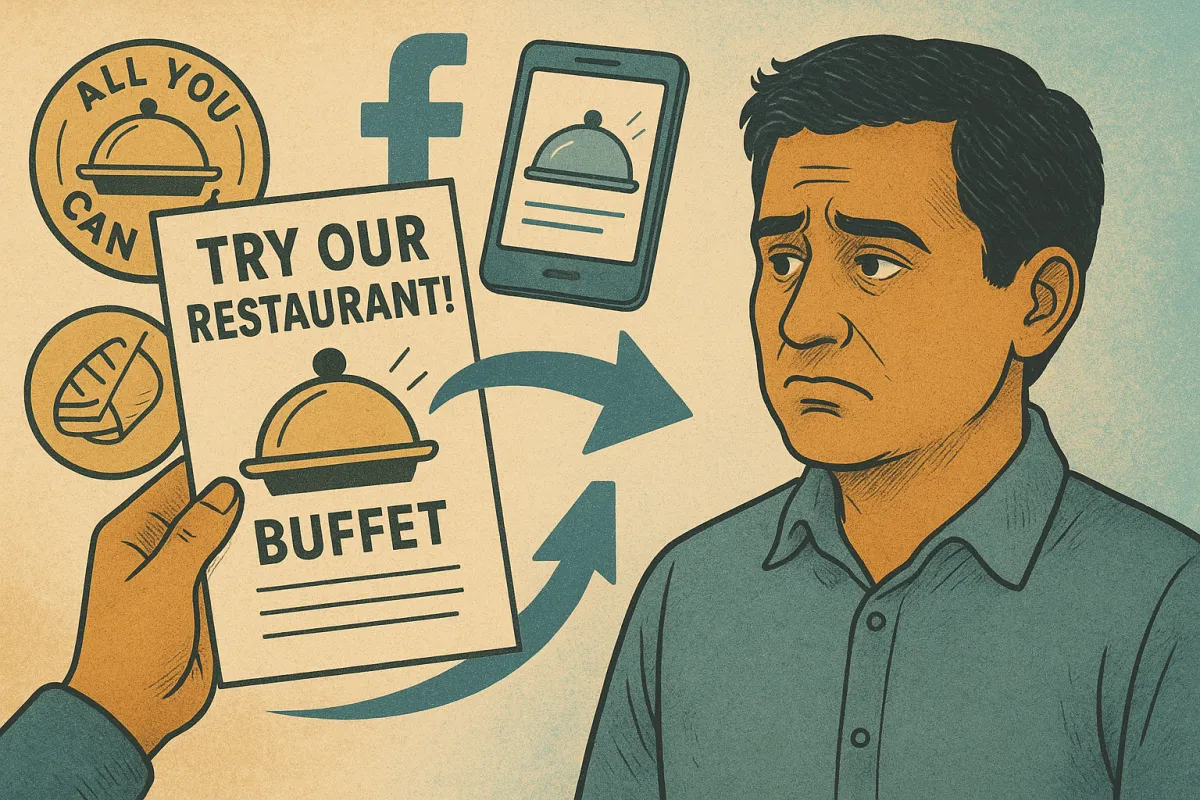
You spent two thousand dollars printing fliers last month. You hired someone to put them in mailboxes all over your neighborhood.
How many new customers did you get? Maybe ten. Maybe five. Maybe none.
You run a lunch buffet every day. All you can eat for twelve dollars. You thought it would bring crowds. Instead, you get people who eat a lot and never come back. You lose money on every person who walks through the door.
You boost posts on Facebook. You run Instagram ads. You pay for Google listings. You are on every delivery app. You spend money everywhere.
But nothing changes. Your restaurant stays the same. Some days are busy. Some days are slow. But you are not growing. You are just surviving.
You look at your competitor down the street. They do not seem to advertise much. But their dining room is always full. They have lines on weekends. They charge higher prices. And people pay happily.
What are they doing that you are not?
This is the question that keeps restaurant owners up at night. And the answer is simple but hard to accept.
You are playing the old game. They are playing the new game. And the old game does not work anymore.
The Phone Call That Changed Everything
Last month, I got on a call with a restaurant owner named Vikram. He owns an Indian restaurant in New Jersey. He has been open for six years.
He was frustrated. Really frustrated.
"I do everything right," he said. "I advertise. I offer discounts. I have a lunch buffet. I print fliers. I am on all the apps. But I am barely breaking even. What am I doing wrong?"
I asked him one question: "When was the last time someone told their friend they had an amazing experience at your restaurant?"
Long silence.
He said: "People tell me the food is good."
I said: "Good is not enough anymore. Good is expected. Good is the minimum. What makes people remember you? What makes them talk about you? What makes them choose you over ten other Indian restaurants?"
Another long silence.
Then he said something honest: "I don't know. I guess nothing."
That is when I knew exactly what his problem was. And it is the same problem most Indian restaurant owners have.
They are focused on transactions. Not experiences. They are focused on getting people in the door. Not making people remember. They are focused on competing on price. Not creating value.
This is the old way. And the old way is dying.
The Old Way: Why Everything You Learned Is Wrong
Let me tell you about the old way of running a restaurant. This is what worked twenty years ago. This is what your parents might have done. This is what most Indian restaurants still do today.
The old way says: Print fliers and put them everywhere.
Twenty years ago, this worked. People got a flier. They did not have smartphones. They did not have Google. So they kept the flier. When they wanted Indian food, they looked at the flier. They called you.
Today? People throw fliers away without reading them. Or they take a picture with their phone and forget about it. Fliers go straight to the trash. You waste money printing them. You waste money distributing them. And you get almost nothing back.
I have seen restaurant owners spend five thousand dollars on fliers in one year. They might get fifty customers from those fliers. That is one hundred dollars per customer. And most of those customers never come back.
This is insane. But restaurant owners keep doing it because "that's how we always did it."
The old way says: Run a cheap buffet to bring people in.
The lunch buffet. Every Indian restaurant has one. All you can eat for ten or twelve or fifteen dollars.
Restaurant owners think: "If I give people a great deal, they will come. Then they will love my food. Then they will come back and order from the menu."
But that is not what happens. Here is what actually happens.
People who come for buffets are looking for the cheapest meal. They are not looking for an experience. They are not looking for quality. They are looking for quantity.
They load their plates. They eat a lot. They never order drinks because drinks cost extra. They do not tip well because "I already paid for the buffet." And they never come back for dinner because dinner costs more.
You lose money on the food. You lose money on the labor. You train your customers to expect cheap prices. And you attract the wrong customers.
I know restaurant owners running lunch buffets who would make more money if they closed for lunch completely. But they are afraid to stop because "what if we lose customers?"
You are not losing customers. You are losing money.
The old way says: Offer discounts to compete.
Twenty percent off. Buy one get one free. Free delivery on first order. Discount for pickup. Special prices on certain days.
Discounts everywhere. Because you think: "If my price is lower, people will choose me."
But what actually happens? You train customers to wait for discounts. They never pay full price. You make less money on every order. And you still do not build loyalty because discount customers are not loyal customers.
They go wherever the discount is. Today it is you. Tomorrow it is your competitor. They do not care about your restaurant. They care about the deal.
The old way says: Be on every delivery app.
DoorDash. Uber Eats. Grubhub. Postmates. Every app. Because "that's where the customers are."
So you pay thirty percent commission on every order. Thirty percent! That is your entire profit margin. Sometimes more than your profit margin.
You think: "At least I am getting orders."
But you are not building a business. You are building dependency. The apps own your customers. The apps control your prices. The apps decide how you appear in search results. You are not growing. You are just working for the apps.
The old way says: More items on the menu means more customers.
Your menu has sixty items. Appetizers. Breads. Rice dishes. Curries. Biryanis. Indo-Chinese. Tandoor items. Desserts. Everything.
You think: "If I have everything, nobody will go somewhere else."
But what actually happens? Your kitchen is complicated. Your food costs are high. Your cooks need to know how to make sixty different dishes. Quality suffers. Nothing is special because everything is just okay.
Customers look at your menu and feel overwhelmed. They do not know what to order. Nothing stands out. They order the same safe dishes they always order.
This is the old way. And if you are doing any of these things, you are playing the old game. And the old game does not work anymore.
Why The Old Way Stopped Working
Something changed in the last ten years. Something fundamental.
Information became unlimited. Before smartphones, people had limited information. They did not know what restaurants existed. They did not know what other people thought about restaurants. They relied on fliers and Yellow Pages and driving around.
Now? Everyone has Google in their pocket. Everyone can see reviews. Everyone can see photos of your food. Everyone can compare prices. Everyone can see what other people say about you.
You cannot trick people anymore. You cannot convince them with a flier that your restaurant is good if your Google reviews say otherwise. You cannot discount your way to success if customers can see you discount all the time.
Customer expectations changed. Twenty years ago, people just wanted good Indian food at a fair price. That was enough.
Now? People have been to amazing restaurants. They have seen beautiful presentations on Instagram. They have experienced incredible service. They know what is possible.
Good food is not special anymore. Good food is the minimum. If your food is not good, you do not even get a chance. But if your food is just good, you still do not stand out.
Competition exploded. When your parents opened an Indian restaurant, maybe there were three others in your city. Now there are thirty. Or fifty. Or more.
You cannot compete by being slightly better anymore. You cannot compete by being slightly cheaper. You must be completely different. You must give people a reason to choose you that has nothing to do with price or convenience.
Technology changed everything. People order online. They read reviews. They follow restaurants on social media. They share experiences. They have loyalty apps. They expect modern systems.
If your restaurant feels old-fashioned, if your website is bad, if you do not have good photos, if you are hard to find online, you lose. Even if your food is great.
The old way assumed customers would come to you. The new way requires you to earn every single customer. Every single time.
The New Way: What Actually Works Now
Let me tell you a story about a man named Danny Meyer. He is one of the most successful restaurant owners in America. He owns Union Square Hospitality Group. He created Shake Shack.
But Danny Meyer did not start with money or fancy restaurants. He started with one small restaurant called Union Square Cafe in New York in 1985.
His restaurant was not in the best location. It was not the cheapest. It did not have the fanciest food. But it became one of the most successful restaurants in New York.
Why?
Because Danny Meyer understood something that most restaurant owners do not understand. He understood that restaurants are not about food. They are about how you make people feel.
He wrote a book called "Setting the Table." In this book, he talks about something he calls "enlightened hospitality."
This is not normal hospitality. Normal hospitality is being polite. Smiling. Bringing food quickly. That is expected. That is the minimum.
Enlightened hospitality is different. It is about making people feel seen. Making them feel special. Making them feel like they matter.
Danny Meyer tells a story in his book. One time, a customer came into his restaurant upset. She had lost her coat at another restaurant earlier that day. It was a special coat. She was really upset.
The staff at Union Square Cafe listened to her story. They felt bad for her. After she left, they called the other restaurant. The coat was there. They sent someone to pick up the coat. They delivered it to her home.
She did not ask them to do this. They just did it. Because they cared.
That woman became a customer for life. She told everyone about Union Square Cafe. Not because of the food. Because of how they made her feel.
This is enlightened hospitality. This is going beyond what is expected. This is creating an experience that people never forget.
Danny Meyer calls this "unreasonable hospitality." It is unreasonable because most restaurants would never do it. It costs time. It costs effort. It does not directly make money.
But it creates something more valuable than money. It creates loyalty. It creates stories. It creates people who tell their friends: "You have to go to this restaurant."
What Will Guidera Taught Me About Building Brands
Another person who changed how I think about restaurants is Will Guidera. Will is a brand strategist who has helped build some of the biggest brands in the world.
Will talks about something important. He says: "People do not buy products. They buy better versions of themselves."
Think about that for a second. When someone chooses your restaurant, they are not just buying food. They are buying an identity. They are buying a feeling. They are buying a story they can tell.
When someone goes to a fancy restaurant, they are not just buying expensive food. They are buying the feeling of being sophisticated. Of treating themselves. Of having good taste.
When someone goes to a fast-casual restaurant, they are not just buying quick food. They are buying convenience. Health. Modernity. The feeling of making a smart choice.
What are people buying when they come to your restaurant? Are they buying cheap food? If that is all you offer, you will always compete on price. And you will always struggle.
Or are they buying something else? Are they buying authentic regional food they cannot get anywhere else? Are they buying a modern Indian experience? Are they buying a place where they feel at home?
Will Guidera says the brands that win are the ones that understand what people are really buying. Then they deliver that consistently everywhere.
Your menu delivers it. Your space delivers it. Your service delivers it. Your social media delivers it. Your website delivers it. Everything points to the same story.
Most Indian restaurants do not have a clear story. They try to be everything to everyone. Family-friendly but also fine dining. Traditional but also modern. Cheap but also quality.
This confusion kills brands. Customers do not know what you stand for. So they choose based on price or convenience. And you lose.
The New Way: Create An Experience, Not Just A Meal
Here is what the new way looks like. This is what actually works now.
The new way focuses on experience.
People will forget what they ate. But they will remember how you made them feel.
Your job is not to serve food. Your job is to create an experience people want to have again and again.
What does this mean practically?
It means training your staff to care about people. Not just take orders. Not just bring food. But notice people. Remember regulars. Make guests feel welcome.
It means creating an atmosphere. Music that fits your concept. Lighting that creates a mood. Décor that tells your story. Everything intentional.
It means small touches. A handwritten thank you note with the check. A complimentary dessert for someone celebrating. Remembering someone's favorite dish.
These things cost almost nothing. But they create memories. And memories create loyalty.
The new way focuses on being remarkable.
Remarkable means worth making a remark about. Worth telling someone else.
If your restaurant is just good, nobody talks about it. Good is expected. Good is boring.
You need something remarkable. Something people want to tell their friends about.
Maybe it is one signature dish that is absolutely incredible. Not ten good dishes. One amazing dish that becomes famous.
Maybe it is your naan. The best naan in the city. People come just for your naan. They tell everyone: "You have to try the naan at this place."
Maybe it is your grandmother's recipe that nobody else has. Regional food from a specific area of India that no other restaurant serves.
Maybe it is how you welcome people. Maybe you bring a complimentary appetizer to every table. Maybe you remember every regular customer's name.
Find your remarkable thing. Then make it famous.
The new way focuses on building community.
The restaurants that win today are not just restaurants. They are community centers. They are places where people belong.
Look at what Danny Meyer did with Shake Shack. Yes, the burgers are good. But what made Shake Shack special was the feeling. The lines became part of the experience. The outdoor seating became gathering spaces. The brand became part of people's identity.
Your restaurant can be the same. You can be the place where local families come every Sunday. You can be the place where the Indian community gathers. You can be the place where young professionals meet after work.
Build community by hosting events. Maybe a monthly dinner highlighting a specific region of India. Maybe cooking classes. Maybe cultural celebrations.
Build community by being present on social media. Not just posting food pictures. But engaging with your customers. Responding to comments. Sharing their photos. Making them feel like they are part of your family.
Build community by creating a loyalty program that actually rewards loyalty. Not just discounts. But exclusive experiences. Early access to new dishes. Special seating. Recognition.
The new way focuses on quality over quantity.
Old way: Sixty items on the menu. Mediocre execution. Compete on having everything.
New way: Twenty items on the menu. Perfect execution. Compete on being excellent.
I know Indian restaurants that cut their menus in half and saw revenue go up. Why? Because they could focus on making fewer things perfectly. Their food got better. Their kitchen got faster. Their food costs went down.
Customers do not want sixty choices. They want help choosing. They want you to guide them. They want to trust that everything on your menu is excellent.
The new way focuses on modern systems.
Your website must work perfectly on phones. Most people will visit your website on their phone. If it is slow or broken or hard to use, they leave. They order from someone else.
You must have online ordering. On your own website. Not just on delivery apps. You need to own the relationship with your customers.
You must collect customer information. Emails. Phone numbers. Then you must use that information. Send them updates. Send them offers. Remind them you exist.
You must have good photos. Professional photos. Food photography matters. People eat with their eyes first. Bad photos kill sales even if your food is amazing.
You must respond to reviews. Every single review. Good ones and bad ones. Thank people for good reviews. Fix problems from bad reviews. Show everyone that you care.
These are not nice-to-haves anymore. These are requirements. If you do not have these systems, you are behind.
What To Stop Doing Right Now
If you are doing any of these things, stop. Today. Right now.
Stop printing fliers. Nobody reads them. You are wasting money. Take that money and invest it in better food photography or staff training instead.
Stop running a lunch buffet. Unless your buffet is making real profit (not just covering costs, actual profit), kill it. You will be shocked how much money you save. And how much less stressed your kitchen becomes.
Stop discounting constantly. Pick your prices based on your value. Stick to them. If you must run promotions, run them rarely. Make them special. Not expected.
Stop trying to be everything to everyone. Pick who you serve. Pick what you are known for. Say no to everything else.
Stop relying on third-party delivery apps for all your orders. Yes, be on the apps. But work hard to get people to order directly from you. Give them reasons. Better prices. Loyalty points. Exclusive items. Anything. Just get them off the apps.
Stop ignoring your existing customers while chasing new ones. It is ten times cheaper to keep an existing customer than get a new one. Focus on making your regulars love you. They will bring new customers through word of mouth.
What To Start Doing Tomorrow
Here is what actually works. This is what you should focus on.
Start training your staff on hospitality. Not just how to take orders. But how to make people feel welcome. How to notice when someone needs something. How to create moments people remember.
Read Danny Meyer's book "Setting the Table" with your team. Discuss it. Practice unreasonable hospitality. Make it part of your culture.
Start creating remarkable experiences. Pick one thing you will be famous for. Your naan. Your butter chicken. Your regional specialties. Your service. Your atmosphere. Pick one thing and make it absolutely incredible.
Then talk about it. Post about it. Make it central to your brand. Make it the reason people come.
Start building a real community. Not just customers. A community of people who feel connected to your restaurant.
Host events. Create experiences. Engage on social media. Build a loyalty program. Make people feel like they belong.
Start collecting and using customer data. When someone orders, get their email. When someone dines in, offer them a loyalty program. Build your list.
Then use it. Send monthly emails. Share new dishes. Share behind-the-scenes. Share your story. Stay in their minds.
Start telling your story everywhere. Why did you open this restaurant? What makes your food special? Where are you from? What traditions are you honoring?
People connect with stories. Not menus. Not prices. Stories. Tell yours. Tell it on social media. Tell it on your website. Tell it when customers ask.
Start measuring what matters. Not just total sales. Measure repeat customer rate. Measure average order value. Measure profit per customer. Measure direct orders versus app orders.
These numbers tell you if you are building something real. Or just spinning your wheels.
The Restaurant That Changed Everything
Let me tell you about a restaurant owner I worked with. Her name is Priya. She owns a small Indian restaurant in California.
When I met her, she was doing everything the old way. Lunch buffet. Fliers. Constant discounts. Sixty-item menu. Struggling to break even.
I told her everything I am telling you. Stop the buffet. Cut the menu. Stop discounting. Focus on experience.
She was scared. She thought she would lose customers. She thought she would make less money.
But she trusted me. She made the changes.
First, she killed the lunch buffet. She lost some customers. But she saved thousands of dollars in food costs every month. Her kitchen became less stressed. Her food quality went up.
Second, she cut her menu from sixty items to twenty-five. She focused on regional specialties from Gujarat where she is from. Dishes that no other restaurant in her area served.
Customers loved it. They did not miss the other items. They loved having something unique. Something they could not get anywhere else.
Third, she stopped discounting. She raised her prices slightly. She was terrified. But customers kept coming. Because she was not competing on price anymore. She was competing on unique experience.
Fourth, she trained her staff on hospitality. She read them stories from Danny Meyer's book. She taught them to notice people. To remember regulars. To create moments.
Her staff started doing little things. Bringing complimentary chai to tables. Remembering birthdays. Writing thank-you notes. Small things. But meaningful things.
Fifth, she fixed her online presence. She hired a photographer to take beautiful pictures. She rebuilt her website. She started collecting emails. She started posting on social media every day.
What happened?
In six months, her revenue went up thirty-five percent. Her profit went up even more because her costs went down. Her customer reviews went from 3.8 stars to 4.6 stars. Her repeat customer rate doubled.
She stopped competing on price. She started competing on experience. And everything changed.
Now she is planning to open a second location. Not because she needs to. But because she built something worth scaling.
This is the new way. This is what works.
Your Choice: Old Way Or New Way
You have a choice to make right now.
You can keep doing what you are doing. Keep printing fliers nobody reads. Keep running buffets that lose money. Keep discounting your way to poverty. Keep competing with everyone else.
Or you can make a different choice.
You can focus on creating experiences people remember. You can build unreasonable hospitality into your culture. You can be remarkable instead of average. You can build a community instead of just serving customers.
The old way is comfortable. It is what everyone does. It is safe. But it does not work anymore.
The new way is scary. It requires change. It requires you to be different. But it actually works.
Most restaurant owners choose the old way. Because change is hard. Because they are busy. Because they are scared.
But the restaurant owners who choose the new way? They are the ones who grow. They are the ones who thrive. They are the ones who build something that lasts.
Which one will you be?
We Can Help You Make The Change
I know this is overwhelming. I know you are busy running your restaurant. I know change feels impossible when you are in the middle of everything.
That is why we created the Three-Step Indian Restaurant Growth System.
This system shows you exactly how to move from the old way to the new way. Step by step. Nothing complicated. Just practical strategies that work.
We show you how to create an experience people remember. We show you how to build unreasonable hospitality into your culture. We show you how to be remarkable. We show you how to use modern systems that actually work.
This is not theory. This is what is working right now for Indian restaurants across America.
You can watch this training for free. It takes about thirty minutes. By the end, you will understand exactly what you need to do.
Some restaurant owners watch this and implement it themselves. They see results in weeks.
Other restaurant owners watch this and realize they need help. They do not have time to do it alone. They want someone to help them implement everything.
If that is you, you can schedule a call through the Restaurant Growth Challenge. On this call, we will look at your specific restaurant. Your specific situation. And we will create a custom plan for you.
No pressure. No hard sell. Just honest advice from people who understand Indian restaurants.
Click here to watch the Three-Step Indian Restaurant Growth System →
Or click here to schedule a call and let's build your new way together →
The old way is dying. The new way is here. The only question is: will you adapt?
Frequently Asked Questions
If I stop my lunch buffet, won't I lose a lot of customers?
Yes, you will lose some customers. But here is the truth: those customers are costing you money. Buffet customers come for the cheapest meal possible. They load their plates. They do not order drinks. They do not tip well. And they never come back for dinner. When you add up the food cost, the labor cost, and the opportunity cost of filling your restaurant with low-value customers, you are losing money. When restaurant owners kill their buffets, they usually lose about thirty percent of their lunch customers but make more money because they can focus on higher-quality lunch service with better margins. The customers who stay are better customers. And you have space to attract new customers who actually value what you offer.
Why don't fliers work anymore when they used to work for everyone?
Fliers worked twenty years ago because people had limited information. If someone got a flier about an Indian restaurant, they might keep it because they did not know what Indian restaurants existed in their area. Today, everyone has Google in their pocket. When someone wants Indian food, they search on their phone. They see reviews. They see photos. They compare options. They make a decision in seconds. A flier cannot compete with that. Plus, most people throw fliers away immediately without reading them. You are spending hundreds or thousands of dollars to have your message thrown in the trash. Take that same money and invest it in Google reviews, professional food photography, or social media. Those things actually work.
We've been discounting for years. If we stop, won't people go to our competitors?
Some will. But those are not your customers. Those are discount shoppers. They go wherever the deal is. Today it is you. Tomorrow it is someone else. They have no loyalty. You want customers who choose you because they love your food, your service, your experience. Not because you are cheapest. When you stop discounting, you will lose discount shoppers. Good. They were not profitable anyway. But you will keep the customers who actually value what you do. And you can attract new customers who are willing to pay full price for quality. Your revenue might drop slightly at first. But your profit will go up because you are no longer giving away margins. And over time, your revenue will grow too because you are attracting better customers.
What is unreasonable hospitality and how can a small restaurant do it?
Unreasonable hospitality is going beyond what is expected to make customers feel special. It is called unreasonable because most businesses would never do it. But it creates loyalty that lasts forever. Danny Meyer tells the story of a customer who lost her coat at another restaurant. His staff called the restaurant, picked up the coat, and delivered it to her home. She did not ask them to do this. They just did it. This seems expensive and time-consuming. But that woman became a customer for life and told everyone about the restaurant. Small restaurants can do this too. When someone mentions it is their birthday, bring them a free dessert with a candle. When a regular customer comes in, remember their name and their usual order. When someone has a problem, fix it immediately and add something extra. These things cost almost nothing. But they create stories. And stories create growth.
How do I know what my "remarkable thing" should be?
Ask your best customers what they love most about your restaurant. What do they tell their friends? What do they order every time? What makes them come back? Listen to what they say. That is probably your remarkable thing. Or look at what you do differently than other restaurants. Maybe you have family recipes from a specific region of India. Maybe your chef makes the best naan anyone has ever tasted. Maybe your service is unusually warm and personal. Maybe your space has a unique vibe. Find the thing that is already special and make it more special. Make it famous. Talk about it everywhere. Build your brand around it. You do not need to invent something new. You just need to recognize what is already working and amplify it.
We're on DoorDash and Uber Eats. Should we get off those platforms completely?
No, stay on them. But work hard to convert those customers to direct customers. The apps bring you customers you might not get otherwise. Use them. But give people strong reasons to order directly next time. Put inserts in every delivery bag offering a discount for ordering direct next time. Build a loyalty program that only works for direct orders. Collect emails and phone numbers so you can market directly. Make your direct ordering website better than the apps. Over time, you want fifty to seventy percent of your orders coming directly to you, not through apps. The apps take thirty percent commission. That is your entire profit margin. Every customer you move from the apps to direct ordering is pure profit. But you have to give them a reason to switch. Better prices, loyalty rewards, exclusive menu items, faster service. Make direct ordering the obviously better choice.
My restaurant has been open for ten years. Is it too late to change to the new way?
No, it is not too late. In fact, you have an advantage over new restaurants because you already have customers and reputation. Many successful restaurants completely reinvent themselves after years of doing things the old way. The key is to make changes gradually and communicate them to your customers. Tell them why you are changing. Tell them you want to give them a better experience. Most customers will support you. Some might complain. Let them go. They were not your ideal customers anyway. Focus on your best customers and give them an even better experience. The restaurant owner I told you about, Priya, had been open for eight years before she made these changes. Within six months, everything transformed. It is never too late to build something better.
How long does it take to see results from focusing on experience instead of price?
This depends on where you are starting. If you already have decent customer traffic and good food but just need better positioning and experience, you might see results in four to eight weeks. If you need to completely rebuild your concept and retrain your staff, it might take three to six months. But here is what matters: you are building something that lasts. Discounts give you short-term spikes that disappear. Experience creates long-term loyalty that compounds. Every customer you create an amazing experience for tells other people. Those people come and have amazing experiences. They tell more people. This grows exponentially over time. In year one, you might see thirty percent growth. In year two, you might see another fifty percent. In year three, you are opening a second location. This is not a quick fix. It is a foundation for lasting success.
Stop Playing The Old Game. Start Building Something New.
Danny Meyer did not build Union Square Hospitality Group by being cheaper than everyone else. He built it by making people feel something they could not feel anywhere else.
Will Guidera's most successful brands did not win by having more features. They won by understanding what people actually want to buy and delivering it consistently.
Your restaurant can do the same. But you have to stop playing the old game. Stop the buffets. Stop the fliers. Stop the constant discounting. Stop trying to be everything to everyone.
Start creating experiences. Start building unreasonable hospitality. Start being remarkable. Start using modern systems. Start building community.
The new way is not easier. But it actually works.
Watch the free Three-Step Indian Restaurant Growth System now →
Or schedule your call to get personal help →
Your restaurant deserves to thrive. Not just survive. Let us show you how.
The old way is over. The new way is waiting. What will you choose?
Retry
