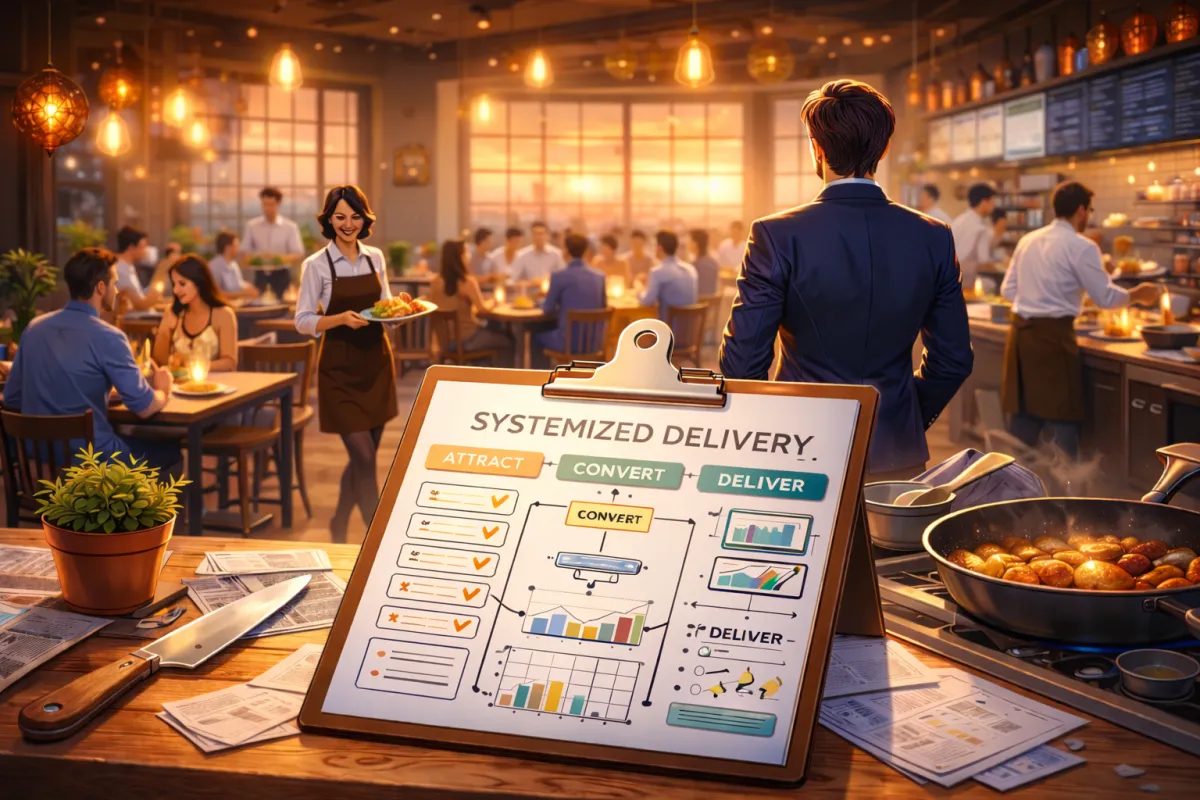
Systemize. This Is How Million-Dollar Restaurant Are Built.
Systemize delivery.
That is the secret. That is how billion-dollar empires are built.
It is not complicated. It is not mysterious. It is not reserved for people with special advantages or lucky breaks.
It is simple. And it is available to every restaurant owner who is willing to do the work.
The Pattern That Creates Empires
Here is the pattern.
Know who you are serving. Serve everybody until you really have the capability to serve a specific avatar long-term. Master that avatar completely. Then go broad again.
This cycle repeats. Over and over.
Start wide. Get narrow. Go deep. Then expand again.
Every major brand follows this pattern. Every empire was built this way. You start by serving anyone who will pay you. You learn what works. You identify who you serve best. You focus relentlessly on that group. You become the obvious choice for them. Then—and only then—you expand outward again.
Most restaurant owners never complete this cycle even once.
They stay stuck in the first phase forever. Serving everyone. Mastering no one. Being the mediocre choice for everybody instead of the obvious choice for somebody.
Systemize your delivery. Know your customer. Go deep before you go wide.
That is how empires are built.
The Truth About Talent
Let me tell you something about people.
The importance of choosing the right person cannot be overstated.
Being clear about who you want to recruit, hire, onboard, and train is everything. This clarity determines your success more than almost any other factor.
Talent is crucial. Finding it is hard. Keeping it is harder.
Payments increase. Supply and demand shift. Competition for great people intensifies constantly.
There is stress involved. That is part of the game.
But here is what most restaurant owners do not understand.
Ten talented people—really skillful people—can do the work of one thousand average employees.
Read that again.
Ten exceptional people outperform one thousand mediocre ones.
This math changes everything. Especially at the rate AI is growing.
AI multiplies the output of skilled people exponentially. A talented person with AI tools can produce what used to require entire teams. An average person with AI tools produces average output faster—still average.
The gap between exceptional and mediocre is widening. Every day. Every month. Every year.
Stop trying to fill positions with bodies. Start looking for exceptional people who can leverage technology to produce extraordinary results.
Your Restaurant Is a Value in the Economy
I need you to understand something about your restaurant.
It is not just a business. It is not just a place that serves food.
Your restaurant is a value in the economy.
It is a place for people to enjoy. To experience. To feel satisfied with good food and atmosphere.
It is really a dining club.
You give people a place to be. A destination. A reason to leave their homes and gather together.
You provide people jobs. Jobs circulate money in the world. Your employees spend their wages at other businesses. Those businesses pay their employees. The cycle continues.
You are a value in the economy. You matter. What you do matters.
But know this—the service industry is a people industry.
Your product is food. Your business is people.
The people you hire. The people you serve. The relationships between them.
Everything flows from this understanding.
The Three Things Every Restaurant Needs
The service industry is a people industry. And there are three things every restaurant must have.
One: Traction.
You need some sort of brand. Recognition. Awareness.
People need to know you exist before they can choose you. They need to think of you before they can visit you.
Traction means you have momentum. Attention. A presence in the minds of potential customers.
Without traction, you are invisible. And invisible restaurants fail.
Two: Conversion.
You must know how to convert people. How to make them become your customers. How to keep them coming back.
Attention without conversion is worthless. People knowing about you means nothing if they never walk through your door.
Conversion is the bridge between awareness and revenue. Master it or struggle forever.
Three: Unique Delivery.
Your delivery must be the most unique thing about your restaurant.
Or at the very least, you must have a unique thing about your delivery that differentiates you from others.
Why should someone choose you over the place down the street? What do you do differently? What experience do you create that no one else creates?
If your answer is nothing then you are competing on price. And competing on price is a race to the bottom that nobody wins.
Find your unique delivery. Make it remarkable. Make it worth talking about.
Stop Thinking. Start Doing.
Here is the only thing you need to do.
Do not focus on it. Just do it.
Stop analyzing. Stop planning. Stop thinking about what might work.
Focus on making the system better. Every day. Every week.
Make the delivery better. Find the friction points. Eliminate them.
Automate certain things. Look for tasks that machines can do so humans can focus on what humans do best.
Look for ways to attract highly skilled talent. Actively look for them. Do not wait for them to find you.
Create a recruiting protocol. A hiring process. An onboarding system. A training program.
And always—always—make sure the environment keeps shining.
The highly skilled people you want could be somewhere else. They could be making two times the monthly salary at another company. They have options.
Why should they stay with you?
Show them you will get there—but together. Make them part of the journey. Give them ownership in the outcome.
When exceptional people feel like partners instead of employees, they stay. When they feel like cogs in a machine, they leave.
The environment you create determines the talent you keep.
Working With a Marketing Agency
Now let me talk about working with a marketing agency like us.
The only thing you need to do is onboard us.
That is it.
Perhaps in the process of finding the best marketing agency, you considered hiring in-house. You did the recruitment. You thought about building an internal team.
That can work. But here is the truth.
Having an agency outsourced is better.
Why?
New thinking. Outside-the-box creativity. Innovation that comes from working with many restaurants, not just yours.
An in-house team sees your restaurant every day. They get tunnel vision. They run out of fresh ideas.
An agency sees dozens of restaurants. We see patterns. We see what works across different markets, different concepts, different challenges. We bring thinking from outside your walls.
That perspective is valuable. That diversity of experience is irreplaceable.
The Foundation of Partnership
Client and agency relationships must be equally strong.
This is not a vendor relationship. This is a partnership.
And partnerships require trust.
TRUST is the biggest factor.
You should be trusting the agency to do the work. To provide the experts. To bring the creativity and strategy and execution.
You provide the resources. You give us what we need—photos, videos, access, information.
But do not be on our ass.
Do not micromanage. Do not question every decision. Do not demand to approve every post before it goes live.
Do not be an annoying restaurant owner.
You are not our boss or leader. You are not managing our team. You are not directing our work.
You are here to find people who do creative work to grow your restaurant. We are those people.
Let us do what you hired us to do.
The Math of Agency vs In-House
Does agency cost more than in-house? Sometimes.
But consider what you actually get.
Our data from working with restaurants like yours. Our experience solving problems similar to yours. Our creativity refined by seeing what works across many clients.
This increases your likelihood of success.
We are not doing things that have never been done. We are doing things that have been done before—and worked.
That is not a limitation. That is an advantage.
You do not want an agency experimenting with unproven tactics on your business. You want an agency applying proven strategies adapted to your specific situation.
Experience is worth paying for. Data is worth paying for. Increased likelihood of success is worth paying for.
You pay for what you get.
We Do Not Negotiate Prices Anymore
Here is something we decided.
We do not negotiate prices anymore.
We used to. We would discount to win clients. We would reduce our rates to close deals. We would compromise our value to fill our roster.
Not anymore.
We know our value in the economy. We know what we bring. We know the results we produce.
So we go full steam now.
If you want the cheapest option, we are not it. Find someone else. There are plenty of agencies willing to compete on price.
If you want results from a team that knows what they are doing, that has the data and experience to increase your likelihood of success, that will be a true partner in your growth—we should talk.
The price reflects the value. The value produces the results. The results justify the price.
This is how it works when both sides are honest about what they bring to the table.
The Simple Path Forward
Let me simplify everything.
Systemize your delivery. Make it better every day.
Find exceptional talent. Ten skilled people beat one thousand average ones.
Build traction. Convert attention into customers. Differentiate your delivery.
Partner with experts. Trust them to do expert work.
Stop negotiating for cheaper. Start investing in better.
This is how restaurants grow. This is how empires are built.
Not through secrets. Not through luck. Not through shortcuts.
Through systems. Through people. Through relentless improvement.
Through doing the work that most restaurant owners refuse to do.
https://www.anthconsulting.com/restaurant-growth-challenge#calendar-652ZsXHqbhZk
If you are ready to systemize your growth, we should talk.
We do not promise cheap. We promise results.
Frequently Asked Questions
What do you mean by systemize delivery?
It means creating repeatable processes that produce consistent results. Your delivery—the experience customers receive—should not depend on who is working that day or how everyone feels. It should be built into the system. Documented. Trained. Refined constantly. Systems create consistency. Consistency creates trust. Trust creates loyalty.
How do ten talented people outperform one thousand average ones?
Exceptional people think differently. They solve problems instead of waiting for instructions. They leverage tools—especially AI—to multiply their output. They make decisions that create value instead of just completing tasks. One great person in the right role produces more impact than dozens of people just showing up.
What makes a restaurant a value in the economy?
You provide jobs that circulate money. You create a gathering place for community. You give people experiences that improve their lives. You support suppliers, farmers, distributors. The ripple effects of a successful restaurant extend far beyond the food you serve.
What are the three things every restaurant needs?
Traction—some form of brand awareness so people know you exist. Conversion—the ability to turn awareness into paying customers who return. Unique delivery—something that differentiates you from competitors so you are not competing solely on price.
Why is agency better than in-house for marketing?
Agencies bring outside perspective, diverse experience from multiple clients, and creativity that comes from seeing patterns across the industry. In-house teams develop tunnel vision. Agencies see what works elsewhere and adapt it to your situation. The data and experience increase your likelihood of success.
What does trust look like in a client-agency relationship?
Trust means letting experts do expert work. You provide resources and information. The agency provides strategy and execution. You do not micromanage every decision or demand approval on every post. You hired expertise—let it operate.
Why do you not negotiate prices anymore?
Because discounting taught clients to undervalue our work. We know what we bring—data, experience, creativity, results. Our price reflects that value. Clients who want the cheapest option are not the right fit. Clients who want the best results understand the investment.
How do I keep exceptional talent when they could earn more elsewhere?
Make them partners in the vision, not just employees collecting paychecks. Show them the path forward. Give them ownership in outcomes. Create an environment where they want to be—not just where they have to be. The best people stay for mission and growth, not just money.
