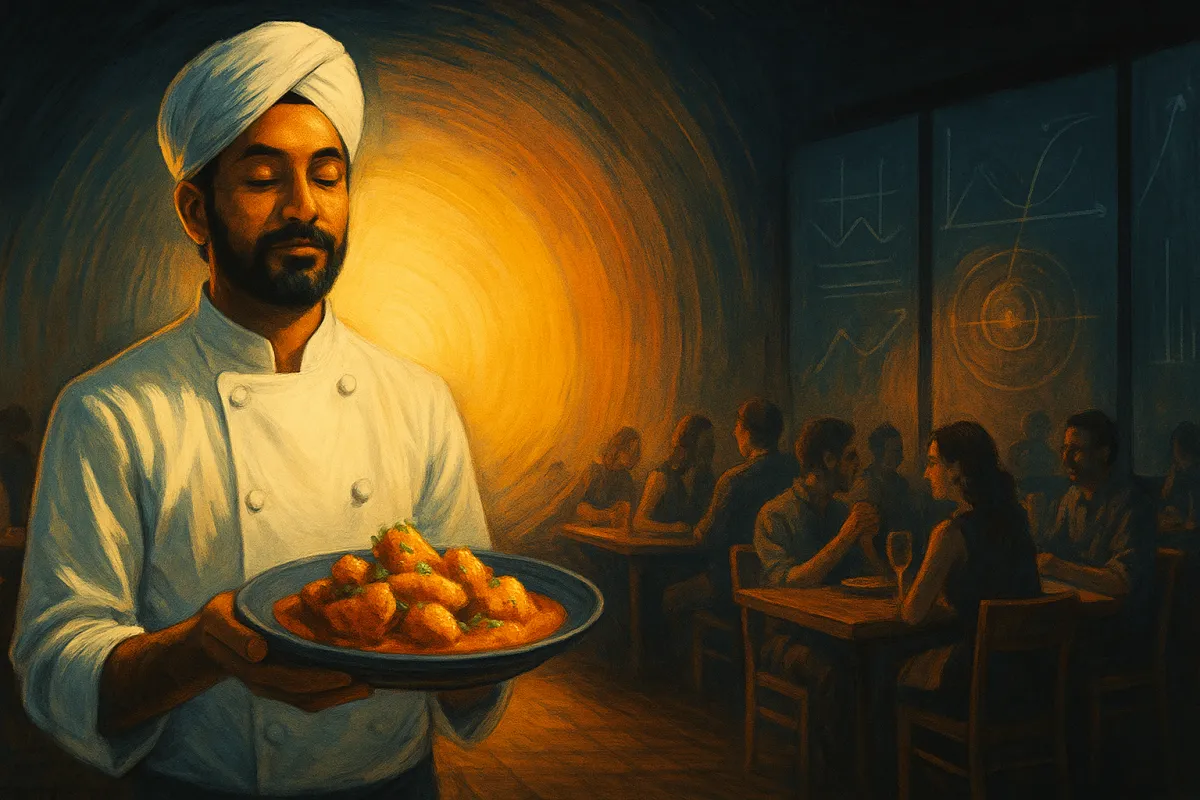
Your Restaurant Menu Is Too Complicated (And It's Costing You Thousands Every Month)
Let me tell you about the most expensive mistake restaurant owners make:
They try to be everything to everyone.
Your menu has 60 items. You offer Indian food, Indo-Chinese fusion, some Italian dishes, a few Thai options, and "American favorites" because you think that's what customers want.
But here's the truth: Every extra item on your menu is costing you thousands of dollars right now. And millions in the future.
The restaurants winning today? They do one thing. And they do that one thing so well that nobody can compete.
Let me show you why simplicity beats variety every single time.
The Power of Doing One Thing Better Than Anyone Else
You know Todd Graves? The founder of Raising Cane's Chicken Fingers?
His entire menu is:
Chicken fingers
Crinkle-cut fries
Texas toast
Coleslaw
Cane's sauce
That's it. Nothing else. No burgers. No salads. No fish. No "alternatives."
Just fried chicken fingers. Done perfectly.
And you know what happened? Raising Cane's is now worth billions of dollars. They have hundreds of locations. Lines out the door. Customers who are obsessed.
Not because they have the most options. Because they have the BEST version of one thing.
Think about that for a second.
While other chicken restaurants were adding sandwiches and wraps and salads and trying to compete with everyone, Todd Graves said "No. Just chicken fingers. But the best chicken fingers you've ever had."
That focus? That's what made him rich.
And that same focus could transform your restaurant.
Why Your 60-Item Menu Is Bleeding Money
Let me break down what's actually happening when you have a massive menu.
You're buying ingredients for 60 different dishes. That means 60 different items to order, track, store, and manage. Half of them sit in your walk-in and spoil because they're only used for one dish that barely anyone orders.
Your kitchen staff is overwhelmed. They have to remember how to make 60 different dishes. They're slower. They make more mistakes. Quality suffers because nobody can be excellent at 60 things.
Your food costs are out of control. Because you're buying so many different ingredients, you can't negotiate good prices. You're not ordering enough of any one thing to get bulk discounts. And waste is everywhere.
Your customers are confused. They look at your menu and feel overwhelmed. Too many choices leads to decision paralysis. They take forever to order. Or they just order what's familiar and safe, which is probably not your most profitable item.
Your marketing is impossible. What are you known for? Everything? That means nothing. Restaurants that are known for everything are remembered for nothing.
Meanwhile, your competitor down the street has 12 items on their menu. They're ordering massive quantities of a few key ingredients, getting better prices, their kitchen staff is fast and consistent, customers order quickly, and everyone knows exactly what they're famous for.
Guess who's making more money?
The Italian Restaurant Problem
Let me tell you about my experience at an Italian restaurant last week.
I don't know Italian food well. I can't pronounce the names. I don't know what most dishes look like.
The menu comes. 45 items. All with Italian names.
I see "Fusilli Col Buco w/Pomodoro." I have no idea what this is. But it sounds fancy, so I order it.
It arrives. A small plate. Big ring-shaped pasta. Red sauce that looks like tomato with maybe beef broth? Some tiny pieces of meat in the sauce.
That's it. That's the whole dish.
I'm still hungry. My friends are still hungry. None of us got a proper protein portion. We're all confused about what we actually ordered.
And here's the kicker: We've been to multiple Italian restaurants. Never once have any of us gotten a full piece of chicken or beef as a main dish. It's always pasta with sauce and maybe some meat sprinkled in.
Maybe next time we'll hit our daily protein at an Italian restaurant. Or maybe we'll just go to an Indian one where we know we're getting real food.
See the problem?
That restaurant lost us as customers. Not because the food was bad. Because the experience was confusing and unsatisfying.
If their menu was simpler? If they explained what each dish actually was? If they had 15 items instead of 45?
We would have ordered confidently. Enjoyed our meal. Come back. Told friends.
Instead, we left disappointed and probably won't return.
What Fine Dining Figured Out
You know what's interesting? Fine dining restaurants have figured this out.
The best fine dining restaurants have tiny menus.
Sometimes only 8 to 12 entrees. Maybe a tasting menu with a set number of courses.
Why?
Because they realized that excellence requires focus.
You can't have 40 dishes and maintain the quality standards of fine dining. It's impossible. The logistics don't work. The kitchen can't execute.
So they simplified. They focused on doing fewer things at an exceptional level.
And customers loved it.
Because when you sit down at a fine dining restaurant with 10 items on the menu, you know every single one of those items is going to be incredible. The chef has perfected each one. The kitchen knows them by heart. The ingredients are the freshest because they're used constantly.
Casual dining is following the same path.
The most successful fast-casual restaurants have 15 to 20 items max. Often less.
Chipotle? You're basically building a burrito bowl with a few ingredient choices.
Sweetgreen? You're building a salad.
Cava? Mediterranean bowl with set options.
Simple. Fast. Delicious. Consistent.
And wildly profitable because their operations are so streamlined.
The Real Reason Simplified Menus Work
Here's what happens when you simplify your menu:
Your kitchen becomes a machine. Your cooks make the same dishes over and over. They get fast. They get consistent. Quality goes up because they've mastered these specific items.
Your food costs drop dramatically. You're ordering larger quantities of fewer ingredients. Better prices. Less waste. Better inventory management. You know exactly how much of each ingredient you need because you're not dealing with 60 different recipes.
Your customers order faster and easier. No decision paralysis. No confusion. They look at 12 to 15 options, they pick one, they order. Fast table turnover means more revenue.
Your brand becomes clear. You're not "an Indian restaurant that also does Chinese and Italian and American food." You're "THE place for authentic Indian curries" or "THE place for tandoori specialties" or "THE place for South Indian dosas."
Your marketing becomes easy. You don't have to explain 60 different dishes. You focus on your signature items. You become known for specific things. When people think of that food, they think of you.
Your staff training is simpler. New servers learn 15 items in a week instead of struggling to remember 60 items for months.
Your quality control is easier. You can actually ensure every dish meets your standards because you're not trying to monitor 60 different preparations.
Your profitability explodes. Lower costs + faster service + higher quality + clearer brand = way more profit.
How to Actually Simplify Your Menu
Okay, so you're convinced. How do you actually do this?
Step 1: Look at your sales data from the last three months.
Which items sell the most? Which items barely sell? Be honest. That dish you love but only sell twice a week? It needs to go.
Step 2: Identify your signature items.
What are you actually known for? What do customers rave about? What brings people back? These are your core items. Everything else is a distraction.
Step 3: Cut ruthlessly.
Start by eliminating the bottom 30 percent of your menu. The items that barely sell, that require special ingredients, that slow down your kitchen, that confuse customers.
Yes, this is scary. You'll worry about losing customers who only came for that one random dish. But here's the reality: Most of those people either don't exist or will happily order something else.
Step 4: Group what's left into clear categories.
Not 15 different categories. Maybe 4 to 6 max. Appetizers. Curries. Tandoori specialties. Breads. Desserts. Done.
Step 5: Make sure each item has a clear, simple description.
No complicated Italian or Hindi names without explanation. Tell people what it is, what it tastes like, and what makes it special.
"Chicken Tikka Masala - Tender chicken in a creamy tomato sauce with aromatic spices. Our most popular dish."
Step 6: Design your menu to guide choices.
Highlight your best items visually. Use boxes or colors. Make it obvious what you want people to order.
Step 7: Train your staff on the new simplified menu.
They should know every item perfectly. They should be able to describe each dish, recommend pairings, and confidently answer questions.
Step 8: Market your focus.
"We've simplified our menu to focus on what we do best." Turn this into a positive. Customers will appreciate it.
What Happens When You Simplify
Let me tell you what we've seen when restaurants simplify their menus:
Food costs drop by 15 to 30 percent. Because waste decreases dramatically and purchasing power increases.
Kitchen speed increases by 20 to 40 percent. Because staff is making the same dishes repeatedly and getting really good at them.
Customer satisfaction goes up. Because there's less confusion, faster service, and more consistent quality.
Table turnover improves. Because customers order faster when they're not overwhelmed by choices.
Staff retention improves. Because the job is easier and less stressful when there are fewer items to learn and prepare.
Revenue actually increases in most cases. Because you're serving more customers faster with better quality, even though you have fewer items.
And profit margins improve significantly. Because your costs are lower while revenue stays the same or increases.
The Indian Restaurant Advantage
Indian restaurants have a huge advantage here.
Your cuisine is complex. One dish has 15 spices and hours of preparation. Customers understand that Indian food takes skill and time.
So when you simplify your menu to 15 to 20 exceptional dishes? Nobody thinks you're being cheap or lazy. They think you're being focused and intentional.
"We've simplified our menu to perfect our signature dishes."
Customers respect that. They appreciate it. They trust that what's on the menu is going to be incredible.
Compare that to an American diner with a 10-page menu. Everyone knows that kitchen is just reheating frozen food. There's no way they're making 200 items from scratch.
Your cultural authenticity supports simplicity.
You can say "We focus on traditional North Indian recipes passed down through generations" and suddenly your 15-item menu feels special and authentic, not limited.
Use this advantage. Lean into it. Your cuisine gives you permission to simplify in a way that adds to your brand instead of taking away from it.
The Million-Dollar Question
Here's what you need to ask yourself:
What is the ONE thing your restaurant does better than anyone else?
Not three things. Not "we're good at everything." ONE thing.
Is it your butter chicken? Your biryani? Your tandoori meats? Your South Indian dosas? Your specific regional cuisine?
Whatever that one thing is, build your entire menu around it.
Let that be your anchor. Your signature. Your claim to fame.
Then add 10 to 15 complementary items that support that focus.
This is how you become THE place for something instead of just another restaurant.
Raising Cane's is THE place for chicken fingers.
In-N-Out is THE place for burgers.
What will YOUR restaurant be THE place for?
Stop Trying to Compete with Everyone
Here's the mistake: You see your competitor has Chinese dishes, so you add Chinese dishes. You see another restaurant has wraps, so you add wraps. You see someone offering pizza, so you add pizza.
You're trying to compete with everyone. Which means you're competing with nobody.
Because you're not better than the Chinese restaurant at Chinese food. You're not better than the wrap place at wraps. You're not better than the pizza place at pizza.
You're spreading yourself so thin that you're mediocre at everything.
Meanwhile, the restaurant that ONLY does one thing? They're exceptional at that thing. They can't be beat at their specialty.
Stop trying to be everything. Start being the absolute best at one thing.
That's how you win. That's how you build a brand. That's how you become the restaurant people drive 30 minutes to visit.
The Cost of Not Simplifying
Let me be clear about what's at stake:
Every day you keep a complicated menu, you're losing money.
You're wasting food. You're paying for ingredients you barely use. You're confusing customers who leave without ordering or never come back. You're slowing down your kitchen and serving fewer people. You're impossible to market because you stand for nothing specific.
Every month, that's thousands of dollars.
Every year, that's tens of thousands.
Over the lifetime of your restaurant, that's millions.
Not exaggerating. Millions of dollars left on the table because you're trying to do too much instead of doing one thing incredibly well.
The restaurants that simplify? They're the ones that last 20, 30, 40 years. They're the ones that expand to multiple locations. They're the ones that become local institutions.
The restaurants with 60-item menus? Most of them close within five years.
Which one do you want to be?
READY TO SIMPLIFY YOUR MENU AND MULTIPLY YOUR PROFIT?
We're offering FREE 30-minute strategy calls for Indian restaurant owners who want to identify their core strength and build their menu around it.
We'll help you:
✅ Analyze your sales data to see what's actually working (and what's wasting money)
✅ Identify your signature items that should be the foundation of your brand
✅ Create a simplified menu strategy that increases profit while reducing complexity
✅ Develop a marketing message around your focus that makes you stand out
✅ Build a roadmap for transitioning to a simplified menu without losing customers
This isn't about making your menu boring. It's about making it focused, profitable, and excellent.
Book your free strategy call here →
Stop trying to be everything. Start being the absolute best at one thing.
Click to schedule your call now →
Frequently Asked Questions
Q: Won't I lose customers if I remove menu items?
You'll lose a tiny percentage of customers who only came for specific items. But you'll gain many more customers because your restaurant will be faster, better, more consistent, and easier to understand. Plus, many of those "lost" customers will just order something else from your simplified menu. The math almost always works out in favor of simplification.
Q: How many items should my menu have?
For most Indian restaurants, 15 to 25 items is ideal. That's enough variety to satisfy different preferences (vegetarian, chicken, lamb, seafood) without overwhelming customers or your kitchen. Fine dining can go smaller (10 to 15). Fast casual should be even smaller (8 to 12). The key is quality and focus, not quantity.
Q: What if customers ask for items I removed?
Be honest: "We've simplified our menu to focus on what we do best and ensure every dish is exceptional." Most customers will respect this. Some might be disappointed but will try something else. Very few will actually leave. And the improved experience for everyone else will more than make up for it.
Q: How do I decide which items to keep?
Look at three things: Sales data (what actually sells), profitability (what makes you money), and brand identity (what you're known for). Keep items that score high on at least two of these three criteria. Everything else is a candidate for removal. Your signature dishes that define your restaurant should definitely stay even if they're not the top sellers.
Q: Should I simplify all at once or gradually?
It depends on how drastic the change is. If you're going from 60 items to 20, do it gradually over 2 to 3 months. Remove the bottom performers first, watch what happens, then remove more. If you're going from 30 to 20, you can probably do it all at once. Test and learn. You can always add items back if you made a mistake (though you rarely will).
Q: What about customers who want variety?
Real variety isn't 60 mediocre options. Real variety is 15 exceptional options that cover different proteins, spice levels, and dietary preferences. A well-designed simplified menu can offer plenty of variety within a focused concept. Plus, true variety comes from doing things differently than your competitors, not from having the most items.
Q: How do I explain the menu changes to customers?
Frame it positively: "We've streamlined our menu to focus on our signature dishes and ensure every meal is exceptional." Or "We're committed to doing fewer things, but doing them better than anyone." Put a note on your menu, your website, and your social media. Most customers will appreciate honesty and focus.
Q: Won't my kitchen staff be bored making the same things?
Actually, most kitchen staff prefer this. It's less stressful, easier to train, and they take pride in perfecting specific dishes. Plus, when they're not scrambling to remember 60 recipes, they can focus on improving quality and developing new preparation techniques. You can also rotate specials to keep things interesting without cluttering the core menu.
Q: What if my food costs don't drop like you said they would?
If you simplify correctly and your food costs don't drop, you're doing something wrong. Check these things: Are you actually ordering larger quantities of fewer ingredients to get better pricing? Are you tracking waste and seeing it decrease? Are you still buying unnecessary ingredients out of habit? Often, the savings don't show up immediately because ordering patterns take time to adjust. Give it 60 to 90 days.
Q: Should I have a separate lunch and dinner menu?
Only if they serve genuinely different purposes and customer bases. Most restaurants overcomplicate this. A simplified menu can work for both lunch and dinner, maybe with portion size differences or a few lunch-specific combos. The goal is consistency and efficiency, not creating more menus to manage.
Q: What about seasonal specials and new items?
Specials are great for testing new ideas without committing to the core menu. Run them as daily or weekly specials. If something is wildly popular, consider swapping it into the main menu by removing an underperformer. This keeps things fresh while maintaining your simplified focus.
Q: How do I compete with restaurants that have bigger menus?
You compete by being better. You can't compete on variety with a restaurant that has 80 items. But you can absolutely compete on quality, consistency, speed, and clarity. Position your simplified menu as a strength, not a limitation. "We do fewer things, but we do them better than anyone." That's compelling.
Q: What about dietary restrictions and allergies?
A simplified menu actually makes this easier to manage, not harder. With fewer items, your kitchen staff can learn exactly what's in each dish and what modifications are possible. You can clearly mark vegetarian, vegan, and gluten-free options. Train your servers to handle common allergies confidently. Simplicity improves safety and accuracy.
Q: Will this work for my type of restaurant?
Menu simplification works for almost every restaurant type: quick service, fast casual, casual dining, and even fine dining. The specific number of items and the approach might differ, but the principle is universal: Focus beats variety. Excellence beats options. If you're not a buffet, you can benefit from simplification.
Q: What if I'm known for having "something for everyone"?
You're actually known for nothing. "Something for everyone" is not a brand position—it's the absence of one. Restaurants that are known for something specific always outperform restaurants known for variety. Make the hard choice to be the best at one thing rather than mediocre at everything.
The Bottom Line
Simplicity is not a limitation. It's a superpower.
The restaurants that win aren't the ones with the most options. They're the ones that do one thing so well that customers can't imagine going anywhere else.
Todd Graves built a billion-dollar empire selling chicken fingers and fries.
In-N-Out became a cultural icon selling burgers and fries.
Raising Cane's, Chick-fil-A, Shake Shack—all of them built on radical menu simplification.
Your Indian restaurant can do the same thing.
Pick your signature dishes. Cut everything else. Perfect what remains. Build your brand around your focus.
Stop trying to compete with everyone. Start dominating one thing.
That's how you turn your restaurant from "just another option" into "THE place" for something special.
That's how you reduce costs, increase profit, and build something that lasts.
The complicated menu is costing you thousands now and millions over time.
The simplified menu is your path to becoming legendary.
Which one are you choosing?
Book your free strategy call and let's identify what makes your restaurant special →
P.S. - Every day you keep a complicated menu, your competitor with 15 focused items is getting further ahead. How much longer are you going to let that happen?
