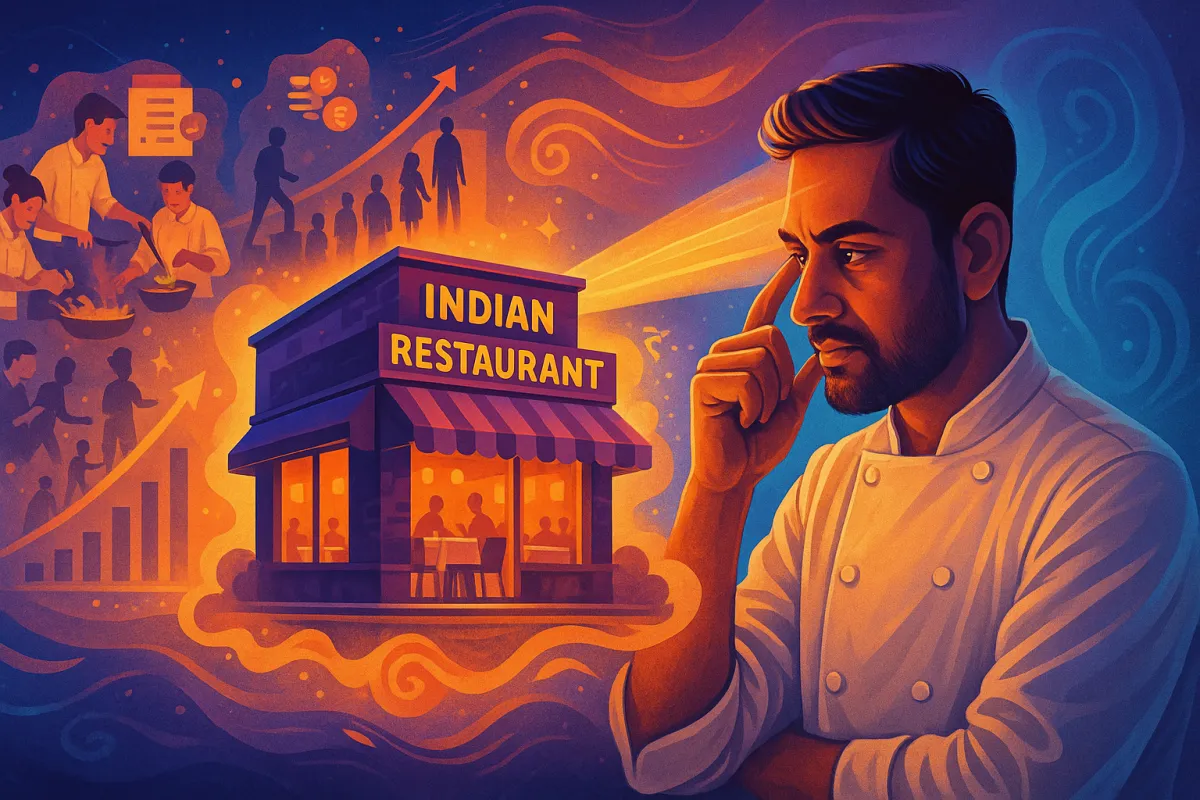
The Decision You Make Today Is Not About Today: Why Every Restaurant Owner Must Think in Outputs, Not Inputs
The output being far greater than the input.
This is the only math that matters in building a restaurant that actually grows.
Most restaurant owners measure their days by how hard they worked. How many hours they put in. How exhausted they feel when they finally lock the doors. They confuse effort with progress and wonder why the restaurant looks the same year after year.
But the owners who build something bigger understand a different equation. They understand that what you do today is not about today. It is about where that decision takes you tomorrow, next year, five years from now.
Every action you take either compounds into something greater or evaporates into nothing. The question is not whether you are busy. The question is whether what you are busy doing is building toward a future worth having.
Vision First, Then Action
Here is the truth most restaurant owners get backwards.
They start with what they can do today and hope it leads somewhere good. They react to problems. They put out fires. They survive each week and call it progress.
But the owners who scale do the opposite. They start with a vision of where they want to be. Then they work backwards to figure out what today's actions must be to get there.
This is not motivational fluff. This is operational reality.
If your vision is to own three locations in five years, then today's decisions must be different than if your vision is to keep doing what you are doing. The menu you build, the systems you create, the people you hire, the content you produce, the brand you establish. All of it changes based on where you are going.
The decision you make today is not about solving today's problem. It is about whether that solution moves you toward or away from the future you want.
The Compound Effect of Right Decisions
Think about every successful restaurant you admire. Every brand that grew from one location to ten to a hundred.
They did not get there by working harder than everyone else. They got there by making decisions that compounded over time. Decisions where the output was far greater than the input.
This is the difference between working in your restaurant and working on your restaurant.
Working in your restaurant means doing the same tasks every day. Prepping food. Managing staff. Handling complaints. Closing out registers. These tasks are necessary but they do not compound. Tomorrow you will do them again and be no further ahead than you are today.
Working on your restaurant means building systems that produce results beyond your direct effort. Training a manager who can run shifts without you. Creating content that attracts customers while you sleep. Establishing processes that maintain quality without your constant supervision. Building a brand that sells itself.
The input might be the same amount of time. But the output is exponentially different.
When Change Becomes Necessary
Here is what every restaurant owner eventually realizes, whether they admit it or not.
The things that got you here will not get you there.
The hustle that opened your doors will not scale your business. The hands-on approach that built your reputation will not multiply your locations. The personal touch that won your first customers will not reach your next thousand.
Scaling requires change. Not change for the sake of change. Change that makes the same things happen in more efficient, more powerful, more automated ways.
This is where most owners get stuck. They know the old way is not working but they cannot let go of it. They built everything themselves. They understand every detail. They trust no one else to do it right.
But this attachment to the old way is exactly what keeps them trapped in it.
The Technology and Delegation Question
The restaurant owners who scale understand that they cannot do everything themselves forever.
AI technology can handle tasks that used to require hours of human attention. Scheduling. Inventory management. Customer communication. Content creation. Marketing optimization. These tools are not replacements for human judgment. They are amplifiers of human capacity.
Delegation is not about finding people as good as you. It is about building systems that allow good people to produce consistent results. The goal is not to clone yourself. The goal is to create processes that work without requiring you to be present for every decision.
This is how every successful restaurant was built. The owner started somewhere. They learned everything. They managed every detail. They operated every station. They led every shift. They had to understand it all before they could trust anyone else with any of it.
But then they made a choice. They chose to build systems instead of just doing tasks. They chose to train leaders instead of just supervising workers. They chose to document processes instead of keeping everything in their head.
The ones who made that choice scaled. The ones who did not stayed stuck doing the same things forever.
The Three Types of Restaurant Owners
After hundreds of conversations with restaurant owners, a pattern becomes clear.
There are three types, and they reveal themselves by how they talk about their journey.
The first type is the successful owner who scaled. When you ask them about their path, they say something like "I would not change a thing." Not because everything was easy. Not because they made no mistakes. But because they understand that every challenge, every failure, every difficult decision was part of what got them where they are. They adapted when adaptation was needed. They changed course when the old way stopped working. They made decisions based on where they wanted to go, not just where they were.
The second type is the slow lane successful owner. They built something good but they know it could have been faster. When you ask them about their path, they say "I should have adapted sooner." They see now what they could not see then. The opportunities they missed because they held on too long to old methods. The growth they delayed because they were afraid to change. They are successful, but they carry the weight of knowing they left time and money on the table.
The third type is the stuck owner. When you present them with new approaches, new technologies, new ways of thinking, they say "I do not believe in that." They dismiss what they do not understand. They reject what challenges their current way of operating. They have no vision for growth because they cannot imagine their restaurant being anything other than what it is today.
The stuck owners need a mindset shift before anything else can change. No strategy, no technology, no marketing approach will help someone who has decided that growth is not possible or not desirable.
The Hunger That Drives Growth
Here is what separates the first two types from the third.
The successful owners and the slow lane successful owners share something in common. They want more.
Not more in a greedy sense. More in the sense that they have tasted what it feels like to build something meaningful and they want more of that feeling. The feeling of creating something from nothing. The feeling of solving problems that seemed impossible. The feeling of watching their vision become reality.
This hunger is what drives them to keep improving even when things are going well. To keep learning even when they already know more than most. To keep adapting even when the current approach is working.
The stuck owners have lost this hunger. Or maybe they never had it. They operate from a place of protection rather than growth. They want to keep what they have rather than build something greater.
No external force can create this hunger. It has to come from within. But for those who have it, the right strategies and systems can channel it into extraordinary results.
What This Means for Your Restaurant Today
Every decision you make today is a vote for the future you are building.
If you spend today doing the same tasks you did yesterday, you are voting for a future that looks exactly like today.
If you spend today building a system that will work without you tomorrow, you are voting for a future with more freedom and more growth.
If you spend today learning a new skill or implementing a new technology that makes your operation more efficient, you are voting for a future where the same effort produces greater results.
If you spend today creating content that will attract customers for months or years to come, you are voting for a future where marketing happens automatically.
The math is simple. Small daily improvements compound into massive long-term advantages. Small daily neglects compound into permanent stagnation.
The question is not whether you have time to work on growth. The question is whether you can afford not to.
Making the Output Greater Than the Input
This is the core principle that separates growing restaurants from stuck ones.
Find the activities where a small input creates a large output. Then do more of those and less of everything else.
Content that attracts customers for years costs the same time to create as content that disappears in a day. Choose the content that compounds.
Training that creates independent leaders costs the same time as training that creates dependent workers. Choose the training that multiplies your capacity.
Systems that run without you cost the same effort to build as habits that require your constant presence. Choose the systems that free you.
Decisions that open future opportunities cost the same mental energy as decisions that close them. Choose the decisions that expand your options.
This is not about working harder. This is about working on the right things. The things where the output is far greater than the input.
The Path Forward
You started your restaurant somewhere. You learned everything because you had to. You managed every detail because there was no one else. You operated every station because the business demanded it. You led every shift because leadership meant being present.
That got you here.
But here is not there. And the same approach that built what you have will not build what you want.
The change required is not abandoning what made you successful. It is evolving it. Taking the knowledge you gained from doing everything yourself and using it to build systems that do not require you to do everything yourself.
This is not giving up control. This is multiplying control. Instead of controlling one restaurant through your personal presence, you control multiple restaurants through your systems, your training, your processes, your brand.
The vision must come first. Where do you want to be in five years? What does that restaurant, or those restaurants, look like? How many people do they serve? How many people do they employ? What role do you play in the daily operation?
Once the vision is clear, the daily decisions become clear. Every choice either moves toward the vision or away from it. Every action either compounds into future success or evaporates into daily survival.
The decision you make today is not about today.
It is about everything that comes after.
Take the Next Step
If you are the type of owner who wants more, who knows there is another level but cannot quite see the path to get there, we should talk.
We work with restaurant owners who have the hunger for growth but need the systems to channel it. Owners who are ready to make their output far greater than their input. Owners who understand that the right decisions today create exponential results tomorrow.
Schedule a call and let us find out if we are the right fit to help you build what you are capable of building.
https://www.anthconsulting.com/restaurant-growth-challenge#calendar-652ZsXHqbhZk
The future you want starts with the decision you make today.
Frequently Asked Questions
What does it mean for output to be greater than input?
It means getting more results from the same or less effort. Instead of trading hours for tasks that must be repeated tomorrow, you invest hours in systems, content, training, and processes that continue producing results long after the initial work is done. A social media post that attracts customers for two years has greater output than one that disappears in two days, even though both took the same time to create. The goal is finding and focusing on activities where small inputs create large, compounding outputs.
How do I know if I am working on my restaurant versus in my restaurant?
Working in your restaurant means doing tasks that keep the operation running today but do not build toward tomorrow. Prepping food, managing a shift, handling a complaint. These are necessary but they do not compound. Working on your restaurant means building things that produce results beyond your direct effort. Training managers, creating systems, building your brand, developing content strategies. If what you did today will still be producing results a year from now, you were working on your restaurant. If you will have to do the same thing again tomorrow to get the same result, you were working in it.
What if I do not have time to work on growth because I am too busy with daily operations?
This is the trap that keeps most restaurant owners stuck. The daily operations consume all available time, leaving nothing for growth activities. The only way out is to make growth activities non-negotiable. Start with one hour per week dedicated to systems, training, or content. Protect that time like you would protect a shift that must be covered. As the systems you build start working, they free up more time, which you reinvest into more growth activities. The compound effect eventually creates the freedom you need.
How do I transition from doing everything myself to delegating?
Start by documenting what you do. Write down the steps of your most repeated tasks. Create checklists that anyone could follow. Then train someone on one task at a time, using your documentation as the guide. Resist the urge to take tasks back when they are not done perfectly. Instead, improve the documentation and training. Over time, you build a library of systems and a team capable of executing them. The goal is not to find people as good as you. The goal is to create systems that produce consistent results through good people.
What is the difference between successful owners and stuck owners?
Successful owners make decisions based on where they want to go. Stuck owners make decisions based on where they are. Successful owners see change as necessary for growth. Stuck owners see change as a threat to what they have. Successful owners are hungry for more even when things are going well. Stuck owners are satisfied with survival even when more is possible. The difference is mindset first, then strategy. No amount of good strategy helps someone who has decided growth is not possible or not worth pursuing.
How do I develop the hunger for growth if I feel stuck?
Reconnect with why you started. Most restaurant owners began with a vision bigger than just getting through each day. Somewhere along the way, survival replaced ambition. Spend time with owners who are growing. Their energy is contagious and their example proves what is possible. Set a goal that excites you rather than one that just seems achievable. A goal that requires you to become more than you currently are. The hunger often returns when you have something worth being hungry for.
Can AI and technology really help a restaurant scale?
Technology is a multiplier, not a replacement. It takes what you are already doing and makes it more efficient, more consistent, more scalable. AI can handle scheduling, inventory analysis, customer communication, content creation assistance, and marketing optimization. But it only works if you have clarity on what you are trying to accomplish. Technology without strategy just makes you more efficiently stuck. Technology with clear vision accelerates everything.
How long does it take to see results from working on the business instead of in it?
The compound effect takes time to become visible but it starts immediately. In the first few months, you might not see dramatic changes, but you are building the foundation. By six months to a year, the systems you built start producing noticeable results. Your team operates more independently. Your content attracts customers consistently. Your processes maintain quality without constant supervision. By two to three years, the compound effect becomes powerful. The gap between restaurants that invested in growth and those that just survived becomes impossible to ignore.
