Why Cheap Restaurant Pricing Fails (And the Quality Strategy That Builds Empires)
I walked into a quick service Indian restaurant last week.
The menu board promised biryani for $6.99. Cheap, right? Great deal.
I ordered. Waited 25 minutes. When my food finally came, I opened the container and saw maybe two small pieces of chicken swimming in rice. The portion looked like it was meant for a child.
I paid $6.99 and left hungry, disappointed, and annoyed.
You know what I did? I went next door to another Indian restaurant. Spent $13.99 for biryani. Got it in 8 minutes. The container was packed with tender chicken, fragrant rice, and actually filled me up.
Which restaurant do you think I'll go back to?
The expensive one. Every single time.
Here's the lesson that too many restaurant owners miss: You can be anything in the restaurant industry. Bold. Innovative. Traditional. Fusion. Upscale. Casual.
But you can never be cheap.
Let me explain why—and show you the actual path to restaurant success that nobody's talking about.
Why "Cheap" Always Loses
Think about it from a customer's perspective.
If I want cheap food, I have endless options. McDonald's. Taco Bell. A sandwich at home. Instant ramen. A frozen meal from the grocery store.
All of these are cheaper than your restaurant. And faster.
So when you try to compete on price, you're not competing with other restaurants. You're competing with fast food chains that have billions of dollars in purchasing power and optimized systems. And you're competing with people just eating at home.
You will lose that competition. Every time.
But here's what's worse: When you're cheap, you attract customers who only care about price. They don't care about quality. They don't care about experience. They'll leave you for someone 50 cents cheaper.
These customers will never be loyal. They'll never tell their friends about you. They'll never become regulars.
And because your prices are so low, you can't afford good ingredients. You can't afford to train staff well. You can't afford to maintain your restaurant properly.
So quality suffers. Service suffers. The experience suffers.
It's a death spiral.
The Quick Service Restaurant Trap
I see this constantly with small quick service restaurants.
They think: "If I make my prices really low, people will come."
So they do.
Biryani for $6.99. Chicken tikka for $7.99. Samosas for $1.99.
Then reality hits:
They can't afford to give decent portions at those prices. So customers get tiny servings and leave unsatisfied.
They can't afford enough staff. So service is slow. People wait 20 to 30 minutes for "fast" food.
They cut corners on ingredients. So the quality is mediocre at best.
The result?
Customers try them once, are disappointed, and never come back. Reviews are terrible. "Small portions." "Took forever." "Not worth it even though it's cheap."
The restaurant struggles. Makes no money. Eventually closes.
I've watched this happen dozens of times.
Meanwhile, the restaurant next door charges double. They give generous portions. Fast service. Quality ingredients. They're packed every day.
What Actually Works: The Shake Shack Story
Let me tell you about Danny Meyer and Shake Shack.
When Danny Meyer decided to open a burger restaurant, everyone told him the market was saturated. McDonald's. Burger King. Wendy's. Five Guys. In-N-Out.
Why would anyone pay $8 for a burger when McDonald's sells them for $1?
But Danny Meyer didn't try to compete on price. He did the opposite.
He made expensive burgers using high-quality beef. He paid his staff well and trained them extensively. He created an experience, not just a transaction.
People thought he was crazy.
Today, Shake Shack is worth billions. Lines out the door. Customers who will drive 30 minutes and wait 45 minutes for a burger.
Not because it's cheap. Because it's excellent.
That's the lesson.
The Mindset That Makes or Destroys Restaurants
There are two types of restaurant owners:
Type 1 thinks: "How cheap can I make this so people will come?"
They focus on cutting costs. Small portions. Cheap ingredients. Minimal staff. Fast turnover.
Type 2 thinks: "How good can I make this so people keep coming back?"
They focus on creating value. Generous portions of quality food. Excellent service. Memorable experiences. Building loyalty.
Type 1 restaurants struggle and eventually close.
Type 2 restaurants thrive and expand.
The difference isn't luck. It's mindset.
Why That Corner Kebab Shop Doesn't Hit
You know that kebab shop on the corner? Or that pizza place? That biryani spot you pass every day?
You've never been there. Neither have your friends.
Why?
Because nothing about them stands out. They're just... there. Cheap. Generic. Forgettable.
You don't know if the food is good. You don't know anything about them except that they're nearby and probably cheap.
That's not enough.
There are dozens of places nearby that are also cheap. Why would you pick that specific one?
You wouldn't. So they stay empty. Struggling. Average at best.
Meanwhile, there's an Indian restaurant 15 minutes away that's always packed.
You drive past closer options to go there. You wait 30 minutes for a table. You pay more.
Why?
Because they're not competing on proximity or price. They're competing on being excellent.
The Two Non-Negotiables for Success
If you're opening a restaurant, there are exactly two things you must have:
1. Your food must be genuinely good.
Not "good enough." Not "pretty good for the price." Actually good. Better than what people can make at home. Worth talking about.
2. You must give customers an exceptional experience.
From the moment they walk in (or open your website) to the moment they leave. Every touchpoint. Every interaction.
If you don't have both of these, don't open a restaurant.
Just be a pop-up. Test your concept. See if people actually love what you're doing.
Because without great food and great experience, you'll just be another average restaurant fighting for scraps.
And average restaurants die.
Why Fine Dining and Casual Dining Can't Fake It
Quick service restaurants can sometimes survive being mediocre. They're convenient. People are in a hurry. Standards are lower.
But fine dining and casual dining? You can't fake it.
If your food isn't great and your experience isn't memorable, you'll have empty tables on weekdays. Maybe some business on weekends, but never full.
And you know what happens to restaurants with empty tables? They close.
The restaurants that are packed even on Tuesday nights? They've gone beyond just good food and good service.
They've built a brand.
People don't just eat there. They experience something. They tell stories about it. They post about it. They bring their friends.
The Restaurants That Win: Building a Brand
Let me tell you about Eleven Madison Park in New York City.
Could they compete on price? Absolutely not. A meal there costs $300+ per person.
But they're consistently ranked as one of the best restaurants in the world. Reservations are booked months in advance. People save up for years to eat there once.
Why?
Because they built a brand around exceptional experiences.
Every detail is perfect. The food is art. The service is flawless. The atmosphere is magical. People leave feeling like they experienced something special.
That's what customers are actually paying for.
Not the food itself. The experience. The memory. The story they'll tell.
And here's the key: It works at every price point.
Chick-fil-A isn't fine dining. But they built a brand around exceptional service and quality. People wait in long drive-thru lines because they know it'll be good.
Chipotle built a brand around fresh, customizable food. People pay more than Taco Bell because the experience is better.
Price doesn't matter when the value is there.
The Restaurant Dominance Framework: 7 Essential Elements
After working with over 1,000 restaurant owners, we've identified exactly what separates thriving restaurants from struggling ones.
It's not luck. It's not location. It's not even just good food.
It's a framework. Seven essential elements that work together to create restaurant dominance.
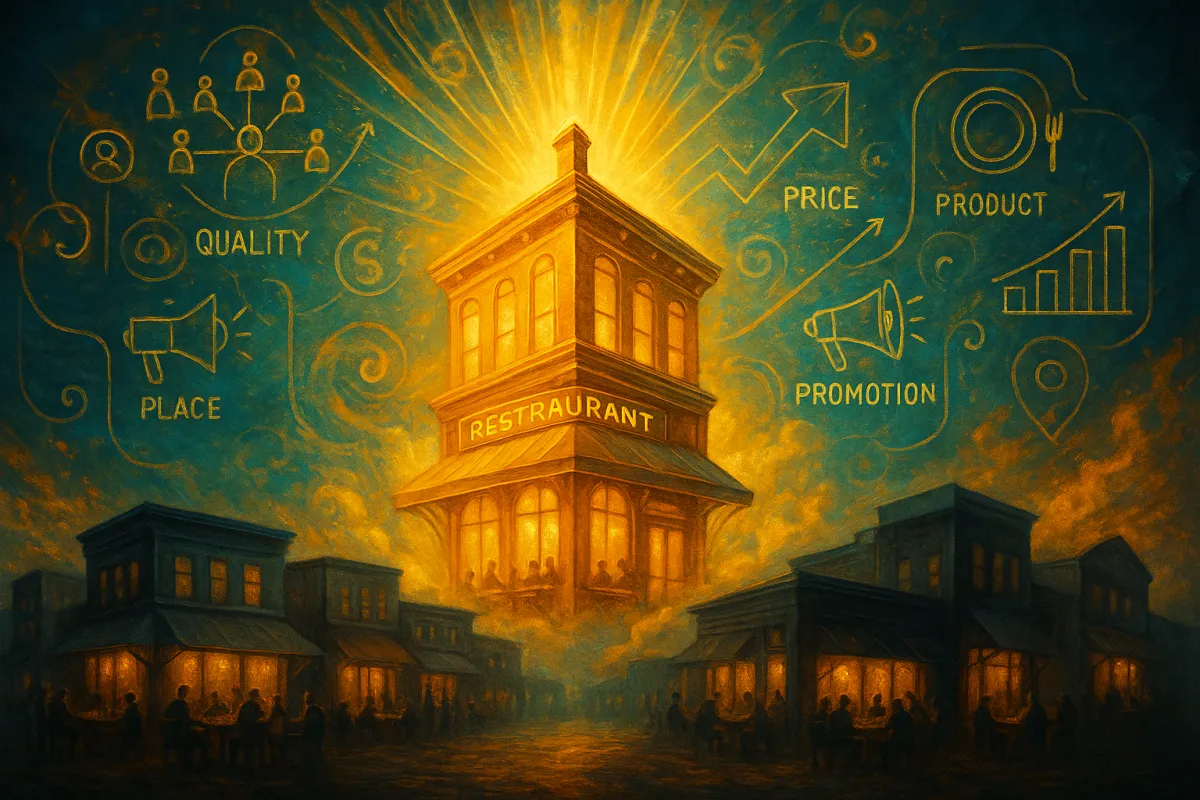
Most consultants will tell you about the "7 Ps of Marketing." Product, Price, Place, Promotion, People, Physical Evidence, Process.
That's fine. But it's generic. It's the same advice every restaurant gets.
We've developed something better. Built specifically for restaurant owners who want to dominate their market, not just survive.
Let me walk you through each element and show you how it actually works in real restaurants.
Element 1: The Quality Promise (Your Non-Negotiable Standard)
This is your foundation. Everything starts here.
What's your non-negotiable standard for quality?
For Shake Shack, it's 100% all-natural Angus beef. Never frozen. Hormone-free. No exceptions.
For Chipotle, it's "Food With Integrity." Responsibly raised meat. Organic produce when possible. No GMOs.
For Raising Cane's, it's fresh chicken tenders. Never frozen. Made to order. That's it.
Your quality promise is what you'll never compromise on, no matter what.
And here's the key: Your customers need to know what that promise is. It needs to be clear. Obvious. Part of your identity.
If you're an Indian restaurant, maybe your promise is "We use grandmother's recipes with imported spices from India. Every dish is made from scratch daily."
That's a promise customers can understand and value.
When you deliver on that promise consistently, you build trust. Trust builds loyalty. Loyalty builds a thriving restaurant.
Element 2: The Value Equation (Not Price, But Worth)
Let's be clear: This isn't about setting your prices.
This is about making sure customers feel like they got more than they paid for.
Remember that $13.99 biryani I bought? It wasn't cheap. But I felt like I got a great deal because:
The portion was generous. The quality was high. The service was fast. The flavor was incredible. I left satisfied and happy.
I got more value than I paid for.
That's the equation you need to solve. Not "how low can I price this?" But "how much value can I pack into this experience?"
Sweetgreen charges $12 to $15 for a salad. That's expensive for a salad. But customers feel like it's worth it because:
The ingredients are premium and fresh. You get to customize it exactly how you want. The portions are filling. The atmosphere is clean and modern. They feel good about eating healthy.
The value is there. So people pay.
Your job isn't to be the cheapest. Your job is to deliver so much value that price becomes secondary.
Element 3: The Presence Strategy (Where and How Customers Find You)
This used to be just about physical location. Not anymore.
Your presence is everywhere customers might look for you.
Your physical restaurant, yes. But also:
Your Google Business Profile (when someone searches "Indian restaurant near me")
Your website (when someone wants to see your menu or make a reservation)
Your social media (when someone is scrolling and gets hungry)
Your delivery app listings (when someone wants food brought to them)
Your reputation sites (when someone is reading reviews to decide where to eat)
You need to dominate all of these spaces.
Cava, the Mediterranean fast-casual chain, does this brilliantly. You can find them on Google with perfect info. Their website is clean and easy to use. Their Instagram makes you hungry. Their delivery is seamless. Their reviews are overwhelmingly positive.
They're everywhere customers are looking.
That's presence strategy. And it's not optional anymore.
Element 4: The Attraction System (How You Pull Customers In)
This is your marketing. But not the spammy, annoying kind.
This is about creating magnetic pull that makes people want to visit you.
There are two types of attraction:
Paid attraction: Ads that bring people in right now. Google Ads when someone searches. Facebook ads to people nearby. Delivery app promotions.
Organic attraction: Content that builds your brand over time. Social media posts that make people hungry. Stories that make people curious. Reviews that make people trust you.
Most restaurants only do one or the other. The best restaurants do both.
Chipotle runs ads. But they also create organic content that goes viral constantly. TikTok videos. Instagram posts. Stories about their ingredients. Challenges and promotions.
They're pulling customers in from every direction.
And here's the secret: Organic attraction is more valuable long-term. Because once you build it, it keeps working without you spending money.
But paid attraction gives you immediate results while you're building organic.
You need both.
Element 5: The People Power (Your Team as Your Competitive Advantage)
Your staff makes or breaks your restaurant. Period.
Customers don't remember the food as much as they remember how they were treated.
Chick-fil-A understands this better than anyone.
Their food is good. But it's not groundbreaking. It's chicken sandwiches and fries.
What makes them special? Their people.
Every Chick-fil-A employee says "my pleasure" instead of "you're welcome." They're trained extensively. They're empowered to solve problems. They actually seem happy to serve you.
That experience is what brings people back.
Your people are your brand in action. They're the human face of everything you promise.
So invest in them:
Hire for attitude, train for skill. Pay them well. Treat them with respect. Give them the tools to succeed. Empower them to create great experiences.
When your team is excellent, your restaurant is excellent.
Element 6: The Tangible Experience (What Customers See, Feel, and Sense)
This is everything physical about your restaurant.
The moment someone walks in (or visits your website, or opens your delivery container), what do they experience?
Danny Meyer calls this "the dining room as stage."
Everything is a signal:
Your entrance. Your host stand. Your lighting. Your music. Your decor. Your table settings. Your menu design. Your bathrooms. Your packaging.
Every single detail either adds to or subtracts from your brand.
Shake Shack isn't fancy. But everything about the experience feels intentional. Clean. Modern. Fun. The concrete floors. The metal chairs. The open kitchen. The branded cups.
It all tells the same story: Quality casual dining.
What story is your restaurant telling through its physical experience?
If you say you're upscale but your bathrooms are dirty, the customer believes the bathroom.
If you say you're high-quality but your to-go containers are cheap and flimsy, the customer believes the container.
Make every physical element reinforce your promise.
Element 7: The Operational Flow (Systems That Deliver Consistency)
This is the behind-the-scenes magic that makes everything work.
Your processes. Your systems. Your technology. Your procedures.
How do orders move from customer to kitchen to table?
How do you ensure every dish tastes the same every time?
How do you train new staff to maintain your standards?
How do you handle busy rushes without falling apart?
The restaurants that scale are the ones with exceptional operational flow.
Chipotle's assembly line isn't an accident. It's a carefully designed system that allows them to serve customers in under 5 minutes while maintaining quality and giving customization.
Every step is optimized. Every role is clear. Every procedure is documented.
That's how they opened thousands of locations while maintaining consistency.
If you want to grow beyond one location (or even just run one location excellently), you need systems that work without you standing there supervising everything.
Document your processes. Train your team thoroughly. Use technology to automate what you can. Create consistency through systems, not just through you being there.
That's operational flow.
How These 7 Elements Work Together
Here's the magic: None of these elements work alone.
You need all seven working together, reinforcing each other.
Great quality means nothing if your operations can't deliver it consistently.
Excellent people can't succeed if your physical environment makes them look bad.
Perfect systems are worthless if your team doesn't care.
But when all seven elements align?
That's when you become dominant. That's when customers become obsessed. That's when you can charge premium prices and still have lines out the door.
That's when you stop competing with other restaurants and start creating your own category.
The Growth Path Nobody Talks About
Most restaurant growth advice is terrible.
"Open more locations!"
"Franchise!"
"Expand your menu!"
That's all backwards.
You don't grow by doing more of what you're doing. You grow by perfecting what you're doing, then replicating that perfection.
Here's the actual path:
First, master your seven elements at one location. Get them all working together flawlessly. Build a restaurant that's so good, customers can't stop talking about it.
Second, document everything. How you hire. How you train. How you prepare each dish. How you create the experience. Make it repeatable.
Third, test scalability. Can you open a second location and deliver the same quality? Not similar quality. The exact same quality.
Fourth, build the infrastructure for growth. The leadership team. The supply chain. The training systems. The technology. The capital.
Then—and only then—do you expand.
Most restaurants skip steps one through four and jump straight to expansion. They open location two before location one is perfected.
That's why most restaurant expansion fails.
You're not replicating success. You're replicating mediocrity. And mediocrity at scale is just expensive failure.
Why Most Restaurants Stay Stuck
I've worked with over 1,000 restaurant owners. Most of them are stuck in the same place.
They're not failing. But they're not thriving either.
They're just... existing.
Working 70-hour weeks. Making enough to pay the bills but not enough to build wealth. Constantly stressed. Never quite getting ahead.
Why?
Because they're focused on the wrong things.
They obsess over menu prices instead of value delivery.
They try to copy competitors instead of building their own brand.
They chase short-term promotions instead of long-term loyalty.
They work in their restaurant instead of on their restaurant.
They're busy. But they're not building.
What We Do Differently
Our approach to restaurant growth is different from every other agency.
We don't work with restaurants that want to be cheap. We work with restaurants that want to be excellent.
We help Indian restaurants specifically because we understand the unique challenges and opportunities.
We focus on quality over quantity. We take on fewer clients and give them everything we've got.
Here's our philosophy:
You, the restaurant owner, focus on two things:
Creating exceptional food that customers love.
Delivering experiences that customers remember and talk about.
That's it. That's your job.
Our job? Everything else.
We build your brand so it reflects the quality you deliver.
We create your presence across every platform customers use.
We design your attraction systems—both paid and organic.
We help you develop your team into a competitive advantage.
We optimize your tangible experience so every detail reinforces your promise.
We streamline your operations so you can scale without sacrificing quality.
You do what only you can do. We handle the rest.
And we stay with you. Not just at the beginning. Throughout your entire growth journey.
I'm personally involved with every client. Brainstorming. Strategizing. Problem-solving. Building together.
Because your success is our success.
The Restaurant Owner Who Gets It
Let me tell you about one of our clients. I'll call him Raj.
When Raj came to us, his restaurant was... fine. The food was good. Service was okay. He was making enough to survive.
But he was working 80 hours a week. Stressed. Exhausted. Not making real money.
He wanted to grow. But he didn't know how.
We worked with him on the seven elements.
First, we helped him clarify his quality promise. He was making "Indian food." We helped him refine it to "North Indian home-style cooking using family recipes and imported spices."
Suddenly his brand was clear.
Second, we worked on his value equation. He was pricing low to compete. We helped him increase prices by 20 percent while improving portions and presentation.
Customers didn't complain. They appreciated the better value.
Third, we built his presence. Optimized his Google profile. Created a beautiful website. Built his social media. Got him on every delivery platform.
Suddenly people could actually find him.
Fourth, we created his attraction system. A mix of local ads and organic content showing his cooking process, his family story, his passion.
New customers started coming in regularly.
Fifth, we helped him hire and train better staff. Invested in his people. Created systems so they could deliver excellent service consistently.
His team became proud to work there.
Sixth, we redesigned his restaurant's physical experience. New lighting. Better furniture. Cleaner bathrooms. Branded packaging.
Everything reinforced his promise of quality.
Seventh, we documented all his processes. Created training manuals. Implemented technology. Built systems that worked without him.
Now the restaurant ran smoothly even when he wasn't there.
Today? Three years later?
Raj has two locations. Both are thriving. He works 45 hours a week. He's actually making real money—enough to save, invest, plan for the future.
But here's the best part:
His restaurants are packed. Even on Tuesday nights. Because people don't see him as just another Indian restaurant.
They see him as THE place for authentic North Indian home cooking. With a story. With a promise. With an experience.
That's the difference the seven elements make.
READY TO STOP COMPETING ON PRICE AND START DOMINATING ON QUALITY?
We're offering FREE 30-minute strategy calls for Indian restaurant owners who are tired of being cheap and ready to be excellent.
In this call, we'll:
✅ Assess all seven elements of your restaurant and identify what's holding you back
✅ Show you where you're leaking value and how to fix it
✅ Create a clarity around your quality promise that differentiates you from every competitor
✅ Map out your growth path from where you are to where you want to be
✅ Determine if we're a good fit to work together on building your dominant brand
This isn't for every restaurant owner. This is for owners who:
→ Refuse to compete on being cheap
→ Are committed to quality and excellence
→ Want to build a brand, not just run a restaurant
→ Are ready to invest in growth
→ Understand that premium prices require premium value
If that's you, let's talk.
Book your free strategy call here →
Stop fighting for scraps with cheap prices. Start building a restaurant customers will drive 30 minutes for and wait 45 minutes to get into.
Click to schedule your strategy call now →
Frequently Asked Questions
Q: If I raise my prices, won't I lose customers?
You'll lose customers who only care about price. Those customers were never loyal anyway—they'd leave you for someone 50 cents cheaper. But you'll attract customers who value quality and are willing to pay for it. These customers become regulars, leave great reviews, and bring friends. The math almost always works out: You serve fewer customers but make more money per customer, and those customers stick around.
Q: How do I justify higher prices if my competitors are cheaper?
You don't justify them—you demonstrate value. Make your portions generous. Use premium ingredients. Perfect your service. Create an experience. When customers feel like they got more than they paid for, price stops being an issue. Shake Shack charges $8 for a burger in a world where McDonald's charges $1. They don't justify it—they deliver enough value that customers happily pay.
Q: What if I'm in an area where people are price-sensitive?
Every area has people willing to pay for quality. You might be a smaller market, but those customers exist. Your job is to find them and serve them exceptionally well. Also, "price-sensitive" often means "hasn't seen enough value to justify higher prices yet." Show them the value. Many "price-sensitive" customers will pay premium prices for premium experiences.
Q: Can quick service restaurants charge premium prices?
Absolutely. Sweetgreen, Cava, Chipotle, Shake Shack—all quick service, all premium-priced. The key is delivering value fast. High-quality ingredients, generous portions, quick service, great experience. Quick doesn't mean cheap. It means efficient. If you deliver premium value efficiently, you can absolutely charge premium prices in quick service.
Q: How long does it take to implement all seven elements?
It's not an overnight transformation. For most restaurants, getting all seven elements working well takes 6 to 12 months. But you see improvements immediately. Month one, you clarify your quality promise and start building your value equation—customers notice right away. Month three, your presence and attraction systems are working—new customers start coming in. Month six, your team and operations are stronger—consistency improves. By month 12, everything is working together and growth accelerates.
Q: Which of the seven elements should I start with?
Always start with Element 1: Your Quality Promise. Everything else builds on this foundation. If you're not clear on what you stand for and what you'll never compromise on, the other elements won't work. Once your quality promise is clear, work on Element 7: Operational Flow, to ensure you can deliver that promise consistently. Then build the others around those two foundations.
Q: What if I've already built my restaurant around low prices?
You can change, but it requires a full rebrand. You'll need to communicate clearly: "We're evolving to focus on quality over price." Some customers will leave. That's okay—they weren't your ideal customers anyway. Focus on delivering so much value that new customers come in and become loyal. We've helped restaurants successfully make this transition. It's uncomfortable for a few months, then you emerge stronger.
Q: How do I compete with chains that have huge marketing budgets?
You don't compete on their terms. Chains compete on consistency, convenience, and price. You compete on quality, experience, and local connection. They're McDonald's. You're the local favorite. Different games. Plus, with the seven elements working together, you build organic attraction that's actually more powerful than paid advertising. Your customers become your marketing team.
Q: Do I need to implement expensive technology for operational flow?
Not necessarily. Operational flow is about systems and processes, not expensive technology. Yes, a good POS system helps. Yes, inventory management software is useful. But the most important thing is documenting your procedures and training your team thoroughly. You can build great operational flow with relatively simple technology if your systems and people are strong.
Q: What if my food is great but I still have empty tables?
Then your problem isn't Element 1 (Quality Promise), it's likely Elements 3, 4, or 6 (Presence, Attraction, or Tangible Experience). Great food is necessary but not sufficient. You need people to know about you, find you easily, and feel compelled to visit. This is where marketing and brand-building come in. The seven elements work together—you can't just have one or two.
Q: How do I know if I'm delivering enough value for my prices?
Three indicators: First, are customers coming back regularly? Second, are they bringing friends? Third, are they leaving positive reviews that mention value ("so worth it," "great deal," "totally worth the money")? If yes to all three, your value equation is working. If no, ask customers directly: "Did you feel like you got your money's worth?" Their honest answers will tell you what to improve.
Q: Should I focus on dine-in, takeout, or delivery?
All three if possible, but perfect one first. Most successful restaurants start with dine-in excellence, then expand to takeout and delivery while maintaining quality. Your Element 7 (Operational Flow) needs to handle all three without compromising any of them. Chipotle does this brilliantly—dine-in, takeout, delivery, and catering all work seamlessly. But they perfected dine-in first.
Q: What if I want to franchise eventually?
Perfect for you. The seven elements are specifically designed to be replicable. If you build them properly at one location, you can replicate them at location two, three, and beyond. This is how successful franchises are built—not by expanding fast, but by building something so good and so systematic that it can be perfectly replicated. Get one location to domination-level first, document everything, then expand.
Q: How involved will you be if we work together?
Very involved. I (the founder) am personally involved with every client throughout the relationship. We brainstorm together. Strategize together. Solve problems together. This isn't a "hand-off to junior account manager" situation. Your success is too important. We work with fewer clients specifically so we can give each one our full attention. Quality over quantity, always.
Q: What's your success rate with restaurant clients?
We're selective about who we work with, so our success rate is high. Restaurants that commit to the seven elements and execute consistently see significant growth within 6-12 months. But here's the key: We only take on restaurants that are already committed to quality. We can't help restaurants that want to be cheap—that's a fundamentally flawed strategy. But restaurants that want to be excellent and are willing to do the work? They thrive.
The Bottom Line
You can't win by being cheap. You win by being excellent.
Stop trying to be the cheapest option. Start being the best option.
Raise your prices. Increase your value even more. Deliver experiences worth talking about.
Build your restaurant on the seven elements:
Your quality promise that never wavers.
Your value equation that makes customers feel like they got more than they paid for.
Your presence everywhere customers look.
Your attraction system that pulls people in.
Your people who deliver your brand with every interaction.
Your tangible experience that reinforces everything you promise.
Your operational flow that delivers consistency at scale.
When these seven elements work together, something magical happens.
You stop competing with other restaurants. You create your own category. You become THE place for what you do.
Price stops mattering because value is so obvious.
Marketing becomes easier because customers do it for you.
Growth becomes natural instead of forced.
And you build a restaurant that lasts.
Not just a restaurant that survives. A restaurant that dominates. A restaurant that becomes an institution. A restaurant your grandchildren will be proud of.
That's what excellence looks like. That's what we help you build.
Book your free strategy call and let's start building your dominant restaurant →
P.S. - The restaurants packed every Tuesday night aren't the cheapest ones. They're the excellent ones. Stop fighting for scraps. Start building excellence.
