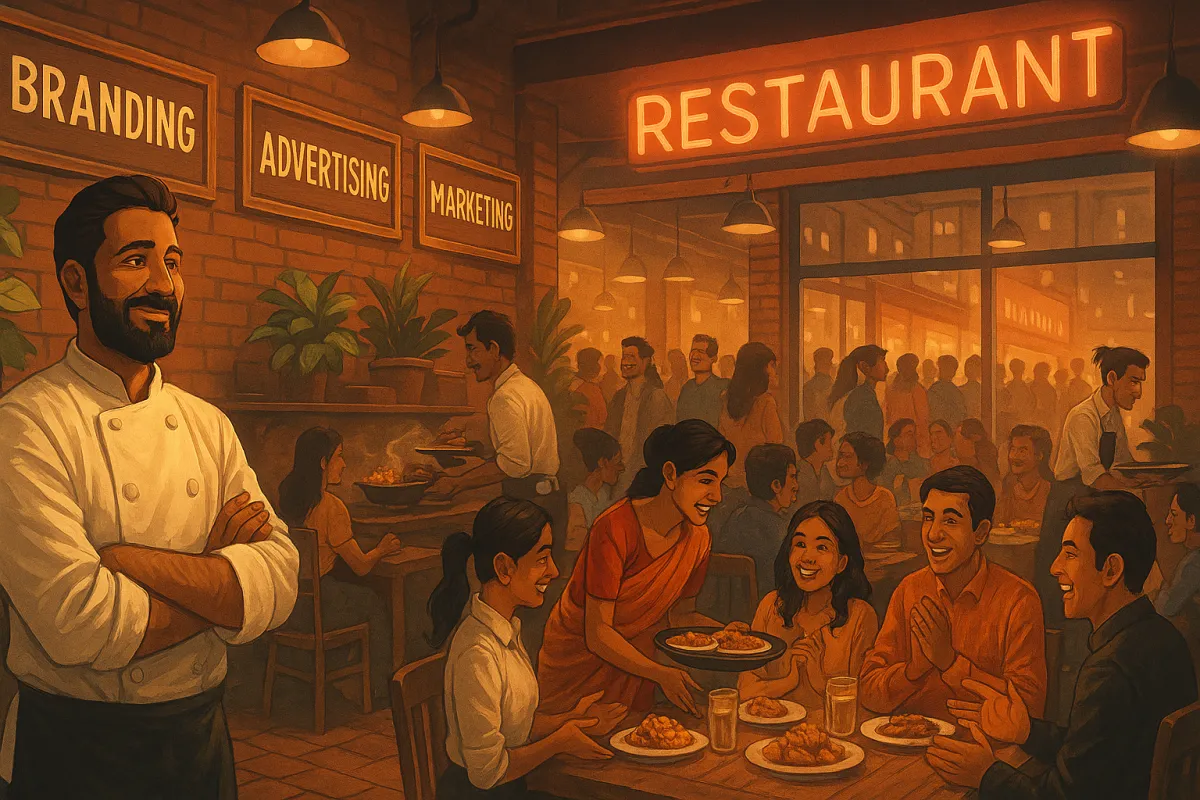
Branding, Advertising, and Marketing: The Three Forces That Fill Your Restaurant Every Night
Most restaurant owners use the words branding, advertising, and marketing interchangeably. They throw them around in conversation like they all mean the same thing. Get some marketing done. Run some ads. Build the brand. It all blurs together into one vague idea of getting more customers.
This confusion is costing you money. A lot of it.
Because these three things are not the same. They are distinct forces that work together in a specific way. When you understand what each one actually does and how they combine, you stop wasting money on tactics that do not fit together. You start building something that compounds over time. You create a system that fills your restaurant not just today but for years to come.
Let me break this down in a way that will change how you think about growing your restaurant.
The Foundation: What Marketing Actually Is
Marketing is the broadest of the three. It is the foundation everything else sits on.
At its core, restaurant marketing is how you show people what you offer to get them to eat at your place. That sounds simple, but it contains multitudes.
Marketing includes the food you make. Not just cooking it, but designing a menu that customers will love. Choosing dishes that photograph well. Pricing items in a way that feels like value. Creating specials that give people a reason to visit this week instead of someday.
Marketing includes the experience you create. The atmosphere when someone walks through your door. The music playing. The lighting. How the tables are arranged. Whether the space feels intimate or energetic. All of this is marketing because all of it influences whether someone comes back and whether they tell their friends.
Marketing includes how you communicate. Your website. Your social media presence. The words you use to describe your dishes. The photos you post. The emails you send. Every touchpoint where a potential customer encounters your restaurant is marketing.
Marketing includes your reputation. The reviews you accumulate. The word of mouth that spreads. The stories people tell about their experience. This is marketing too, even though you do not control it directly.
Think of marketing as the entire universe of activities that connect your restaurant to customers. It is the big picture. The strategy. The overall approach to getting people to know about you and choose you over every other option they have.
Without marketing, you are just a restaurant that exists. With marketing, you are a restaurant that people know about, think about, and choose.
The Identity: What Branding Actually Is
Branding is more specific than marketing. It is not everything you do. It is who you are.
Your brand is the position you hold in people's minds. It is what you are known for. It is the feeling someone gets when they think about your restaurant.
Let me give you an example that makes this concrete. Imagine a five-star Michelin Indian restaurant where celebrities dine, with an ocean view and impeccable service. Before you even taste the food, you have feelings about this place. You expect excellence. You expect an experience worth talking about. You expect to pay premium prices and feel like it was worth every penny.
That expectation, that set of feelings and associations, is the brand.
Now imagine a different Indian restaurant. Casual atmosphere. Families everywhere. Generous portions. Affordable prices. The kind of place where you go when you want comfort food without fuss.
Completely different brand. Completely different position in people's minds. Neither is better or worse. They are just different, and they attract different customers for different occasions.
Your brand answers the question: what are we known for? It is the thing that makes you distinct. The reason someone chooses you instead of the ten other Indian restaurants within driving distance.
Here is what most restaurant owners get wrong about branding. They think it is about logos and colors and fonts. They hire a designer to make things look nice and call that branding.
That is not branding. That is visual identity, which is just one small expression of brand.
Real branding goes much deeper. It is your personality as a restaurant. It is your values, whether you articulate them or not. It is your why, the reason you exist beyond making money. It is the promise you make to customers about what they will experience.
When your brand is strong, people know exactly what to expect from you. They can describe your restaurant to a friend without hesitation. They know who you are for and who you are not for. They feel something when they think about you.
When your brand is weak or nonexistent, you are just another option. Interchangeable. Forgettable. Competing only on price and convenience, which is a race to the bottom.
Building a brand takes time. It requires consistency. Every interaction a customer has with your restaurant either reinforces the brand or dilutes it. The food, the service, the space, the social media, the way you handle complaints, all of it builds or erodes the brand over time.
But once you have a strong brand, everything else becomes easier. Advertising works better because people already have positive associations. Word of mouth spreads faster because people have something specific to say. You can charge higher prices because you are not competing with everyone else.
Brand is the long game. It is the most valuable asset you can build.
The Amplifier: What Advertising Actually Is
Advertising is the loudest of the three. It is how you get information out to people and ask them to take action.
Where marketing is the strategy and branding is the identity, advertising is the megaphone. It takes what you have and puts it in front of people who do not know about you yet.
Here is what most restaurant owners get wrong about advertising. They think it needs to be creative. They think the goal is to make something clever or beautiful or entertaining.
It is not.
The goal of advertising is to make someone stop and think, I need this.
That is it. Everything else is secondary.
Good advertising is not about winning awards or impressing other marketers. It is about interrupting someone's scroll, catching their attention for a split second, and creating desire. Making them feel like they are missing out if they do not visit your restaurant.
This can be simple. A photo of a dish that looks so good it makes someone hungry. A headline that speaks directly to what they are craving. An offer that feels too good to ignore. Simplicity often beats creativity because simplicity is clear, and clarity converts.
The best advertising does three things. First, it reaches the right people. Not everyone, but the specific people who are most likely to become customers. Second, it communicates something compelling. A reason to care, a reason to act. Third, it makes it easy to take the next step. Visit the website. Make a reservation. Order online. Whatever action you want, the path should be obvious.
Advertising without good branding is expensive and inefficient. You are paying to reach people who have no context for who you are. Every ad has to do all the work of explaining and persuading from scratch.
Advertising with strong branding is a multiplier. People already know you or have heard of you. The ad just reminds them and gives them a reason to act now. It builds on existing awareness rather than starting from zero every time.
This is why the restaurants that seem to get endless value from their advertising are usually the ones with the strongest brands. The brand does half the work before the ad even runs.
How the Three Work Together
Now let us put these pieces together, because understanding each one separately is not enough. The magic happens in the combination.
Marketing is the foundation. It is everything you do to connect your restaurant to customers. The food, the experience, the communication, the reputation. Without solid marketing fundamentals, nothing else works. You cannot advertise your way out of bad food or terrible service.
Branding is the identity that sits on top of that foundation. It is the specific position you occupy in people's minds. The thing you are known for. The feeling people have about you. Strong branding makes everything else more effective and more efficient.
Advertising is the amplifier that takes your brand and puts it in front of more people. It accelerates awareness and drives action. But it can only amplify what already exists. If the brand is weak, advertising just spreads weakness faster.
Think of it like this. Marketing is building a great restaurant. Branding is making that restaurant mean something specific to people. Advertising is telling more people about it.
You need all three, and you need them in the right order.
If you advertise before your marketing fundamentals are solid, you are paying to send people to an experience that disappoints them. Bad reviews follow. Word of mouth turns negative. You burn money and damage your reputation simultaneously.
If you advertise before your brand is clear, your ads have to work too hard. They have to explain who you are, why you are different, and why someone should care, all in a few seconds. It is expensive and ineffective.
But when you get the sequence right, when marketing fundamentals are solid, when brand is clear and compelling, then advertising becomes rocket fuel. Every dollar goes further. Every impression builds on existing awareness. Every new customer already has positive expectations because the brand has done its work.
The Restaurant Marketing System
Let me get practical about what this looks like for an Indian restaurant owner.
Your marketing foundation includes menu development that creates dishes people photograph and share. It includes creating an atmosphere that makes people want to stay longer and come back sooner. It includes service that turns first-time visitors into regulars. It includes systems for collecting reviews and responding to feedback. It includes a website that clearly communicates what you offer and makes it easy to take action. It includes social media that keeps you top of mind between visits.
All of this is marketing. All of this needs to be working before you spend heavily on advertising.
Your brand is the specific position you want to own. Maybe you are the most authentic South Indian food in your city. Maybe you are the place for special occasions and celebrations. Maybe you are the family-friendly spot where everyone feels welcome. Maybe you are the innovative fusion concept that does things nobody else does.
Whatever it is, it needs to be specific. It needs to be true. And it needs to be consistent across every touchpoint. The food, the space, the service, the social media, the advertising, everything should reinforce the same brand.
Your advertising is how you scale awareness once the foundation and identity are solid. This might be social media ads that put your best content in front of people who match your ideal customer profile. It might be Google ads that capture people searching for Indian food in your area. It might be promotions that give people a reason to visit for the first time.
The advertising gets people in the door. The marketing experience turns them into repeat customers. The brand makes them tell their friends.
This is the system. This is how restaurants fill up night after night without constant discounting or desperate promotions.
Why Most Restaurant Marketing Fails
Most restaurant marketing fails because owners skip steps.
They jump straight to advertising without fixing fundamental problems with the experience. They spend money on ads that send people to restaurants that disappoint them. The ads work in the sense that they drive traffic, but the customers never come back and never recommend the place to anyone.
Or they advertise without any clear brand. Their ads look like everyone else's ads. Same food photos. Same generic copy. Nothing distinctive. Nothing memorable. The ads blend into the noise and get ignored.
Or they try to build a brand without doing the actual marketing work of creating a great experience. They invest in nice logos and beautiful photos but the food is mediocre and the service is forgettable. The brand becomes a lie that customers see through immediately.
The restaurants that win understand the sequence. Foundation first. Identity second. Amplification third. Each step prepares for the next.
This takes patience. It takes discipline. It is tempting to skip ahead, to throw money at advertising and hope it works. But shortcuts in restaurant marketing usually just accelerate failure.
The Compounding Effect
Here is what happens when you get this right.
In year one, you build the foundation. You refine the menu, improve the experience, develop systems for consistency. Marketing fundamentals get solid.
In year two, you clarify the brand. You figure out exactly what you stand for and start communicating it consistently. Regulars begin describing you the way you want to be described. The brand takes shape.
In year three and beyond, advertising amplifies everything. Every dollar spent reaches people who have already heard of you, who already have positive associations, who are primed to convert. Customer acquisition costs drop. Lifetime value increases. Word of mouth compounds on top of paid advertising.
This is how restaurants become institutions. Not overnight, but through consistent execution of these three forces working together over time.
The restaurants that try to shortcut this, that spend heavily on advertising without the foundation and identity, they might get short-term spikes. But they never build lasting momentum. They are always starting over, always chasing the next promotion, always wondering why growth feels so hard.
The restaurants that do the work in the right order build something that compounds. Each year is better than the last because everything builds on what came before.
What This Means for You
If you are reading this and realizing you have been doing things out of order, that is good. Awareness is the first step.
Start by honestly assessing your foundation. Is the food genuinely excellent? Is the experience worth talking about? Are your systems consistent? Is your online presence professional and clear?
Then look at your brand. Can you articulate what you are known for? Can your staff? Can your regulars? If everyone gives a different answer, your brand is not clear yet.
Only when foundation and identity are solid should you invest heavily in advertising. And when you do, the advertising should amplify the brand, not try to create it from scratch.
This is not the fast path. But it is the path that works.
Take the Next Step
We help Indian restaurant owners build all three layers of this system. The marketing foundation that creates an experience worth talking about. The brand identity that makes you distinctive and memorable. The advertising strategy that amplifies everything and drives predictable growth.
If you are ready to stop throwing money at random tactics and start building something that compounds, let us talk. Schedule a call and we will look at where you are, where you want to go, and whether we are the right fit to help you get there.
https://www.anthconsulting.com/restaurant-growth-challenge#calendar-652ZsXHqbhZk
Frequently Asked Questions
What is the difference between branding and marketing?
Marketing is the broad universe of activities that connect your restaurant to customers. It includes everything from menu development to social media to the experience you create in your space. Branding is more specific. It is the identity you hold in people's minds. What you are known for. The feeling people have when they think about your restaurant. Marketing is what you do. Branding is who you are.
How long does it take to build a restaurant brand?
Real brand building takes years, not months. You can clarify your brand positioning relatively quickly, but actually owning that position in customers' minds requires consistent execution over time. Most restaurants start seeing meaningful brand recognition after 18 to 24 months of consistent effort. The good news is that once built, a strong brand becomes your most valuable and durable asset.
Should I invest in advertising if my brand is not clear yet?
You can do light advertising to stay visible and drive some traffic, but heavy investment in advertising before your brand is clear is usually wasteful. Your ads will have to work too hard, explaining who you are from scratch every time. Better to invest that money in clarifying your brand and improving your marketing foundation first. When you do advertise later, every dollar will go further.
What makes restaurant advertising effective?
The most effective restaurant advertising is simple and creates an immediate feeling of desire. It makes someone stop and think, I need this. This usually comes from compelling food photography, clear communication of what makes you special, and an obvious next step. Creativity for its own sake is overrated. Clarity and desire are what drive results.
How do I know what my restaurant's brand should be?
Start with truth. What are you genuinely best at? What do your happiest customers say about you? What makes you different from competitors? Your brand should be rooted in reality, not aspiration. Then consider what position is available in your market. Being the best at something specific is more powerful than being pretty good at everything. The intersection of what you do well and what the market needs is where your brand should live.
Can I build a brand on social media alone?
Social media is a powerful tool for expressing and reinforcing brand, but it cannot build brand alone. Brand is built through the total experience customers have with your restaurant. The food, the service, the space, the consistency. Social media can communicate and amplify that experience, but it cannot replace it. Restaurants with great social media but mediocre experiences do not build lasting brands.
How much should a restaurant spend on advertising?
There is no universal answer, but a common guideline is three to six percent of revenue for established restaurants and higher for new restaurants trying to build awareness. More important than the amount is the efficiency. Advertising with strong brand foundations typically returns more per dollar spent. Start smaller, measure results carefully, and scale what works rather than committing large budgets before you know what performs.
What is the biggest mistake restaurant owners make with marketing?
Skipping steps. Jumping straight to advertising without building the foundation or clarifying the brand. This leads to wasted money, disappointed customers, and frustration. The second biggest mistake is inconsistency. Starting initiatives and abandoning them before they have time to work. Restaurant marketing rewards patience and discipline more than brilliance and speed.
