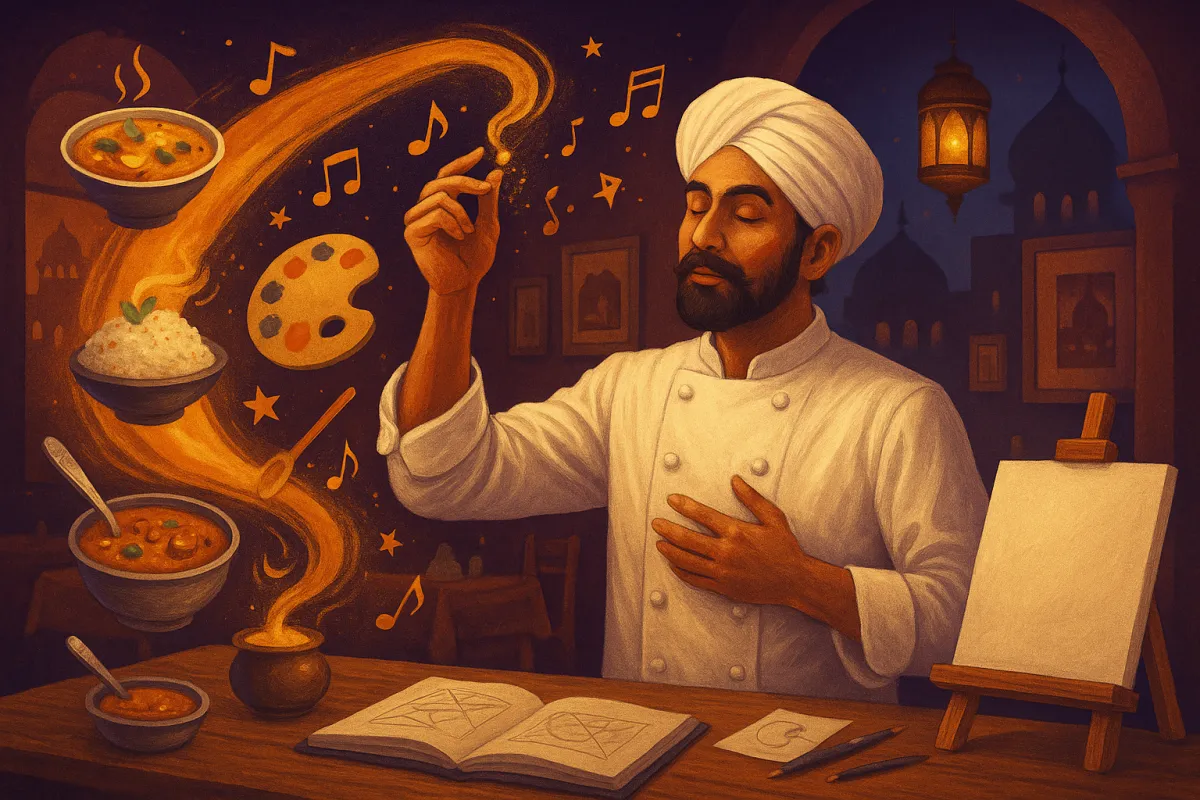
Why the Best Restaurants Are Built by Founders Who Think Like Artists, Not Operators
The best products in the world do not come from people chasing money. They come from founders who are obsessed with the product itself. The process. The craft. The act of imagining something, seeing it clearly in their mind, and then making it real with their hands.
For these founders, money is a byproduct. The real reward is the joy of creation. The satisfaction of taking raw ingredients, raw ideas, raw potential, and transforming them into something that did not exist before. Something that matters. Something that moves people.
Rick Rubin, the legendary music producer, talks about this as the creative act. He describes it as tuning in to something larger than yourself. Quieting the noise. Listening for what wants to be made. And then having the courage and skill to bring it into existence.
This is not just advice for musicians and artists. This is a framework for anyone building something meaningful. Including restaurant owners.
The Restaurant as Creative Endeavor
What if you stopped thinking about your restaurant as a business and started thinking about it as art?
Not art in the pretentious sense. Not art that requires explanation or justification. But art in the truest sense: the deliberate creation of an experience that moves people. That makes them feel something. That stays with them after they leave.
When you approach your restaurant this way, everything changes. The menu is no longer just a list of dishes. It is a composition. The dining room is not just a space with tables. It is a stage. The service is not just transactions. It is choreography.
This shift in perspective is what separates restaurants that are remembered from restaurants that are forgotten. It is what separates brands that grow from businesses that simply exist.
Rick Rubin's creative philosophy offers a framework for this. It involves tuning in to inspiration rather than forcing ideas. Moving from verbal decision-making, where you overthink and rationalize, to physical decision-making, where you trust your instincts and let your hands guide you. Embracing a continuous, non-linear process where the work unfolds naturally rather than being forced into a rigid plan.
For restaurant owners, this means finding ideas in the everyday. Noticing what excites you when you eat somewhere else. Paying attention to what your best customers respond to. Experimenting freely without fear of failure. Letting the restaurant evolve organically based on what feels right, not just what the numbers say.
It means cultivating your own unique taste. Your own perspective. Your own point of view about what food should be, what hospitality should feel like, what an evening at your restaurant should mean to someone. This taste becomes your compass. It guides every decision, from the spices in a dish to the music playing in the background to the words on your website.
This is how you build something that cannot be copied. Because it comes from you. From your specific combination of experiences, preferences, and vision. No one else can replicate it because no one else is you.
The Two Kinds of Restaurant Owners
Over the past five years, we have been on calls with more than a thousand restaurant owners. That is not an exaggeration. That is the actual number. And in those conversations, a clear pattern has emerged.
There are two kinds of restaurant owners.
The first kind is driven by something internal. They have passion that you can feel through the phone. They talk about their food the way parents talk about their children. They have ideas they cannot wait to try. They get excited about small details that most people would never notice. They are constantly thinking about how to make things better, different, more interesting. They see their restaurant not as a job but as an extension of who they are.
The second kind is going through the motions. They opened a restaurant because it seemed like a reasonable business. Or because their family expected it. Or because they saw someone else do it and figured they could too. They do what other restaurants do. They follow the same playbook. They look at what the place down the street is doing and copy it. When you ask them what makes their restaurant special, they struggle to answer. When you ask about their vision, they talk about paying the bills.
There is nothing morally wrong with being the second kind. Running any business is hard work, and there is dignity in that. But these are not the restaurant owners we work with.
We work with the first kind. The ones who are passionate. The ones who can innovate and are willing to do the hard work that innovation requires. The ones who have hunger inside them, not just for success but for the product itself, for the content, for the experience they are creating.
When we get on a call with the second kind of owner, the one who just wants to do what everyone else does, who just needs the basics, I immediately know this is not a fit. Not because I think less of them. But because our expertise, our system, our entire approach is built for something different.
If we just did digital marketing for restaurants, that would be boring. Anyone can run some ads and post on social media. That is not what we do. Every project we take on needs to have meaning. A mission. A founder who is willing to do whatever it takes to get where they want to go. Where the relationship is not about services delivered but about a systemized approach built on first principles of scaling and growing together.
We are partners, not vendors. And partnership requires both sides to be fully invested.
Why Brand Is Everything Now
Here is a truth that most restaurant owners have not fully accepted yet: brand is everything.
In 2024 and beyond, it is easier and more effective to build a brand around a person than to compete on traditional marketing channels. You can spend months optimizing your website for search engines. You can send thousands of WhatsApp messages. You can distribute fliers across the neighborhood. All of these things can work to some degree.
But nothing works like a strong brand built on content that features real people.
Everything is content today. Every interaction someone has with your restaurant, online or offline, is content. Every photo on Instagram. Every video on TikTok. Every review on Google. Every story a customer tells their friend. It is all content, and it all shapes how people perceive you.
People want to see other people. That is the fundamental insight that most restaurant owners miss. They post pictures of food, which is fine. They post announcements about specials, which is necessary. But they forget that humans are wired to connect with other humans. We want to see faces. We want to know the person behind the food. We want stories, personalities, something real.
This is why some restaurants blow up seemingly overnight while others struggle for years despite having better food. The ones that blow up understand content. They understand that people scroll through hundreds of posts every day, and the only thing that makes someone stop is something interesting. Something human. Something that creates a connection.
You can hire someone to be the face of your brand for a few hundred dollars a month. A charismatic person who represents your restaurant, creates content, engages with customers online. This sounds strange to traditional business owners, but it works. It works because people follow people, not logos.
Or you can become that face yourself. Step in front of the camera. Tell your story. Show behind the scenes. Let people into your world. This is uncomfortable for most restaurant owners, but it is incredibly powerful.
The more people see your restaurant, the more they talk about it. The more they talk about it, the more it spreads. And once you reach a critical mass of awareness, you have created something that cannot be bought: a brand that is remembered.
What Brand Actually Means
Let me be specific about what brand means because the word gets thrown around loosely.
Your brand is not your logo. It is not your color scheme. It is not your tagline or your mission statement hanging on the wall.
Your brand is how customers perceive your restaurant.
It is your personality. Your reputation. The total experience someone has when they interact with you, from the first time they see your Instagram to the moment they pay the check and walk out the door. It is how you make people feel.
This perception is built through everything you do. Your visual identity matters, yes. Your logo, your colors, your design choices. But it is also built through your voice. How you write your menu. How your staff greets people. How you respond to reviews. What you post on social media and how you say it.
Most importantly, your brand is built through customer experience. What happens when someone walks through your door? How do they feel while they are there? What do they remember afterward? What do they tell their friends?
Your brand communicates your personality. It tells people what kind of restaurant you are before they ever visit. It expresses your values, whether you articulate them explicitly or not. It conveys your goals: are you trying to be the best Indian restaurant in the city, or are you just trying to get by?
Strong brands attract customers who align with those values. They repel customers who do not. This is a feature, not a bug. You do not want everyone. You want your people. And a clear brand helps your people find you.
Seth Godin wrote about the Purple Cow. The idea that in a world full of ordinary brown cows, the only way to be noticed is to be remarkable. To be a purple cow that people cannot help but talk about.
Your brand is your purple cow. It is what makes you worth noticing, worth remembering, worth recommending. Without it, you are just another restaurant. With it, you are something people care about.
The Content Machine That Builds Brands
So how do you actually build a brand in practice?
You become a content machine.
This does not mean posting randomly whenever you remember. It means treating content as a core business function, as important as food quality or service. It means creating a consistent stream of material that shows who you are, what you do, and why anyone should care.
The content should feature people. Your chef. Your staff. Your regulars. Yourself if you are willing. People connect with faces and stories, not products and promotions.
The content should be interesting. This is obvious but often ignored. Before you post something, ask yourself: would this make someone stop scrolling? Would this make someone feel something? Would this be worth watching even if they had never heard of your restaurant? If the answer is no, do not post it.
The content should be consistent. Not just in frequency but in quality and voice. People should be able to recognize your content instantly. It should feel like it comes from a specific place, a specific perspective, a specific brand.
The content should tell a story over time. Each individual post matters less than the cumulative effect. Someone who follows you for three months should feel like they know your restaurant, even if they have never visited. They should feel connected to you. When they finally do come in, it should feel like visiting an old friend.
This is how brands are built today. Not through advertising. Not through promotions. Through consistent, interesting, human content that creates connection over time.
Why We Are Selective About Who We Work With
I want to be transparent about something. We turn down most of the restaurant owners who want to work with us.
This is not arrogance. It is alignment.
Our system works. We have proven it over five years with hundreds of restaurant owners. We know how to build brands, create content strategies, and scale restaurants that have something worth scaling.
But the system only works when the restaurant owner brings something to the table. Passion. Vision. Willingness to try new things. Commitment to the process even when it gets uncomfortable. Openness to being a real brand, not just another restaurant with a logo.
When a restaurant owner tells me they just want to do what everyone else does, that they just need basic marketing, I know our system is not for them. Not because basic marketing is bad, but because basic marketing is not what we do. There are plenty of agencies that can help with that.
We work with founders who think like artists. Who understand that their restaurant is a creative act. Who want to build something that matters, not just something that pays the bills.
If that sounds like you, we should talk.
If it does not, no hard feelings. But we are probably not the right fit.
What Working With Us Looks Like
For the restaurant owners who do fit, here is what partnership with us looks like.
We start with first principles. We do not ask what other restaurants are doing. We ask what your restaurant should be doing based on your specific vision, market, and strengths. We build from the ground up, not from templates.
We focus on brand before tactics. Before we talk about ads or posts or campaigns, we get clear on who you are and what you stand for. This clarity makes everything else easier and more effective.
We create systems, not one-off projects. Marketing that works once is not valuable. Marketing that works consistently, month after month, is how restaurants grow. We build machines that generate results predictably.
We treat content as king. Because it is. We help you become a content machine, whether that means creating it yourself, hiring someone to be your brand face, or some combination. We understand what makes content work and how to produce it consistently.
We measure what matters. Not vanity metrics that make you feel good but actual business results. Customers through the door. Revenue growth. Brand awareness. The things that actually build your restaurant.
We grow together. Our success is tied to your success. We do not win unless you win. That alignment is what makes the relationship work.
Take the Next Step
If you are a restaurant owner who sees yourself in this post, who resonates with the idea of treating your restaurant like art, who has passion and hunger for something beyond just paying the bills, then reach out.
We have one conversation. No pressure, no hard sell. Just a discussion about where you are, where you want to go, and whether we might be the right partners to help you get there.
The restaurant owners who work with us go on to build real brands. Restaurants that are remembered. Restaurants that grow. Restaurants that mean something.
That could be you. But only if you are willing to be more than just another restaurant doing what everyone else does.
Book your free consultation. Let us find out if there is a fit.
Frequently Asked Questions
What makes a restaurant owner a good fit for your services?
Passion and vision. We look for owners who genuinely care about their product, not just as a business but as a craft. Owners who have ideas, who want to innovate, who see their restaurant as something worth building into a real brand. If you are just looking to copy what the restaurant down the street is doing or just need basic marketing services, we are probably not the right fit. But if you have hunger for something more and are willing to put in the work to get there, we should talk.
Why do you focus specifically on Indian restaurants?
Specialization creates excellence. By focusing exclusively on Indian restaurants, we have developed deep understanding of this specific market, these specific customers, and these specific challenges. We know what works and what does not. We have seen patterns across hundreds of restaurants that a generalist agency would never notice. This specialization allows us to deliver better results, faster, with less wasted effort.
What do you mean by treating a restaurant like an artistic endeavor?
It means approaching every element of your restaurant with intention and creativity. Your menu is not just a list but a composition. Your space is not just a room but an experience. Your brand is not just a logo but a personality. When you think like an artist, you make decisions based on what feels right and what creates meaning, not just what everyone else is doing. This mindset produces restaurants that stand out because they cannot be copied.
How important is personal branding for restaurant owners?
It is increasingly critical. People connect with people, not businesses. When customers can see the face behind the food, hear the story, feel like they know the person running the restaurant, they form a connection that transcends the transaction. You can build personal brand yourself by being the face of your content, or you can hire someone charismatic to represent the brand. Either way, human presence in your content dramatically increases its effectiveness.
What does your process look like when working with a new restaurant?
We start with deep discovery. Understanding your vision, your market, your strengths, your challenges. From there we establish brand foundations, getting clear on who you are and what you stand for. Then we build systems for consistent content creation and marketing execution. Everything is measured and refined over time. It is not a one-time project but an ongoing partnership focused on continuous growth.
How long before we see results?
Early momentum typically builds within 30 to 60 days for restaurants that are fully engaged in the process. Real brand building and sustainable growth usually takes three to six months to materialize fully. Anyone promising overnight transformation is either lying or selling something that will not last. We focus on building systems that produce results month after month, not quick wins that disappear.
What if we have tried marketing before and it did not work?
Most failed marketing efforts share common problems: wrong strategy, insufficient time, or lack of brand foundation. When you try to market a restaurant that has no clear brand identity, no compelling story, no differentiation, even good tactics will underperform. Our approach starts with brand and builds marketing on top of that foundation. This dramatically increases the probability that marketing efforts will actually work.
Do you work with new restaurants or only established ones?
We work with both, but the requirements are the same. Passion, vision, and willingness to invest in building a real brand. New restaurants actually have some advantages because they can build brand from the beginning rather than trying to retrofit it later. What matters is not how long you have been open but what kind of restaurant owner you are.
