Paid Ads vs Organic: The Complete Guide to Getting Customers Through Your Restaurant Door
Let me tell you something that will change how you think about marketing your restaurant.
Paid ads are twenty times faster than organic posting.
Twenty times.
That is not an exaggeration. That is just how it works.
But here is the thing most people get wrong. They think it is one or the other. Paid ads or organic. Fast results or slow brand building.
It is both. You need both. And this guide will show you exactly how they work together.
The Problem With Most Restaurant Posts
Most images and videos that restaurants post are just bad.
I am sorry to say it so directly. But it is true.
The angles are not planned. The lighting is off. The food does not look appetizing. The whole thing feels like they do not really care.
And when customers see that you do not care about how you present yourself, they lose trust.
Think about it like this.
Imagine you are walking down a street looking for a place to eat. You see two restaurants. One has a beautiful sign, clean windows, and you can see happy people inside. The other has a faded sign, dirty windows, and looks empty.
Which one do you walk into?
Your social media is that window. Your posts are that sign. People are looking at you before they ever visit.
If your window is dirty, they keep walking.
Organic Is Brand. Paid Is Speed.
Let me explain the difference with a simple picture.
Organic posting is like planting a garden. You put seeds in the ground. You water them every day. You wait. Slowly, things grow. Eventually, you have vegetables and flowers. But it takes time. Months. Maybe years.
Paid ads are like going to the grocery store. You need tomatoes today? You go buy tomatoes today. You get what you need right now.
Both give you tomatoes. But one is fast and one is slow.
Here is where restaurants make mistakes.
Some only plant the garden. They post on social media for years. They never see real results because organic reach is so small. Only five to seven percent of your followers even see your posts. They give up and say social media does not work.
Some only go to the grocery store. They run paid ads. They get customers. But when they stop paying, the customers stop coming. They have no brand. No loyalty. No foundation.
The smart restaurants do both.
They plant the garden every single day. They build the brand. They create trust. They become known.
And they go to the grocery store when they need fast results. They run paid ads to fill seats tonight. To hit revenue goals this month. To grow faster than waiting would allow.
Organic builds the brand that keeps your restaurant solid like a heavy brick that does not move. Paid ads provide the growth that moves you forward.
You need the brick. And you need the movement.
Why Your Creative Matters Most
When people talk about paid ads, they focus on the wrong things.
They talk about targeting. They talk about ad cost. They talk about ROI. They talk about copy and headlines.
These things matter. But they are not the most important thing.
The most important thing is your creative. The image or video itself.
Think about it like fishing.
The targeting is choosing which lake to fish in. The ad cost is how much you pay to rent the boat. The copy is the words on your tackle box.
But the creative? The creative is the bait.
You can be at the perfect lake with the best boat and the fanciest tackle box. But if your bait is bad, you catch nothing.
The angle of your photo. The lighting. The way the food looks. The first three seconds of your video. This is what makes someone stop scrolling.
Everything else comes after.
Get the creative right first. Then worry about targeting and copy and cost.
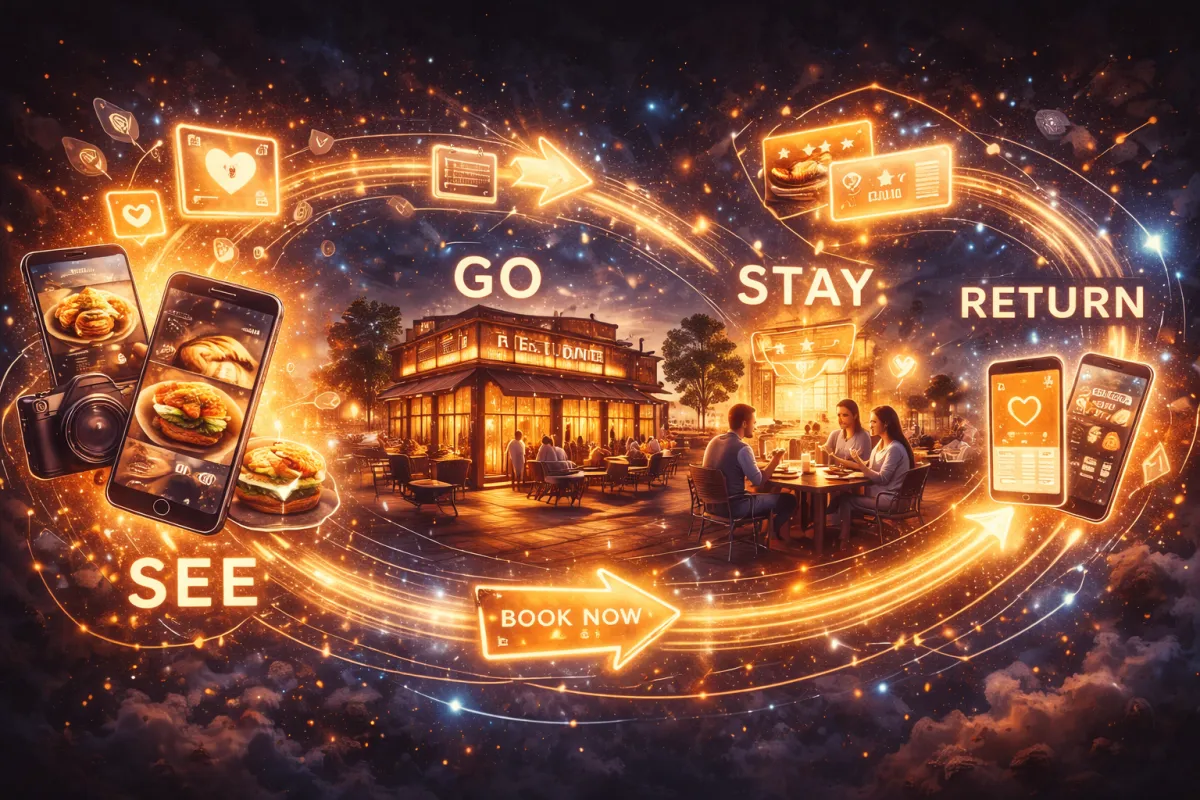
The Customer Journey: See, Go, Stay, Return
Let me give you a simple way to think about how customers find you and become loyal.
It is a loop with four parts.
See. Go. Stay. Return.
See is when they first notice you. They see an ad. They see a post. A friend tags your restaurant. They drive past your sign. Something catches their attention.
Go is when they decide to visit. They look at your menu. They read your reviews. They check your location. And they decide yes, I will go there. They walk through your door or book a table online.
Stay is the experience. They eat your food. They feel the atmosphere. They interact with your staff. They enjoy themselves. Or they do not.
Return is when they come back. Not because of a discount. Because they got value. Because the experience was worth repeating. Because you gave them something more than just food.
This is the loop you want customers in. See you. Visit you. Enjoy you. Come back to you.
Every part of your marketing should move people through this loop.
The Three Big Questions
Now let me connect this to three questions you must answer.
Why do they come?
This is the hook. The reason they pay attention in the first place.
Maybe it is a beautiful photo of your food. Maybe a friend recommended you. Maybe a post that said best Indian food in town. Maybe a special promotion.
This is like the first three seconds of a video. The headline that makes them stop scrolling. The thing that gets their attention.
Without a good answer to why, they never even know you exist.
What makes them visit?
This is the decision. The moment they convert from interested to customer.
Your menu looks good. Your reviews are strong. Your price feels fair. Your location is convenient. Everything checks out.
This is like clicking book now on a website. They have decided. They are coming.
Without a good answer to what, they stay interested but never show up.
How do you get them to come back?
This is retention. The reason they become loyal.
They liked the food. The staff were friendly. The atmosphere was enjoyable. The quality was consistent. They got value for money.
This is what makes customers become regulars. What makes them tell friends. What makes them choose you again and again.
Without a good answer to how, you are always chasing new customers instead of keeping the ones you have.
Conversion Is King
Let me explain what conversion really means.
Conversion is turning a visitor into a desired outcome. Usually a paying customer.
Every action a customer takes is a conversion moment.
They search for you. That is a conversion from not knowing to curious.
They look at your reviews. That is a conversion from curious to interested.
They check your menu. That is a conversion from interested to considering.
They book a table. That is a conversion from considering to committed.
They walk through the door. That is a conversion from online to physical.
They order food. That is a conversion from visitor to customer.
They come back again. That is a conversion from customer to loyal.
Each step is a conversion. Each step is a moment where they could leave or continue.
Your job is to make each step easy. To remove friction. To give them reasons to keep going.
Conversion is king because without it, nothing else matters. You can have a million people see your ad. If none of them convert, you have zero customers.
The Framework That Makes It Simple
Now let me give you a framework you can use for any marketing you do.
It has five parts.
T = Total Addressable Market
This is who could become your customer.
Not everyone. The specific people who might want what you offer.
For a restaurant, this might be people who live within five miles. Tourists visiting your area. Workers looking for lunch. Couples looking for date night. Families on weekends.
Each group is different. They want different things. They respond to different messages.
The bigger and more specific you can define these groups, the better you can target them.
A = Angles (Hooks)
This is the story you tell that makes someone care.
It is not about your product. It is about why they should pay attention.
Different groups need different angles.
For the lunch crowd: Quick lunch in fifteen minutes.
For couples: Best romantic spot in town.
For families: Kid-friendly with a great kids menu.
For tourists: Top-rated local food with 4.8 stars on Google.
Same restaurant. Different angles for different people.
The hook is the first impression. The headline. The first three seconds of the video. The image that makes them stop scrolling.
Good hooks answer one question: What is in it for me?
M = Media
This is where you deliver your message.
Instagram. TikTok. Facebook. Google. Yelp. Your website. Email. Word of mouth. Influencers. Flyers. Signs.
Media is the vehicle. The hook is what is inside the vehicle.
Different audiences live on different media. Meet them where they are.
Retention
Once you have their attention, you must keep it.
In an ad, this means the video keeps them watching past three seconds. The image tells a story.
In real life, this means the menu is clear. The staff are friendly. The food is good. The experience delivers on the promise.
Retention is why they do not back out once they are interested.
CTA = Call to Action
This is the ask. What you want them to do next.
Book a table. Order online. Claim this offer. Join our loyalty program.
Good CTAs are clear, simple, and actionable.
The CTA must match where they are in the journey.
If they are seeing an ad: Book a table.
If they are on your website: Order online.
If they are returning visitors: Join rewards.
How It All Fits Together
Here is the full flow.
Find your audience (TAM). Craft hooks that get their attention (Angles). Deliver it where they are (Media). Keep them interested (Retention). Ask them to act (CTA). Give them a great experience. Encourage them to return.
TAM → Hook → Media → Retention → CTA → Action → Experience → Return
Each piece connects to the next. Each piece can be tested and improved.
When someone says ads do not work, they are usually failing at one specific part.
Maybe their hook is weak. Maybe their creative is bad. Maybe their CTA is unclear. Maybe the experience does not match the promise.
This framework lets you find the broken piece and fix it.
A Real Example
Let me walk through a restaurant example.
TAM Breakdown:
Local lunch workers. Dinner couples. Weekend brunch seekers. Tourists. Families.
Hooks For Each:
Lunch workers: Employee specials every weekday. Quick service guaranteed.
Dinner couples: Most romantic dinner spot in the neighborhood.
Brunch seekers: Bottomless mimosas every Sunday.
Tourists: Highest-rated local restaurant on Google.
Families: Kids eat free on Tuesdays.
Media:
Instagram Reels for the visual food content. Facebook ads for local targeting. Google for people searching for restaurants near me. TikTok for younger audiences. Email for returning customers.
Retention:
Beautiful food photography that makes them hungry. Videos showing happy customers. Behind-the-scenes of the kitchen. Testimonials and reviews.
CTAs:
Book your table now. Order online for pickup. Reserve your brunch spot. Join our rewards program.
Experience:
Friendly service. Delicious food. Clean environment. Consistent quality. Value for money.
Return:
Loyalty rewards. Birthday offers. New menu items. Seasonal specials. Email reminders.
Each piece works together. Each piece can be measured and improved.
The One-Line Summary
Here is everything in one line.
Success equals the right audience times a compelling hook times strong retention times a clear CTA times effective media.
Right Audience × Compelling Hook × Strong Retention × Clear CTA × Effective Media = Success
If any piece is zero, the whole thing is zero.
If every piece is strong, results multiply.
Stop Looking Down. Start Looking Up.
One more thing before we finish.
Stop looking at the restaurant down the street. Stop looking at competitors who are below you.
Always look at those who are above you.
The restaurants doing better than you. The ones with lines out the door. The ones with five-star reviews. The ones growing while others struggle.
You want what they have. But you are not doing what they do.
They are running paid ads with great creative. They are posting organic content that builds brand. They are optimizing every step of the customer journey. They are treating marketing like the serious business function it is.
If you want their results, you have to do their work.
Put your money where your mouth is. Invest in marketing that works. Build the brand that lasts. Run the ads that drive revenue.
Both. Not one or the other. Both.
Join the Restaurant Growth Challenge
This framework is exactly what we use with our clients.
We help restaurants identify their TAM. Craft hooks that actually work. Create creative that stops the scroll. Run paid ads that drive real bookings. Build organic presence that strengthens brand.
The Restaurant Growth Challenge shows you what this looks like for your specific restaurant.
We get on a call. We look at where you are now. We map out the next thirty days with specific strategy and actions.
If you want to move twenty times faster than organic alone, let us talk.
https://www.anthconsulting.com/restaurant-growth-challenge#calendar-652ZsXHqbhZk
Your competitors are not waiting. Neither should you.
Frequently Asked Questions
Why are paid ads twenty times faster than organic?
Organic posts reach only five to seven percent of your followers. Paid ads reach exactly who you target, as many as you pay for. You can get in front of thousands of potential customers today instead of waiting months or years for organic growth to compound.
Should I stop organic posting if paid ads are faster?
No. You need both. Organic builds your brand, creates trust, and keeps your restaurant solid. Paid ads drive fast results and revenue. Organic is the foundation. Paid is the acceleration. Without organic, paid results disappear when you stop paying.
Why is creative more important than targeting in paid ads?
Targeting is choosing which lake to fish in. Creative is the bait. You can be at the perfect lake, but with bad bait you catch nothing. The image or video is what makes someone stop scrolling. Everything else comes after they pay attention.
What is the See, Go, Stay, Return loop?
See is when they notice you. Go is when they decide to visit. Stay is the experience when they are there. Return is when they come back because of value. Every piece of your marketing should move customers through this loop toward loyalty.
What does TAM mean and why does it matter?
TAM is Total Addressable Market—the specific people who could become customers. Different groups want different things. Lunch workers want speed. Couples want romance. Families want kid-friendly. When you know your TAM segments, you can create hooks that speak directly to each.
What makes a good hook?
A good hook answers one question: What is in it for me? It gets attention in the first three seconds. It gives a reason to stop scrolling. It speaks to a specific desire or problem. It is not about your restaurant—it is about what the customer gets.
What is a CTA and why is it important?
CTA is Call to Action—the ask. Book a table. Order online. Join rewards. Without a clear CTA, people stay interested but never act. The CTA must be simple, clear, and match where the customer is in their journey.
How do I know which part of my marketing is broken?
Use the framework. Is your TAM defined clearly? Are your hooks compelling? Is your creative high quality? Is your retention strong? Is your CTA clear? Check each piece. Find the weak one. Fix it. Then check the next.
