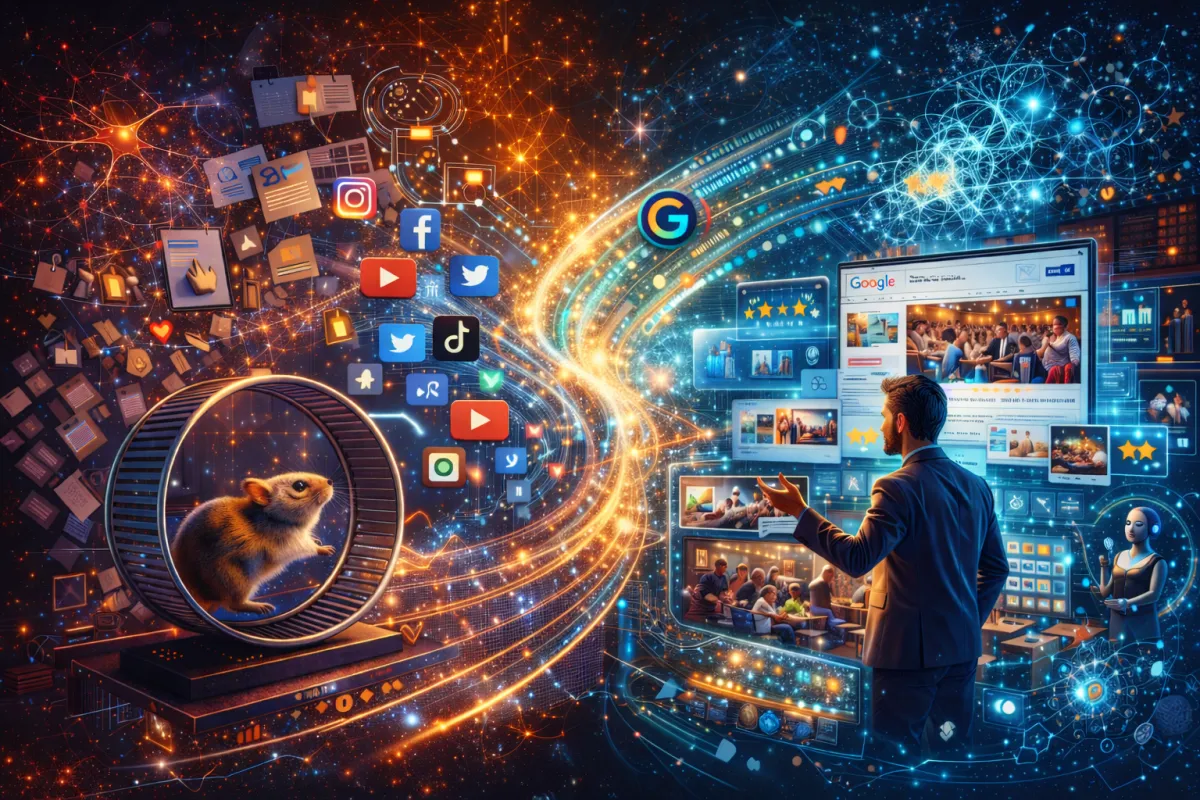
If Your Restaurant's Online Presence Does Not Look Like This, You Are Stuck on a Hamster Wheel
Picture two restaurants.
One has mastered the online game. Their content flows. Their reviews compound. Their brand grows. Customers discover them, evaluate them, choose them, experience them, and tell others. The cycle feeds itself. Growth becomes automatic.
The other restaurant? They are running on a hamster wheel.
Posting randomly. Hoping for customers. Wondering if anyone will come back. Spinning and spinning but never actually moving forward.
Which one are you?
The Messy Middle: How Customers Actually Decide
Google spent years researching how people make purchasing decisions. What they found changed everything we thought we knew about marketing.
They call it the Messy Middle.
Here is how it works.
Exposure happens constantly. Your brand exists in the world—on social media, on Google, in conversations. People see you even when they are not actively looking.
Then a Trigger happens. Someone gets hungry. Someone plans a date night. Someone craves Indian food. Someone sees a post that makes them think of your restaurant.
Now they enter the messy middle.
They Explore. They search Google. They scroll Instagram. They ask friends. They look at options.
Then they Evaluate. They read reviews. They check menus. They look at photos. They compare you to competitors.
But here is the key insight: they do not do this once.
They loop between Exploration and Evaluation multiple times. Back and forth. Discovering options, comparing them, discovering more, comparing again.
This loop continues until something tips them toward a decision.
Then Purchase happens. They book a table. They order online. They walk in.
After that comes Experience—the actual meal, the service, the atmosphere. And that experience feeds back into Exposure, starting the cycle again for the next customer.
Where Most Indian Restaurants Lose
Most restaurants lose customers in the messy middle.
They are invisible during Exploration. When someone searches for Indian restaurants, they do not show up. When someone scrolls Instagram, their content is not there. When someone asks friends, nobody mentions them.
Or they fail Evaluation. The reviews are inconsistent. The photos look amateur. The website looks like 2012. The competitor down the street looks more professional—even if their food is worse.
The messy middle is where the battle is won or lost.
And most Indian restaurant owners do not even know this battle exists.
The Hamster Wheel of Guessing
Is it not frustrating?
Not knowing when the next customers will come. Not knowing if your current customers will return. Posting content and wondering if anyone sees it. Running promotions and hoping they work.
This is the hamster wheel.
You are working hard. You are putting in effort. But you are not actually moving forward.
The wheel keeps spinning. You keep running. But you end up in the same place.
This is what happens when you do not have a system. When you are guessing instead of knowing. When you are hoping instead of building.
Why People Trust People More Than Brands
Let me ask you a question.
What color is the "G" in the Google logo?
Google is probably the platform you see most days. You use it constantly. It is one of the most recognized brands on Earth.
Is the G red or blue?
You probably did not get that right away.
The answer is blue. But you had to think about it.
Now let me ask you another question.
Can you picture your favorite chef's face? Your favorite restaurant owner who greets you at the door? The server who remembers your name?
You can picture them instantly.
This is the difference between business brands and people.
People remember people. People trust people. People connect with people.
We are not built to trust logos and colors and corporate messaging. We are built to trust faces and voices and personalities.
This is why personal brands get 20 times more engagement than business brands. This is why companies pay influencers and celebrities millions—more than they spend on their own ads. This is why showing the real people behind your restaurant matters more than any professional food photography.
When those people show up consistently, we build a connection with them. We feel like we know them. We trust them.
And when we trust someone, we buy from them.
How Customers Actually Come to You
Customers do not come to you because they saw your ad one time.
They come because they saw you consistently—to the point where you became oversubscribed in their mind. Where visiting your restaurant became inevitable. Where they had to experience it for themselves.
This is not about how much you post.
This is about showing up consistently until you become familiar.
There is no market. There are only individuals. Each person has their own story, their own triggers, their own decision-making process.
Do not treat people like markets. Treat people like individuals. Connect with them as humans.
The Five Ways to Get Noticed
If you want to get noticed—truly noticed—there are only five ways to do it.
1. Scary
Content that shocks. That creates fear. That makes people pay attention because the stakes feel real. For restaurants, this might be exposing industry secrets, revealing what competitors do wrong, or showing the truth about food quality.
2. Strange
Content that is unusual. Unexpected. Different from everything else in the feed. When everything looks the same, strange stands out.
3. Sexy
Content that is visually stunning. That creates desire. That makes people want what you have. For restaurants, this is beautiful food, beautiful spaces, beautiful moments.
4. Free Value
Content that teaches. That helps. That gives before asking for anything in return. Recipes, tips, behind-the-scenes knowledge—value that builds trust.
5. Familiar
Content that keeps showing up. Again and again. Until you become the obvious choice because you are the one they know.
Most restaurants try to compete on sexy alone—beautiful food photos. But beautiful food photos are everywhere. They are not enough anymore.
The restaurants that win combine multiple elements. They show up consistently (familiar) while providing value (free value) in a way that is visually compelling (sexy) and different from everyone else (strange).
Our Approach for 2026
Here is what we are doing for Indian restaurant owners this year.
We have built a community of over 1,000 Indian restaurants. We have five-plus years of experience. We have a team that has cracked the code of building restaurant online presence the proper way.
No more guessing where customers will come from. No more wondering if they will return. More productivity. More growth. A system instead of a hamster wheel.
This is the path we take restaurant owners through:
1. Discovering
You find us. Through content, through search, through referral. You realize there might be a better way.
2. Warming Up
You engage with our content. You see our approach. You start to understand why we think differently about restaurant marketing.
3. Watch the VSL
You watch our video that explains everything. How the system works. What makes it different. What results look like.
4. Take the Assessment
You evaluate whether this is right for you. We evaluate whether you are right for us. Not everyone is a fit—and that is okay.
5. Get the Free Workbook
You get real value before any money changes hands. A complete content strategy system you can use yourself.
By this point, you are one of our people. You understand the approach. You have seen the value. You know whether we should work together.
Who This Is Actually For
Here is something most marketers will not tell you.
People judge value based on their situation, not yours.
Some people throw time at their problems. Some people throw money at their problems to save time. Different people see value differently.
The question is: who has the most to gain from what we do?
There are three distinct market zones:
Luxury Market: They buy based on pedigree. Status. Prestige. The most expensive option because expensive signals quality.
Affluent Niche: They buy based on passion. Community. Experience. Fun. They want to be part of something they believe in.
Mass Market: They buy based on price. The cheapest option that meets minimum requirements.
We are built for the Affluent Niche.
Indian restaurant owners with passion. Owners who see that we are passionate about Indian culture, food, the restaurant business. Owners who value community, experience, and the joy of building something great together.
If you are looking for the cheapest option, we are not it. If you are looking for partners who care as much about your success as you do, we should talk.
90% of Your Value Depends on Who Is Looking
Here is a truth that changes everything.
90% of your value depends on who is looking.
The same restaurant, the same food, the same experience—can be worth nothing to one person and everything to another.
Being in front of the right person matters more than anything else.
People search for "best" way more than they search for "cheap." They want the best in their eyes. For their situation. For their desires.
One customer who truly gets the value is worth more than a hundred customers who do not.
Clone your best partnerships. Build community around people like that. Create experiences and exclusivity for the customers who appreciate what you do.
Stop trying to appeal to everyone. Start becoming irreplaceable to someone.
The Gap Between Reality and Desire
Here is the psychology that drives every purchase.
People have a Current Reality—where they are now. Empty tables. Inconsistent customers. Struggling to grow. Running on the hamster wheel.
People have a Desired Reality—where they want to be. Full tables. Loyal customers. Growing brand. A system that works.
The obstacle between those two realities creates tension.
No tension, no sales.
The restaurants that grow are the ones that help customers see the gap. Between where they are and where they could be. Between the hamster wheel and the growth engine.
The magic question is: what have you tried that has not worked?
When someone answers that question, they connect with their current reality. They feel the frustration. They acknowledge the gap.
Then you show them the path.
And they always buy the path of least resistance.
Problem-Aware vs Solution-Aware
One more insight that most marketers miss.
There are two types of potential customers:
Solution-Aware: They know what they want. They have a budget. They are shopping for the best option.
Problem-Aware: They feel the frustration. They know something is wrong. But they have not figured out the solution yet.
Most marketers chase solution-aware customers. These people are actively looking to buy.
But problem-aware customers are actually better.
Why? Because solution-aware people are fixed in their mindset. They think they know what they need. They are comparing you to their predetermined criteria.
Problem-aware people are open. They are frustrated. They know something needs to change but they do not know what. When you show them the answer—when you connect their frustration to your solution—you become their guide.
That is what we do for Indian restaurant owners.
We find the ones who are frustrated. Who know the hamster wheel is not working. Who feel the gap between where they are and where they want to be.
And we show them the path forward.
The Invitation
If you are running on the hamster wheel—posting without purpose, guessing where customers will come from, wondering if they will ever return—there is a better way.
We have built a system. Tested it with 44-plus Indian restaurants. Refined it over six years. Given the framework to over 1,000 restaurants.
It works.
No more guessing. No more hoping. A system that gets customers through the door, keeps them coming back, and builds a brand that compounds over time.
The first 30 days are free. We prove it works before you pay anything.
Grab a coffee and have a conversation with us.
https://www.anthconsulting.com/restaurant-growth-challenge#calendar-652ZsXHqbhZk
The hamster wheel is optional.
Growth is waiting.
Frequently Asked Questions
What is the Messy Middle and why does it matter for my restaurant?
The Messy Middle is Google's research-backed framework for how customers make decisions. People do not see your restaurant once and decide to visit. They loop between exploring options and evaluating them multiple times before choosing. Your online presence needs to win during both phases—being discoverable during exploration and impressive during evaluation.
Why do you say people trust people more than brands?
Research shows personal brands get 20 times more engagement than business brands. We are hardwired to connect with faces, voices, and personalities—not logos. This is why showing the real people behind your restaurant matters more than polished corporate content. When customers see you, your chef, your team consistently, they build trust and connection.
What are the five ways to get noticed?
Scary (content that shocks or creates stakes), Strange (unusual content that stands out), Sexy (visually stunning content that creates desire), Free Value (content that teaches and helps), and Familiar (consistent presence that builds recognition). The best restaurant content combines multiple elements rather than relying on beautiful food photos alone.
What is the difference between the hamster wheel and a real system?
The hamster wheel is posting randomly, hoping for customers, and guessing if marketing works. A real system is intentional—you know how customers discover you, what makes them choose you, how to keep them coming back, and how to measure results. With a system, effort compounds. On the hamster wheel, you just get tired.
What do you mean by Affluent Niche marketing?
There are three market zones: Luxury (buys on prestige), Affluent Niche (buys on passion, community, experience), and Mass Market (buys on price). We focus on Affluent Niche—Indian restaurant owners who are passionate about their craft and value partnership over cheap solutions. These clients get the most value from what we do.
Why is problem-aware better than solution-aware?
Solution-aware customers think they know what they need. They are comparing you to predetermined criteria. Problem-aware customers know something is wrong but are open to guidance. When you help them understand their problem and show the path forward, you become their trusted guide rather than just another vendor competing on features.
How do you help restaurants escape the hamster wheel?
We take you through five stages: Discovering (finding us and realizing there is a better way), Warming Up (engaging with our approach), Watching the VSL (understanding the full system), Taking Assessment (evaluating fit), and Getting the Free Workbook (receiving real value upfront). By then, you understand whether we should work together.
What if I have tried other marketing approaches that did not work?
That frustration is actually valuable. When you have tried things that failed, you understand the gap between where you are and where you want to be. That awareness makes you a better partner because you know random tactics do not work. You are ready for a system.
