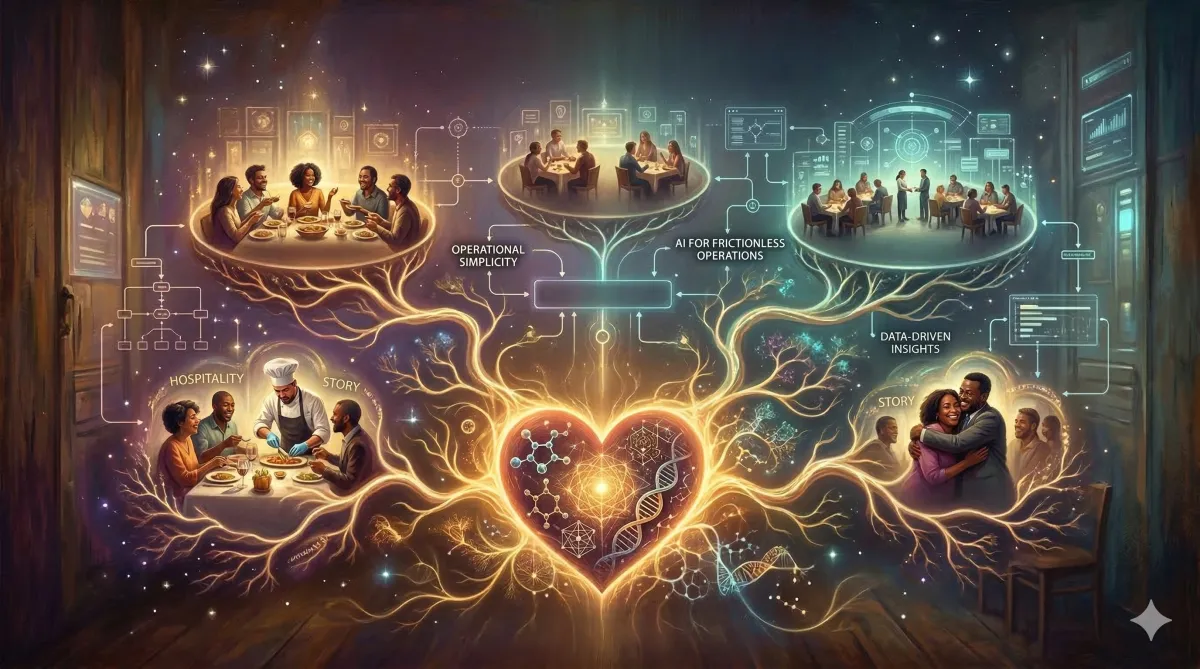
Without Heart, There Is No Scale: Why the Best Restaurants Are Built from the Inside Out
Let me tell you something I have learned after six years in this industry and over a thousand conversations with restaurant owners, managers, CEOs, and CMOs across every format and cuisine you can imagine.
Without heart, there is no scale.
This is not a motivational quote. It is a fundamental operating principle. Without authentic stories, without the ability to enrich lives through your food and your restaurants, organic growth becomes nearly impossible. You end up relying entirely on spending money to acquire customers rather than earning them through something real.
And that is a losing game.
This Is a People Business. An Emotional Business.
There is soul in every layer of a restaurant. The team — your chefs, servers, managers. The customers who walk through your doors hoping for something more than a meal. The place itself — how it looks, how it makes you feel, the story it tells the moment someone steps inside. The product — the food, the service, the hospitality.
Your customer's experience is only ever as good as what you put into it.
I have watched restaurants pour thousands into marketing campaigns while their kitchens lacked consistency, their staff lacked direction, and their spaces lacked warmth. The campaigns brought people in. The experience pushed them away. No amount of advertising can fix a broken foundation.
Finding What Makes You Unique
Every restaurant owner I have met started this journey for a deeply personal reason. A love for food, for cooking, for feeding people, for creating spaces where strangers become friends. That reason — that story — is your most powerful asset, and most owners underestimate it.
Yes, market research matters. Understanding your customers, your demographics, what people in your area are ordering — all of that is important for establishing a restaurant. But the story and uniqueness that set you apart? That comes from inside. It is a gap in the market that only you, your skills, and your team can fill.
Bring your personal story forward. Your childhood. Your bloodline. How you connect with people on a deeper level. How you nourish and develop your staff. Every single detail matters in building a restaurant that is not just surviving but truly successful, profitable, and scalable.
There Are No Shortcuts. Only Mastery.
There is no single hack that gets you there. The fundamental truth is that it takes time, patience, and relentless hard work. Whatever purpose or passion is keeping you going — that is what you rely on. There is no Plan B. You focus on this one thing until you are the best at it. Total mastery.
Most restaurants are not patient enough for this. That is why they stay average.
Look at brands like Mowgli, Dishoom, or Curry Up Now. They might seem untouchable now, impossibly successful. But every single one of them started exactly where you are right now. Some of them started in even harder positions. Yes, debt is there. Rent is there. Cost is there. But that is the business part, and you already know it.
Your job is to transform the business into a restaurant — one where the leader's attentiveness to detail in every aspect is the defining edge. Structure. Cleanliness. Reporting. Team happiness. Storytelling. Standing by that story. Being authentic. Staying updated on what is happening in the world and in your location. Being where your customers are.
The Power of a Personal Brand
Building a restaurant brand is one thing, and it is the core fundamental for scaling. But the owners who have a real edge are the ones who build it alongside a personal brand. You — the owner — telling your story continuously. Your chef's story. Your recipes. Being engaged with the world through your story, your creation, your uniqueness.
This gives you an advantage whether you are running a single location or twenty. People have more ways to connect with you and your restaurant on a deeper level when they know the human behind it.
The Four Pillars That Must Come Before Marketing
After walking and talking with over a thousand restaurant professionals, the fundamental truth I have learned is this: no amount of marketing can help if you do not have these pillars in place first.
Product — Without a great product, marketing just tells more people about something mediocre.
People — Without great people, the customer experience will always fall short.
Place — Without a great space — the ambiance, the feeling, the connection — the emotional hook is lost.
Financials — Without healthy cash flow, there is no room for profit, investment, growth, or excellence.
Only when a restaurant delivers on these pillars consistently does it have the foundation to invest in marketing, advertising, growth, scale, and innovation. At Anth Consulting, we have never taken a client without evaluating these pillars first, because each one matters. Without all four, growth strategies collapse under their own weight.
The 85/15 Rule: Where Most Owners Get Trapped
Here is a pattern I see repeated across the industry. 85% of running a restaurant is managing brutal, repetitive mechanics. Razor-thin margins. Supply chain chaos. Tracking data. Staff attrition. Inventory management. Review responses. Scheduling. Compliance. Maintenance.
Only 15% is the actual magic — the food, the aesthetics, the hospitality, the human connection that makes people come back.
Most restaurant owners spend their entire day drowning in the 85% and have almost no time left for the 15% that actually creates memorable experiences. They are not even creative anymore, because they are caught up in the daily grind that demands every ounce of their energy.
When they have more time in their hands and more profit, there is more space to think, reflect, and innovate. I have heard this from restaurant owners and tech CEOs alike.
Why We Are Building the Restaurant OS
AI is here, and there is no question about that. But here is what I know for certain: AI will not take over the restaurant industry. This industry was built by humans, for humans, and it will always need human connection at its core.
What AI can do is take the weight off your shoulders.
Our goal with Restaurant OS is to decrease fixed costs, increase profit margins, and build your brand — all at once. When we make a restaurant more productive, the output gets better. When it is better, we can layer our software on top of real data to make it even more productive. A compounding cycle.
We are building a fundamental tool that solves the complex, daily problems that weigh on every single person in a restaurant. Because right now, restaurants are spending enormous amounts of money on a dozen different tools that do not talk to each other. There are ways to consolidate that — everything in one place, powered by AI, and you only pay for outcomes. Nothing else.
The Four Pillars of Restaurant OS
After studying the essential functions a restaurant needs to survive and thrive, we built Restaurant OS around four integrated pillars — not fragmented modules, but interconnected systems that create compounding effects.
Pillar 1: The Margin Defense System
This is the financial heartbeat. Real-time cost tracking that deducts exact ingredient quantities when an item sells. Anti-pilferage detection that flags anomalies instantly. Waste tracking that logs every discarded item with a reason, so patterns emerge and problems get fixed. Aggregator profit-leak analysis that shows you exactly how much delivery platforms are costing you.
An owner who sees this system save them thousands per month in hidden waste will never cancel. They cannot unsee the savings.
Pillar 2: The People Engine
This prevents the operational collapse that happens when key staff leave unexpectedly. Bench strength tracking ensures you always have trained backup ready. Contentment diagnostics surface problems before they become resignations. Performance data shows which servers earn the highest tips, which chefs produce the lowest waste, and which shifts generate the most complaints.
A system that reduces turnover by even 20% pays for itself many times over.
Pillar 3: The Customer Experience Engine
This turns customers into regulars and regulars into evangelists. AI monitors every mention of your restaurant online. Reviews below a threshold trigger instant alerts with incident reports tracing back to specific shifts and causes. The system detects recurring friction — tables waiting too long, orders delayed, specific menu items causing complaints — and helps you fix them systematically.
When a friction moment is detected, the system can pre-authorise a budget for your server to offer a complimentary item. Turn frustration into delight. Engineer word of mouth.
Pillar 4: The Operations Guardian
This ensures flawless daily execution without micromanagement. Pre-shift checklists verify everything before doors open. Environmental audits catch the silent irritants — wobbly tables, burned-out lights, scuffed paint — that ruin otherwise perfect meals. Standards become active workflows, not documents collecting dust in a binder. Real-time alerts ensure the right person knows immediately when something goes wrong.
An owner who can trust that standards are maintained without hovering over every detail gets their life back.
One OS. One Truth.
The four pillars are not separate modules. They are integrated. When the Customer Experience Engine detects a pattern of complaints about a specific dish, it feeds into the Margin Defense System to check if ingredients changed. When the People Engine identifies a high-performing server, it feeds into the Customer Experience Engine to prioritise their VIP tables.
Every morning, the restaurant owner opens one dashboard. Not seven. Not twelve. One.
That dashboard shows what happened, what the system caught, what got fixed automatically, and what needs a human decision. The owner's job shifts from managing mechanics to making decisions. The OS handles the 85%. The owner focuses on the 15%.
What Daily Life Looks Like With Restaurant OS
6:00 AM — You wake up. Open one app. Yesterday's revenue, margin performance, overnight reviews, today's staffing status. Two items need attention: a negative review that came in late last night, already flagged with an incident report, and a check-in scheduled with a key team member.
8:00 AM — Your opening manager completes the pre-shift checklist on their phone. Everything verified. Standards protected.
11:00 AM — Lunch service. Sales tracked in real time, inventory adjusted automatically. A server gets a prompt to check on a slow table. A customer waiting too long receives a complimentary coffee, pre-approved by the system.
2:00 PM — You check in briefly. An ingredient running low has already triggered a reorder alert. A VIP who has not visited in three weeks just made a reservation — flagged for special treatment.
6:00 PM — Dinner service. You are on the floor, talking to customers, tasting dishes, being present. Not in the back office crunching numbers.
10:00 PM — Service ends. A daily summary generates in minutes. Revenue, costs, margin, satisfaction score, staff performance, issues flagged. You review it in five minutes and go home.
This is the 15% life. The mechanics run themselves. You focus on the magic.
Get First-Hand Access to Restaurant OS
We are building this now. The four pillars are being developed. The first restaurants are being onboarded. This is not available to everyone yet — we are starting with a small group of restaurant owners who understand the vision and want to be part of shaping something that changes the industry.
If that sounds like you, reach out directly:
Tell me about your restaurant. Tell me what is breaking. Tell me what you wish existed. I read every message. I respond personally.
Because this is not just software. This is the operating system restaurants cannot live without. And we are building it for the owners who are ready to stop drowning in mechanics and start focusing on the magic.
Frequently Asked Questions
What is the 85/15 Rule? 85% of running a restaurant is managing repetitive mechanics — margins, inventory, staffing, operations. Only 15% is the magic: food, hospitality, experience. Most owners are trapped in the 85%. Restaurant OS handles the mechanics so you can focus on the magic.
Why four integrated pillars instead of separate tools? Separate tools create fragmentation and make you the integration layer. Four integrated pillars create compounding effects — when your financial system talks to your customer system, which talks to your people system, insights emerge that isolated tools simply cannot provide.
How is this different from my current POS or inventory system? Restaurant OS does not replace your existing tools. It connects them, makes sense of the data, and creates actionable intelligence. Think of it as the brain that coordinates all the organs.
What does "pitchfork loyalty" mean? It means building software so essential that if someone tried to take it away, you would show up with pitchforks. That is the bar — software you genuinely cannot live without.
How do I know if my restaurant is ready? If you are drowning in mechanics — spending hours on dashboards, chasing data, fighting fires — you are ready. If you want to spend your time on hospitality instead of spreadsheets, you are ready.
How do I get first-hand access? Email [email protected] with details about your restaurant, your biggest challenges, and what you wish existed. We are onboarding a small initial group and responding to every inquiry personally.
