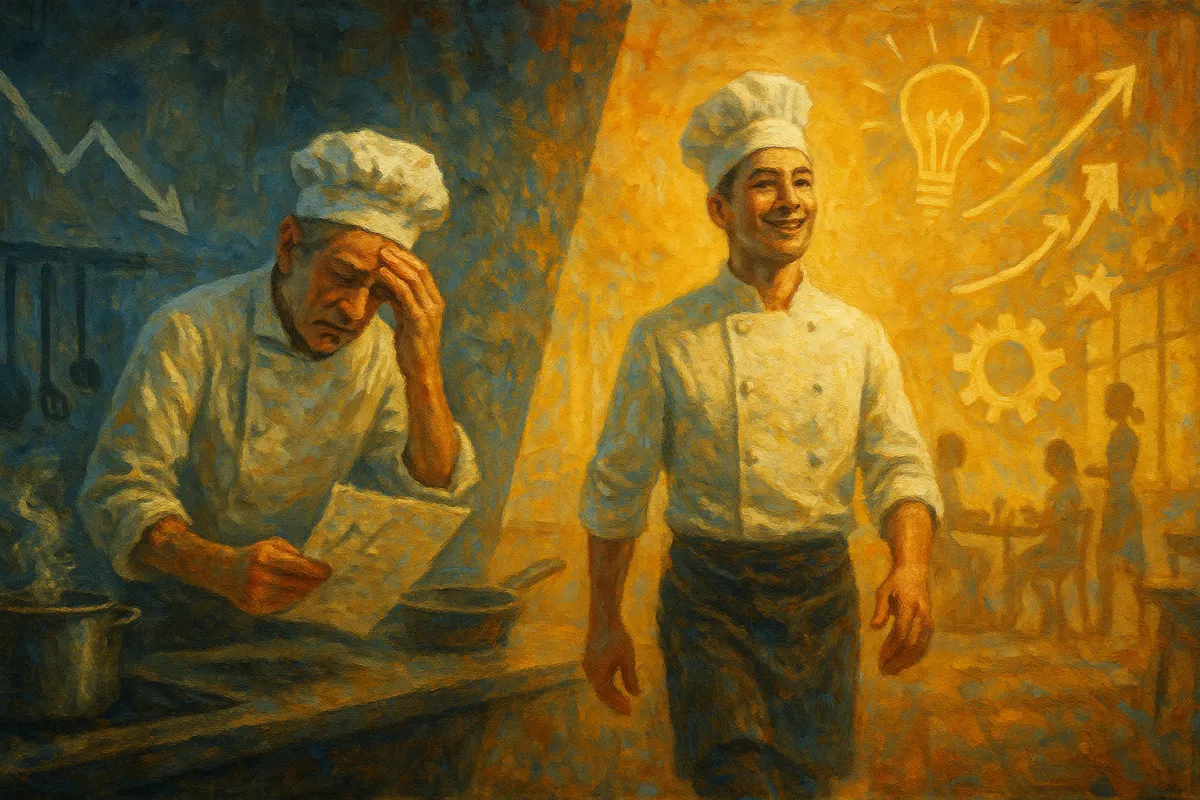
How Restaurant Owners Thrive Under Pressure and Why Your Growth Needs Patience - But Consistency
Entrepreneurship is not for the faint of heart. If you like pressure, if you can stand straight when everything around you is bending, if you can remain reasonable when chaos is screaming in your face, then you might have what it takes. These are not optional traits. These are baseline requirements.
Because here is the truth about running a business, especially a restaurant: it is chaos. It slips out of your hands regularly. It forces you to confront how unstructured everything really is. And your job, day after day, is to take that chaos and turn it into the greatest structure there is.
You can always look at your business through your own eyes, standing right in front of it, seeing what you have always seen. But the real skill is learning to step outside. To gain another perspective. To reason from first principles instead of assumptions. To ask not just "how have we always done this?" but "what is actually true, and what should we do about it?"
This is especially tough for restaurant owners. Your decisions are not made over days or weeks. They are made in seconds. Minutes. Maybe hours if you are lucky. Unless it is something massive, something that will fundamentally change the business, you do not have the luxury of extended deliberation. You decide, you act, you live with the consequences.
And your ability to reason on the spot, to think outside the box when you are standing in the middle of a dinner rush with three problems happening simultaneously, has enormous leverage. It affects how your team performs. It shapes your customers' experience. It determines whether your restaurant grows or stagnates.
This is the game you signed up for. Let us talk about how to play it well.
Eating Glass and Staring Into the Abyss
Elon Musk once said that entrepreneurship is like eating glass and staring into the abyss. If that sounds dramatic, you have probably never run a restaurant. Because for those who have, that description feels almost understated.
There are days when everything goes wrong. The supplier delivers the wrong order. Your best cook calls in sick. A review goes viral for the wrong reasons. The rent is due and the numbers are not adding up. You stare at the ceiling at 3 AM wondering if you made a terrible mistake.
Yes, it is usually like this. Not always, but often enough that you need to be prepared for it.
But here is what separates the owners who survive from the ones who thrive: they do not just endure the pressure. They build systems to navigate it. They develop frameworks and mental models that help them make better decisions faster. They understand that every difficult moment is also a learning opportunity.
Having great frameworks does not eliminate the glass-eating moments. But it gets you a bit further. And then experience gets you a bit further still. You learn, you fail, you learn again, you win, and then you repeat the cycle. That is the path. There is no shortcut, but there are better ways to walk it.
The Patience Problem in Restaurant Marketing
Everything takes time. Everything. And how you deal with that reality, how much patience you can sustain while still pushing forward, determines a lot about your eventual success.
Let me talk specifically about marketing, because this is where I see restaurant owners get frustrated most often.
You hire a marketing agency. You expect results. And when those results do not materialize in the first month, you start questioning everything. Was this the right decision? Are they actually doing anything? Should you pull the plug and try something else?
I understand the impulse. You are spending money you worked hard to earn. You want to see a return. But here is what I need you to understand: expecting significant marketing results in 30 days is, in most cases, simply unreasonable.
I have watched this pattern play out dozens of times. Restaurant owners spend money on marketing, expect immediate transformation, get disappointed, and then either quit too early or jump to the next shiny solution. The cycle repeats, money gets burned, and nothing ever gains traction.
Here is some perspective. Brands that spend millions of dollars on marketing, brands with entire teams dedicated to this, will tell you that marketing typically takes more than three months to really build momentum. Three months minimum. Often longer.
Now, I am not saying you should wait three months to see any signs of life. With our best clients, the ones who invest appropriately and invest in the right things, we typically see momentum building within 30 days. But that momentum is the beginning, not the destination. Our system is built around 30-day cycles where we analyze what is working, double down on it, and eliminate what is not. Then we repeat. Each cycle builds on the last.
The restaurant owners who succeed with marketing are the ones who understand this. They commit to a process. They give it time to work. They stay engaged and provide feedback. And they resist the urge to abandon ship at the first sign of difficulty.
Patience is not passive. It is active endurance in service of a larger goal.
The Holiday Marketing Trap
Let me share something that might be controversial: you do not have to participate in every single holiday unless you are running a fast casual or quick service restaurant where promotional events are part of the core model.
I see too many restaurant owners turning everything into an event. Valentine's Day special. St. Patrick's Day special. Mother's Day, Father's Day, Memorial Day, Labor Day, and everything in between. Every week there is something new to promote.
Here is the problem with this approach. When every week is a special event, nothing is special anymore. Worse, you start training your customers to think of your restaurant as a place for events rather than a place for great food and experience. They wait for the next promotion instead of just coming in because they love what you do.
When you reach that point, and you will feel it when you get there, you need to shift your focus back to the fundamentals. More attention on food quality. More attention on the dining experience. Less noise about the next themed night.
Yes, create fun moments for your loyal customers. Reward them. Make them feel appreciated. But do not let your marketing become a constant stream of "here is what is happening this week" updates. That approach has diminishing returns. Your loyal customers do not need to be informed and reminded constantly. Overcommunication hurts the brand. It creates fatigue. And critically, it does almost nothing to attract new customers.
New customers are not sitting around waiting for your next holiday promotion. They are looking for a great restaurant. Market the restaurant, not the calendar.
Staying in Your Lane: A Story About Focus
I want to share a story that happened recently because it illustrates something important about business focus and brand integrity.
An auto repair shop owner reached out to me. He had heard about the work we do and wanted to know if I could help him get new customers. But here is the interesting part: he did not just want more customers. He wanted to replace his current customers with new ones because, in his words, he had gotten bored of them.
I found this fascinating. The instinct to want something new, something fresh, is very human. And from a pure business standpoint, I could have helped him. Marketing for an auto repair shop follows the same fundamental principles as marketing for any local service business. You identify the problem people have. You find the people experiencing that problem. You position yourself as the solution. The tactics differ from industry to industry, but the core strategy is universal.
I have worked with auto repair shops before, earlier in my career. I know how they acquire customers online. It is remarkably similar to how a dentist acquires customers online, or how any local service business does. The principles transfer.
So I could have taken this on. I could have made some extra money. But I had to ask myself a harder question: would this hurt my brand?
We are a marketing agency specifically for Indian restaurants. Our system is a different kind of art and science. It is creative in ways that are tailored to this specific industry, this specific audience, this specific set of challenges. The momentum we have built, the case studies we have developed, the reputation we have earned, all of it comes from focus.
If I start taking on auto repair shops just because someone I know locally asks, what does that do to our positioning? What does it say to our restaurant clients when they find out we are also working with mechanics and dentists and whoever else comes along?
Maybe I could have done it quietly. Kept it separate. But even that felt like a compromise I was not willing to make.
So instead, I gave him the number of a friend who is just getting started in marketing. Someone who needs to build momentum and experience. Someone for whom this opportunity could be genuinely valuable. He gets a client, my friend gets a chance to prove himself, and I stay focused on what we do best.
This is what staying in your lane looks like. It is not about being rigid or turning down money for the sake of it. It is about understanding that focus is a competitive advantage. The more specialized you become, the better you get at serving your specific audience. And the better you get, the more valuable you become to that audience.
Every time you say yes to something outside your lane, you dilute that value a little bit. Sometimes the dilution is worth it. Often it is not.
Building Your Framework for Pressure
Let me bring this back to where we started: the pressure of running a restaurant.
You cannot eliminate the pressure. You cannot make the chaos go away. But you can build frameworks that help you navigate it more effectively.
First, develop your decision-making speed without sacrificing quality. This comes from practice, but it also comes from having clear principles. Know what your restaurant stands for. Know what you will and will not compromise on. When you have clarity on these fundamentals, many decisions become obvious. You do not have to think through every option because your principles eliminate most of them automatically.
Second, build systems that reduce the number of decisions you have to make. Every decision requires mental energy. The more decisions you can systematize or delegate, the more energy you have for the decisions that truly matter. This is why standard operating procedures exist. This is why checklists work. This is why successful restaurants have clear processes for everything from opening to closing.
Third, cultivate the habit of stepping outside your own perspective. When you are in the middle of a problem, it is hard to see clearly. Train yourself to pause, even for a few seconds, and ask what someone outside the situation would see. What would your mentor say? What would your best employee notice that you are missing? This mental shift can reveal solutions that were invisible a moment ago.
Fourth, embrace the learning cycle. You will make mistakes. You will fail. This is not a problem to be avoided; it is data to be collected. Every failure teaches you something if you are willing to learn. The restaurant owners who improve fastest are the ones who treat mistakes as experiments rather than catastrophes.
Fifth, protect your patience. Marketing takes time. Team development takes time. Building a reputation takes time. The pressure to see immediate results will always be there, but giving in to that pressure usually makes things worse. Commit to processes, give them time to work, and adjust based on real data rather than anxiety.
The Long Game
Restaurant ownership is a long game. The decisions you make today compound over time. The patience you exercise now pays dividends later. The focus you maintain builds a brand that becomes increasingly valuable.
It is easy to get caught up in the day-to-day chaos and lose sight of this. When you are in the middle of a difficult service, when cash flow is tight, when a key employee quits, the long game feels very far away. All you can see is the immediate problem demanding your attention.
But the owners who build something lasting are the ones who can hold both realities at once. They handle the immediate pressure while never losing sight of where they are trying to go. They make short-term decisions that align with long-term goals. They sacrifice temporary wins for permanent advantages.
This is the mindset. This is the skill. And like any skill, it can be developed with practice and intention.
What Comes Next
If you have read this far, you are probably someone who takes your restaurant seriously. You want to build something meaningful, not just survive from week to week. You understand that the pressure is part of the path, and you are looking for better ways to handle it.
That is exactly the kind of restaurant owner we work with.
Our marketing system is built for Indian restaurants specifically. We understand the unique challenges, the cultural nuances, the competitive landscape. We operate on 30-day cycles that build momentum through iteration and refinement. We focus on what works, eliminate what does not, and help you build a brand that attracts new customers while keeping your loyal ones engaged.
If you are ready to stop spinning your wheels and start building real momentum, reach out for a conversation. No pressure, no hard sell. Just a discussion about where you are, where you want to go, and whether we might be the right partner to help you get there.
The abyss is not going anywhere. But you do not have to stare into it alone.
Frequently Asked Questions
How long does it really take to see results from restaurant marketing?
This depends on several factors including your current brand awareness, your market competition, your budget, and the quality of your execution. That said, most restaurants should expect to see early signs of momentum within 30 to 60 days if the strategy is sound. Real, sustainable growth typically takes three to six months to fully materialize. Anyone promising overnight transformation is either lying or selling something that will not last. Our approach focuses on building genuine momentum through 30-day cycles where we continuously optimize based on what the data tells us.
Why do you only work with Indian restaurants?
Focus creates excellence. By specializing exclusively in Indian restaurants, we have developed deep expertise in this specific market. We understand the cultural elements, the customer expectations, the competitive dynamics, and the unique challenges that Indian restaurant owners face. This specialization allows us to deliver better results than a generalist agency ever could. When you work with us, you are getting a team that has seen your specific problems before and knows what solutions actually work.
What if I have tried marketing before and it did not work?
This is more common than you might think. Many restaurant owners have been burned by agencies that over-promised and under-delivered. The key questions to ask are: Was the strategy actually tailored to your restaurant and market? Was there enough time given for the approach to work? Was there ongoing optimization based on results? Often, failed marketing efforts come down to poor fit, unrealistic timelines, or a set-it-and-forget-it approach that never adapts to what the data shows. Our system is built around continuous improvement, which dramatically increases the probability of success.
How do I handle the pressure of making fast decisions in my restaurant?
The best way to improve decision-making under pressure is to reduce the number of decisions you have to make consciously. This means developing clear principles that guide your choices, creating systems and processes for routine situations, and delegating appropriately to trusted team members. When you have strong fundamentals in place, most decisions become obvious applications of principles you have already established. The decisions that require real thought become easier to focus on because you are not wasting mental energy on things that should be automatic.
Should my restaurant participate in every holiday promotion?
Not necessarily. Holiday promotions can be effective, but over-reliance on them creates problems. When every week features some special event, customers start associating your restaurant with promotions rather than with great food and experience. They wait for deals instead of coming in regularly. A better approach is to be selective about which holidays align with your brand and your customers, execute those few promotions well, and focus the rest of your marketing on building a reputation for quality and consistency. Your loyal customers do not need constant event reminders. They need a restaurant worth being loyal to.
How do I know if a marketing agency is right for my restaurant?
Look for specificity and relevant experience. An agency that works with all types of businesses will never understand your restaurant the way a specialist does. Ask about their process and how they measure success. Be wary of anyone who guarantees specific results without understanding your unique situation. Pay attention to how they communicate; if they are hard to reach or vague in their answers before you sign, that will only get worse afterward. Finally, trust your instincts. You will be working closely with these people, and the relationship matters as much as the tactics.
What is the biggest mistake restaurant owners make with marketing?
Impatience. By far, the biggest mistake is not giving a sound strategy enough time to work. Restaurant owners invest in marketing, expect immediate results, get disappointed, and switch to something else before the first approach had a chance to gain traction. This cycle repeats until they have burned through budget and goodwill without ever building real momentum. The second biggest mistake is inconsistency: marketing in bursts when things are slow and stopping when things pick up. Effective marketing requires sustained, consistent effort over time.
How do I stay focused on my niche when other opportunities come along?
This requires clarity about what you are building and why. Every opportunity that pulls you away from your focus has a cost, even if that cost is not immediately visible. When a new opportunity appears, ask yourself whether it aligns with your long-term vision or distracts from it. Consider not just the potential upside but also the time, energy, and attention it will require. Sometimes the best thing you can do is connect the opportunity with someone else who is better positioned to pursue it. Staying in your lane is not about being closed-minded; it is about being strategic with your limited resources.
