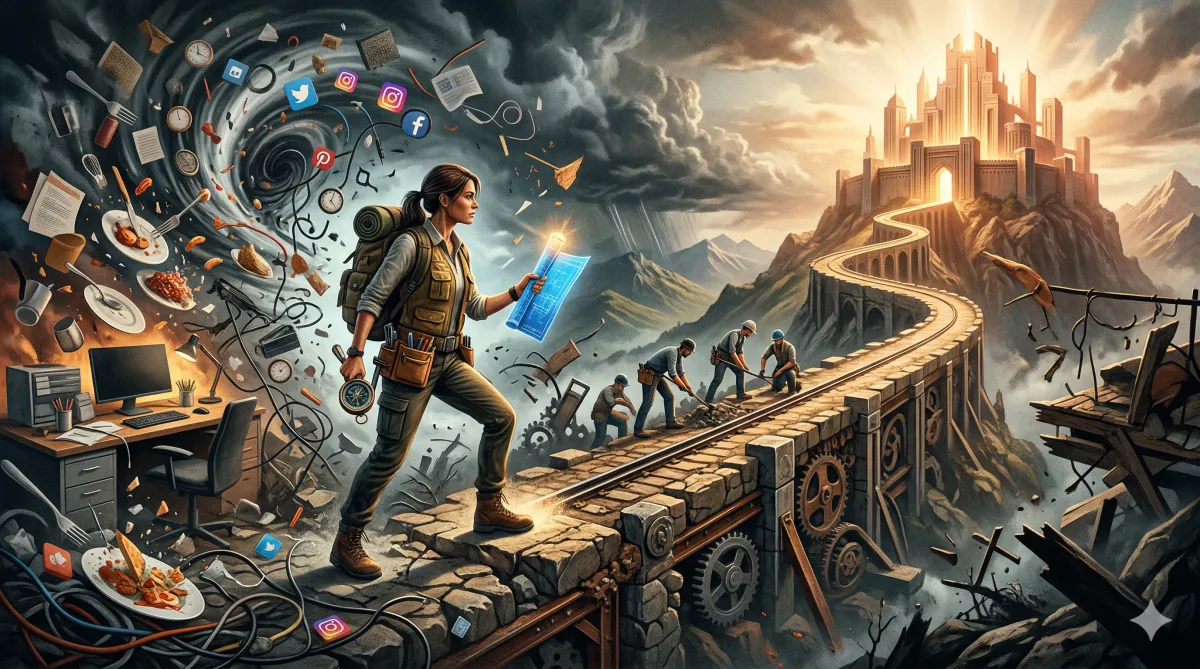
The Restaurant Owner Who Tries to Do Everything Gets Beaten by the One Who Does One Thing Relentlessly
Let me be direct with you about something most people in this industry will not say out loud.
Being busy is not the same as moving forward. Doing more is not the same as getting closer. And the restaurant owner who is running in fifteen directions at once is not ahead of the one who picked one direction and has not moved off it in twelve months.
Structure and direction are not corporate concepts. They are survival tools. And without them, a restaurant — no matter how good the food is — operates in permanent reaction mode. Something breaks, you fix it. Something goes wrong, you handle it. The week ends and you cannot clearly explain what moved forward. You just know you were exhausted the entire time.
That is not running a restaurant. That is running on a treadmill.
Most Owners Think Doing More Gets Them There Faster. It Does Not.
There are a hundred ways to grow a restaurant. Social media. Paid ads. Better reviews. A new menu. A loyalty program. Better staffing. Improved inventory. Stronger supplier relationships. Marketing. Branding. Events. All of it matters. None of it matters if you are trying to do all of it at once.
The owners who actually move — the ones who look back in twelve months and realise their restaurant is fundamentally different from what it was — are almost never the ones who did the most things. They are the ones who identified the one constraint that was holding everything else back, and they worked on that one thing long enough and hard enough to actually break through it.
That is it. One thing. Done properly. For long enough to see it compound.
Most people abandon the one thing after three weeks because it does not feel like enough. So they add five more things. And now they are diluted across six directions, none of which has the depth of focus required to actually produce a result. The goal gets further away while the effort increases. That is the trap.
You Do Not Have to Be Good at This Yet. You Just Have to Be Moving in the Right Direction.
Here is something worth sitting with. You might be a bad manager today. You might be an average leader right now. You might be making operational decisions that you will look back on in a year and cringe at. That is fine. That is normal. That is how it works.
What matters is not where you are. It is whether what you are doing today aligns with where you are trying to go. If your goal is to build a restaurant that runs without you in the mechanics — then every week should have at least one thing that moves you closer to that. Even if you are still deep in the operations. Even if the system is not built yet. Even if the team is not there yet.
Direction matters more than current position. A restaurant owner who is bad at delegation today but is actively and honestly working on it will be in a completely different position in twelve months. The one who is bad at it and not moving on it will be in exactly the same position — just more exhausted.
The growth mindset is not a personality type. It is a commitment to consistent improvement in the direction of the goal. The restaurant team that gets better every week — even slightly — is the one that pulls ahead. Because the improvement compounds. And the competition that stays static gets left behind without even noticing it is happening.
The Hardest Working Person in the Room Should Be You.
This one needs to be said directly because too many owners forget it the moment they have a team around them.
You are the founder. You put money into this. You carry the risk. None of that means you are above the work. In fact, it means the opposite. The best restaurant owners — the ones who build something that lasts — are the ones who are in the battleground. Not in an office high up somewhere. Not giving directions from a comfortable distance. In it. Working alongside the team. Understanding every part of the operation not just in theory but because they have done it themselves.
When the leader works that way, the team feels it. The standard gets set not by what you say but by what you do. And a team that sees their owner working harder than anyone else does not need to be managed into effort. They bring it naturally.
The moment you start thinking the business owes you comfort because you built it — that is the moment the culture starts to shift. Slowly at first. Then very fast.
The World Is Chaos. A Prepared Mind Knows How to Navigate It.
The restaurant industry will throw everything at you. Staff who do not show up. Suppliers who let you down. Weeks where covers are down for no obvious reason. A competitor opens nearby. A review comes in that feels completely unfair. Costs go up. Margins tighten. A piece of equipment breaks on a Friday night.
All of this is noise. It is constant and it is inevitable. The owners who struggle are the ones who react to every piece of it as if it is a signal — as if each problem is telling them to change course. So they do. Constantly. They change the menu, change the staff, change the marketing, change the strategy. And nothing compounds because nothing runs long enough to gain traction.
The owners who pull ahead are the ones who can separate the noise from the signal. The noise is everything that demands immediate attention but does not change the direction. The signal is the pattern underneath — what your sales data is actually telling you about which nights are underperforming and why, what your reviews are consistently saying about the one thing that needs to be fixed, what your team's behaviour is revealing about where the leadership gap actually sits.
A prepared mind does not react to chaos. It reads it. It finds the pattern inside it. And it keeps moving in the direction it chose — because it chose that direction with enough thought that temporary chaos is not a reason to abandon it.
If You Are Feeling Stuck Right Now, Here Is Where to Start.
Every restaurant owner hits periods where the clarity disappears. Where the direction blurs and the days start to feel reactive rather than intentional. It happens. The question is what you do when it does.
Get off social media for a period. Not forever — social media is a tool with real value. But when you are mentally cluttered, the feed makes it worse. Every piece of content you consume that is not directly relevant to your focus is adding to the noise. Clear the space first.
Work with a defined time structure. Not open-ended days where you start early and finish when everything is done — because in a restaurant, everything is never done. Defined hours for defined types of work. Operations time. Strategy time. Team time. Personal time. The structure protects the thinking that the operations will otherwise consume entirely.
Do things you actually enjoy every day. This sounds obvious. It is not being done. Restaurant owners are among the most chronically overworked people in any industry. Without deliberate moments of genuine enjoyment — not rest, but things that actually recharge — the creative capacity that makes good decisions possible slowly disappears. You stop seeing solutions. You only see problems.
Build your curiosity deliberately. Read about what other restaurants are doing in other cities. Study what is working in industries adjacent to yours. Go eat somewhere that does one thing exceptionally well and ask yourself why it works. Curiosity is the raw material of innovation — and innovation in a restaurant does not have to be dramatic. It is usually the small thing you noticed somewhere else that you brought back and made yours.
Try something new consistently. The first time is always hard. That is the cost of growth. But the owner who has tried ten new things this year — new tools, new workflows, new ways of structuring the team, new approaches to a problem they have had for years — is fundamentally more capable than the one who ran the same playbook twelve months in a row. Expertise is just doing something new enough times that it stops being new.
And the Last Thing — Because It Might Be the Most Important Thing.
Find your team. Build your team. Protect your team.
It has never been harder to find genuinely good people. That is the reality of this industry right now and pretending otherwise does not help anyone. But a restaurant without a great team is a restaurant where everything depends on one person — and that person is you — and that is not a business, that is a job that you cannot leave.
When you find someone who cares — who brings the right energy, who holds the standard, who makes the guests feel something — you treat that person like the asset they are. You develop them. You pay them properly. You give them ownership over something. Because the alternative is losing them to a competitor who will, and starting again.
Everything else in this piece — the structure, the focus, the direction, the mindset — it all has a ceiling if the team is not right. With the right team, everything else becomes possible. Without it, everything else is just noise.
One Last Thing Before You Go.
If this resonated — if you are a restaurant owner who knows the direction but feels like the mechanics are consuming too much of your focus — we built something specifically for that.
The Restaurant Growth OS is the system that handles the 85% of mechanics so you can put everything into the 15% that actually makes a restaurant great. We run a free 30-minute diagnostic call every week with owners who want to understand exactly where their operation stands and what changes first.
We deploy first. You pay for results only.
👉 anthconsulting.com/restaurant-growth-os
Frequently Asked Questions
Why does focus matter more than effort in a restaurant business?
Effort without direction is the most expensive thing a restaurant owner can spend. Time goes in, energy goes in, and nothing compounds because each effort is pointed somewhere slightly different from the last one. Focus means identifying the one constraint — the single thing that if fixed would unlock the most movement — and working on it until it breaks. Then identifying the next one. This is how restaurants that look like overnight successes were actually built. Years of focused movement on one thing at a time, not months of frantic effort across everything at once.
How do I know what the "one thing" is for my restaurant right now?
Ask yourself honestly: what is the problem that, if it did not exist, would make every other problem smaller? For most restaurants it is one of three things — the food is inconsistent, the team is unreliable, or the mechanics are consuming the owner's time. Whichever of those is true for you right now is the one thing. Everything else can wait. Fix the foundation first and the rest becomes significantly easier to build on top of it.
How do I handle the chaos of day-to-day operations while also trying to think strategically?
The answer is structure. You cannot think strategically while you are inside the operational chaos — those two states require different mental modes and cannot run simultaneously. The owners who manage both well are the ones who have deliberately separated operational time from strategic time. Even one hour a week that is completely protected for strategic thinking — no emails, no staff issues, no supplier calls — produces more direction than five hours of scattered thinking across a chaotic week.
What does a growth mindset actually look like in a restaurant context?
It looks like a team that debrief after a bad service instead of just moving on. A chef who tries a new technique every month even when the menu is already working. An owner who reads about what great restaurants in other cities are doing and asks whether any of it applies here. It is the consistent, honest commitment to getting slightly better at the things that matter — not perfection, just improvement. The restaurant that improves 1% every week for a year is almost unrecognisable compared to the one that stayed static.
Why is the team so important and what do I do if I cannot find good people?
A restaurant's ceiling is set by its team. Not the food. Not the location. Not the marketing. The team. Because the team delivers every single guest experience — and a great restaurant with a mediocre team delivers a mediocre experience regardless of everything else around it. If you cannot find good people right now, the answer is usually one of two things: either the role is not compelling enough to attract them, or the culture is not strong enough to retain them once they arrive. Both of those are leadership problems — which means they are fixable.
How does Restaurant OS connect to what this blog is about?
Restaurant OS is the practical application of everything here. The structure, the focus, the direction — all of that requires mental space. And most restaurant owners do not have mental space because 85% of their time is consumed by mechanics that should not require a human at all. When the mechanics run on their own — inventory, scheduling, marketing, review management, financial reporting — the owner gets the space to actually think, lead, and build. The system does not replace the leadership. It creates the conditions where real leadership becomes possible.
