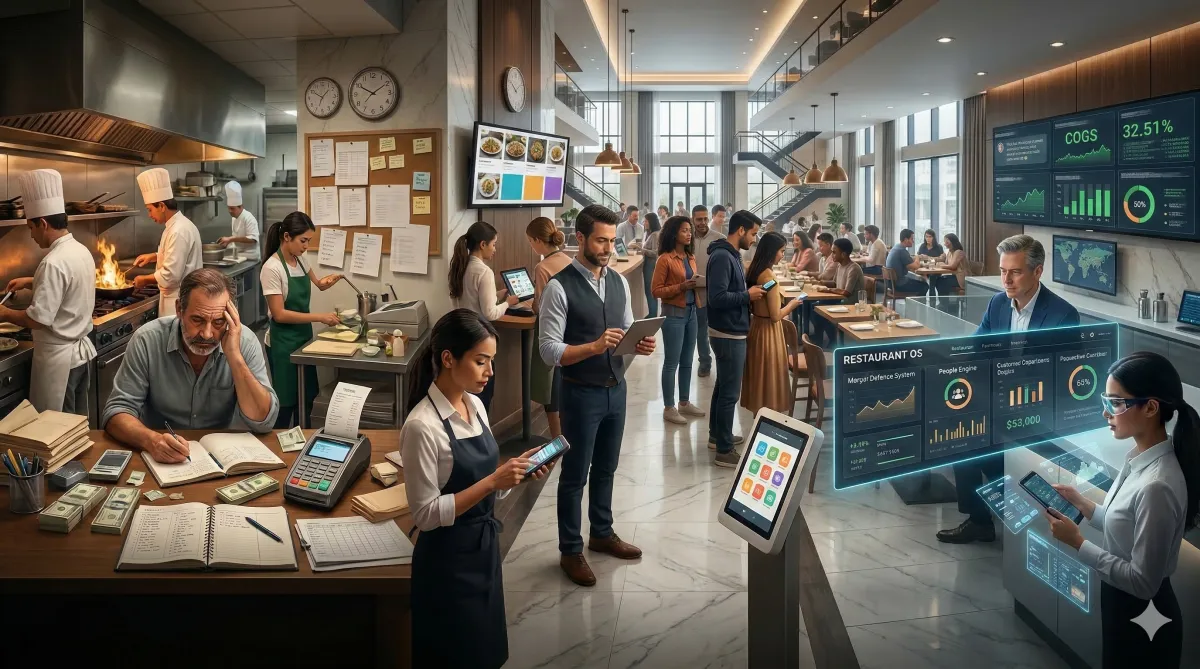
The Restaurant OS: First Principles for Building Software Restaurants Cannot Live Without
Let me start with the most important question:
What would make a restaurant owner show up at your door with pitchforks if you turned off the software?
Not annoyed. Not frustrated. Pitchforks.
That is the bar. That is what we are building toward. And to get there, we have to strip the restaurant business down to first principles and understand what actually matters every single day.
The Brutal Truth About Running a Restaurant
Unlike tech companies living off trapped data and venture capital, a restaurant owner wakes up every single morning with one urgent question:
"How do I put the right product in front of the right customer, bring them into my restaurant, sell to them, and make them happy—today?"
Not next quarter. Not after the funding round. Today.
This daily reality is governed by what I call the 85/15 Rule:
85% of running a restaurant is managing brutal, repetitive mechanics. Razor-thin margins. Supply chain chaos. Tracking data. Staff attrition. Inventory management. Review responses. Scheduling. Compliance. Maintenance.
15% is the actual magic. The food. The aesthetics. The hospitality. The human connection that makes people come back.
Most restaurant owners spend their entire day drowning in the 85%—the mechanical work that bleeds money if not managed perfectly—and have almost no time left for the 15% that actually creates memorable experiences.
A true Restaurant OS cannot be a passive dashboard. It cannot be another tool that sits there waiting to be used.
It must be an active orchestration layer that fixes catastrophic "breakage"—the areas where a business is bleeding money through waste or missing out on scale.
If the OS actively defends their margins, they will gladly pay for it. And if you ever tried to turn it off, they would freak out.
That is the standard. Let me show you how to build for it.
First Principles: What a Restaurant Actually Needs
Before we talk about modules and features, we need to understand the fundamental jobs a restaurant must do to survive.
Strip away everything else. What is left?
Job 1: Protect the Money
A restaurant is a cash business with thin margins. Every day, money leaks out through waste, theft, bad pricing, unnecessary costs, and inefficient operations. The first job is to stop the bleeding.
Job 2: Manage the People
Restaurants run on humans. Staff who cook, serve, clean, manage. Attrition can exceed 100% annually. When key people leave unexpectedly, operations collapse. The second job is to keep the right people, trained and ready.
Job 3: Serve the Customer
The customer is why the restaurant exists. Their experience—from discovery to meal to departure—determines whether they come back and whether they tell others. The third job is to make every customer interaction exceptional.
Job 4: Run the Operations
A thousand small things must happen perfectly every day. Cleanliness. Temperature. Inventory. Timing. Standards. One weak link breaks the chain. The fourth job is to maintain flawless daily execution.
Job 5: Grow the Brand
A restaurant that does not grow eventually dies. Competition increases. Tastes change. The fifth job is to continuously attract new customers and deepen relationships with existing ones.
These five jobs are non-negotiable. Everything else is a distraction.
A Restaurant OS must serve all five—or it will become just another tool that gets abandoned when things get busy.
The Problem With Most Restaurant Software
Most software solves one problem in isolation.
POS systems handle transactions. Inventory software tracks ingredients. Scheduling tools manage shifts. Review platforms monitor reputation. Marketing tools send emails.
Each tool does its job. None of them talk to each other. None of them create compounding effects.
The restaurant owner becomes the integration layer. They have to pull data from seven different dashboards, make sense of it, and decide what to do. They spend hours on the 85% mechanics, and the software is supposed to help but actually creates more work.
This is why most restaurant software fails the pitchfork test.
It does not defend margins. It does not save significant time. It does not prevent disasters. It does not create growth.
It just exists. And when money gets tight, it is the first thing to get canceled.
Rethinking the Modules: What Actually Matters
I have studied the essential functions a Restaurant OS must have. The original framework suggested six modules. But using first principles, I want to challenge that—reduce what is redundant, add what is missing, and create something holistic.
Here is my synthesis:
The Four Core Pillars of Restaurant OS
After stripping everything to first principles, I believe a Restaurant OS needs four core pillars—not six separate modules that fragment attention, but four integrated pillars that cover the five fundamental jobs.
Pillar 1: The Margin Defense System
This is the financial heartbeat of the restaurant.
What it does:
Real-time COGS tracking: When an item sells, exact ingredient quantities are deducted automatically. No manual counting. No end-of-month surprises.
Anti-pilferage detection: Anomalies flagged instantly. If food cost suddenly spikes on a specific shift, you know something is wrong.
Waste tracking: Every item thrown away is logged with a reason. Patterns emerge. Problems get fixed.
Aggregator profit-leak analysis: See exactly how much delivery platforms are costing you. Track conversions on your direct ordering. Know where to focus.
Why it creates pitchfork loyalty:
A restaurant owner who sees this system save them $3,000 per month in hidden waste will never cancel. They cannot unsee the savings. Going back to blind guessing would feel insane.
First principles validation:
Protecting the money is Job 1. This pillar does it actively, continuously, visibly.
Pillar 2: The People Engine
This is the human capital system that prevents operational collapse.
What it does:
Bench strength tracking: The system ensures you always have 5-7% extra trained staff ready. When someone quits, you are not scrambling.
Contentment diagnostics: Regular check-ins prompted by the system. Career path conversations scheduled. Problems surfaced before they become resignations.
Performance patterns: Track which servers get the highest tips, which chefs have the lowest waste, which shifts have the most complaints. Use data to make better staffing decisions.
Training verification: Ensure every employee has completed required training. Flag gaps. Maintain standards.
Why it creates pitchfork loyalty:
The average restaurant loses a key employee every few weeks. Each departure costs thousands in recruitment, training, and lost productivity. A system that reduces turnover by even 20% pays for itself many times over.
First principles validation:
Managing the people is Job 2. This pillar makes it systematic instead of chaotic.
Pillar 3: The Customer Experience Engine
This is the system that turns customers into regulars and regulars into evangelists.
What it does:
Obsessive feedback monitoring: AI scours the internet for any mention of your restaurant. Reviews below 3 stars trigger instant alerts. No complaint goes unnoticed.
Incident report generation: Every negative review traces back to a specific shift, time, and potential cause. SOPs get fixed. Problems do not repeat.
Recurring friction detection: The system identifies patterns—tables waiting too long for checks, orders taking too long, specific menu items causing complaints.
Magic moment enablement: When the system detects a friction moment (like a 20-minute wait), it pre-authorizes a budget for the server to drop a complimentary item. Turn frustration into delight.
Customer relationship tracking: Know who your VIPs are. Know who has not visited in a while. Know who deserves a personal touch.
Why it creates pitchfork loyalty:
This system engineers word of mouth. When customers have exceptional experiences, they tell friends. When complaints get resolved before they become public, reputation is protected. The flywheel of organic growth spins faster.
First principles validation:
Serving the customer is Job 3. Growing the brand is Job 5. This pillar handles both through systematic excellence.
Pillar 4: The Operations Guardian
This is the system that ensures flawless daily execution.
What it does:
Pre-shift checklists: Before doors open, the floor manager verifies everything—lighting, music, table stability, cleanliness, temperature. Nothing is left to memory.
Silent irritant detection: The system prompts regular environmental audits. Wobbly tables, burned-out lights, scuffed paint—small things that ruin perfect meals get caught and fixed.
Standards enforcement: SOPs are not documents that sit in binders. They are active workflows that get completed and verified daily.
Real-time alerts: When something goes wrong—equipment failure, inventory shortage, staffing gap—the right person knows immediately.
Why it creates pitchfork loyalty:
A restaurant owner who can trust that standards are being maintained without micromanaging gets their life back. They can focus on the 15% magic because the 85% mechanics are handled.
First principles validation:
Running operations is Job 4. This pillar makes it automatic instead of exhausting.
Why Four Pillars, Not Six Modules
The original framework had six modules. I consolidated to four pillars for specific reasons:
Reduction 1: Aggregator tracking moved into Margin Defense
Delivery profit leakage is a financial issue, not a separate category. It belongs with all other money protection systems.
Reduction 2: Magic moments moved into Customer Experience
The "Dreamweaver" concept is beautiful, but it is not a standalone system. It is a feature of customer experience management. Integrating it ensures the data that triggers magic moments comes from the same system that tracks all customer interactions.
Addition: Training verification added to People Engine
The original framework missed this. Untrained staff cause waste, complaints, and safety issues. A people system must include training management.
Integration: Everything talks to everything
The four pillars are not separate modules. They are integrated. When the Customer Experience Engine detects a pattern of complaints about a specific dish, it feeds into the Margin Defense System to check if ingredients changed. When the People Engine identifies a high-performing server, it feeds into the Customer Experience Engine to prioritize their VIP tables.
This integration is what creates compound effects.
The Holistic Approach: One OS, One Truth
Here is the holistic vision:
The Restaurant OS is a single concentration layer that sits on top of everything.
It does not replace your POS. It does not replace your inventory system. It connects them, makes sense of them, and creates actionable intelligence.
Think of it as the brain that coordinates all the organs.
Every morning, the restaurant owner opens one dashboard.
Not seven. Not twelve. One.
That dashboard shows:
Money: Here is what you made yesterday. Here is where you lost money. Here is what to fix.
People: Here is who is working today. Here is who needs attention. Here is your bench strength status.
Customers: Here is what people are saying. Here are the friction patterns. Here is who deserves special treatment.
Operations: Here is what needs to be done before opening. Here is what failed yesterday. Here is your standards score.
Every evening, the owner closes that same dashboard.
It shows what happened, what the system caught, what got fixed automatically, and what needs their decision tomorrow.
The owner's job shifts from managing mechanics to making decisions.
The OS handles the 85%. The owner focuses on the 15%.
The "Cannot Live Without" Test
For a Restaurant OS to pass the pitchfork test, it must do four things:
1. Save money VISIBLY
The owner must see the savings. "The system caught $2,400 in waste this month." Specific. Undeniable. If they cancel, they know they will lose that.
2. Save time DAILY
The owner must feel the relief. Every single day, tasks that used to take hours take minutes—or happen automatically. Going back to manual processes would feel like torture.
3. Prevent disasters ACTIVELY
The owner must trust the system. When a complaint happens, it gets flagged. When inventory runs low, they get alerted. When a key employee is unhappy, they know before the resignation. The system catches things they would have missed.
4. Create growth PREDICTABLY
The owner must see the flywheel. More positive reviews. More repeat customers. Higher average tickets. The system does not just defend—it grows.
If the OS does all four, the owner cannot live without it.
Canceling would mean losing money, losing time, risking disasters, and stopping growth. That is pitchfork territory.
What This Means for Restaurant Owners
If you run a restaurant, here is what you should understand:
You do not need more tools. You need integration.
Another app that does one thing will not save you. You need a system that connects everything and creates compound effects.
You do not need more dashboards. You need one truth.
If you are logging into seven platforms to understand your business, you are wasting hours that should go toward hospitality.
You do not need more work. You need orchestration.
The mechanics of running a restaurant should run themselves. You should be free to focus on the magic—the food, the experience, the human connection.
That is what a true Restaurant OS provides.
The Daily Reality With Restaurant OS
Let me paint the picture of what daily life looks like when this system is running:
6:00 AM: The owner wakes up. Opens one app. Sees a summary: yesterday's revenue, margin performance, any overnight reviews, staffing status for today. Two items need attention—a negative review that came in at 11 PM (already flagged with an incident report) and a contentment check-in scheduled with a key server.
8:00 AM: The opening manager completes the pre-shift checklist on their phone. Everything verified. The system logs it. Standards protected.
11:00 AM: Lunch service begins. The system tracks sales in real-time, deducting inventory automatically. A server gets flagged for a slow table—they receive a prompt to check in. Another table is waiting too long for their check—the server gets a pre-approved budget to offer a complimentary espresso.
2:00 PM: The owner checks in. Everything running smoothly. They see that one ingredient is running low—the system already sent a reorder alert to the manager. They also see that a VIP customer who hasn't visited in three weeks just made a reservation—the system flagged them for special treatment.
6:00 PM: Dinner service. Same orchestration. The owner is on the floor, talking to customers, tasting dishes, being present. They are not in the back office crunching numbers.
10:00 PM: Service ends. The system generates a daily summary. Revenue, costs, margin, customer satisfaction score, staff performance, any issues flagged. The owner reviews it in five minutes and goes home.
This is the 15% life.
The mechanics run themselves. The owner focuses on magic.
Get First-Hand Access
We are building The Restaurant OS now.
The four pillars are being developed. The integration layer is being tested. The first restaurants are being onboarded.
This is not available to everyone yet. We are starting with a small group of restaurant owners who understand the vision—who want to be part of building something that changes the industry.
If that is you—if you want first-hand access to infrastructure that defends your margins, saves your time, prevents disasters, and creates growth—this is your chance.
Get First-Hand Access to Restaurant OS →
Be one of the first restaurants to run on this system. Get direct access to the team building it. Shape how it evolves based on your real-world needs.
Or email me directly:
Tell me about your restaurant. Tell me what is breaking. Tell me what you wish existed.
I read every message. I respond personally.
Because this is not just software. This is the operating system restaurants cannot live without.
And we are building it for the owners who are ready to stop drowning in mechanics and start focusing on magic.
Frequently Asked Questions
What is the 85/15 Rule?
85% of running a restaurant is managing repetitive mechanics—margins, inventory, staffing, operations. Only 15% is the actual magic—food, hospitality, experience. Most owners are trapped in the 85%. Restaurant OS handles the mechanics so owners can focus on the magic.
Why four pillars instead of separate modules?
Separate modules create fragmentation. Four integrated pillars create compound effects. When your financial system talks to your customer system talks to your people system talks to your operations system, insights emerge that isolated tools cannot provide.
What is the Margin Defense System?
Real-time COGS tracking, anti-pilferage detection, waste monitoring, and aggregator profit-leak analysis. It actively protects your money instead of passively reporting what happened.
What is the People Engine?
Bench strength tracking, contentment diagnostics, performance patterns, and training verification. It prevents the operational collapse that happens when key staff leave unexpectedly.
What is the Customer Experience Engine?
Review monitoring, incident report generation, friction detection, magic moment enablement, and customer relationship tracking. It turns customers into regulars and regulars into evangelists.
What is the Operations Guardian?
Pre-shift checklists, silent irritant detection, standards enforcement, and real-time alerts. It ensures flawless daily execution without micromanagement.
How is this different from my current POS or inventory system?
Restaurant OS does not replace your existing tools. It connects them, makes sense of the data, and creates actionable intelligence. It is the brain that coordinates all the organs.
What does "pitchfork loyalty" mean?
It means building software so essential that if you tried to take it away, the owner would show up at your door with pitchforks. That is the bar—software they genuinely cannot live without.
How do I know if my restaurant is ready for this?
If you are drowning in mechanics—spending hours on dashboards, chasing data, fighting fires—you are ready. If you want to focus on hospitality instead of spreadsheets, you are ready.
How do I get first-hand access?
Visit anthconsulting.com/restaurant-growth-os to get first-hand access, or email [email protected]. The restaurants that get in first will shape how this system evolves.
This is the Restaurant OS. Four integrated pillars. One concentration layer. The system restaurants cannot live without. We are building it for owners who are ready to stop managing mechanics and start creating magic.
