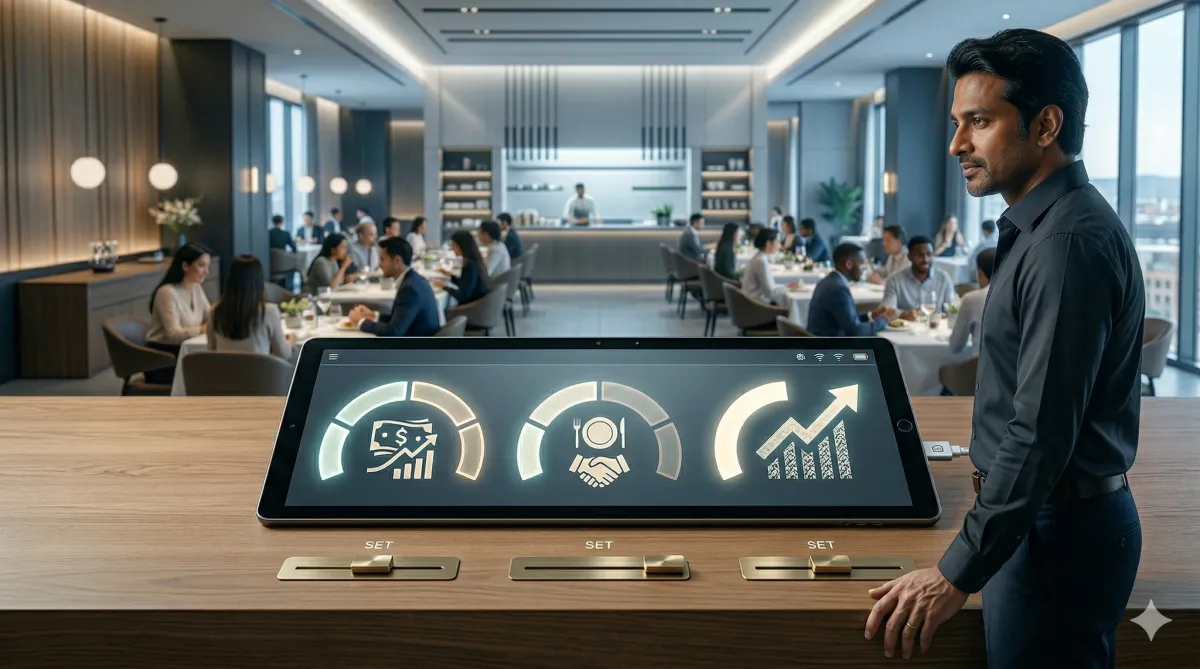
The Restaurant OS: How to Stop Running Your Restaurant and Start Owning It
There is a version of running a restaurant where you are in it — deep in it — every single day. Checking numbers. Ordering chicken. Chasing staff. Responding to reviews. Managing bookings. Watching inventory. Doing it all again tomorrow.
And then there is a version where the restaurant runs.
Not because you hired more people or built a bigger team. But because you built a system — and the system does the work.
That is what Restaurant OS is. That is what we are building. And this is how it actually works.
The Industry Is Not Against AI. It Just Has Not Been Given the Right Version of It Yet.
Most restaurant owners who hear "AI" immediately think about chatbots. Or generating a social media caption. Or some dashboard that shows them data they already know.
That is not what this is.
Think about it differently. Imagine having your own computer — but instead of you using the computer, the computer uses itself. It runs its own tasks. It checks the numbers. It tracks what sold. It looks at inventory levels. And then it comes back to you with one question: "Do you want me to order from the supplier, or would you prefer to handle this one yourself?"
That is what AI agents actually are. Automated workflows that run your daily operational tasks without needing you in the loop for every decision. And instead of twenty different tools that you can barely keep track of — one place. One overview. One system that tells you every hour what has been done and what is in progress across every area of the restaurant.
This is the new way of working. Productivity goes up. Fixed costs come down. And the owner stops being the bottleneck holding the whole thing together.
The 85% and the 15%. And Why Getting This Wrong Costs You Everything.
Every restaurant runs on two things simultaneously.
The first is the 15%. The magic. The food, the experience, the atmosphere, the feeling a guest has when they walk in and feel like they are exactly where they are supposed to be. The brand. What customers think and say and feel about you. This is irreplaceable. No AI touches this. This is yours.
The second is the 85%. The mechanics. Everything from the kitchen all the way to the marketing desk. Every workflow. Every operational process. Every small task that has to happen for the restaurant to function at all — from ordering chicken to managing staff schedules to capturing customer information when someone makes a booking.
Here is the problem most restaurant owners face. They are spending 85% of their time in the 85%. Which means they have almost nothing left for the 15% that actually makes the restaurant great.
The goal of Restaurant OS is the Pareto principle applied to running a restaurant. Maximum leverage. The 85% handled by the system. The 15% handled by the humans — which is the only place humans should be operating at all.
The Three Engines That Run the 85%
When you strip the mechanics back to what actually matters — what has to run without you for the restaurant to be healthy — it comes down to three things.
The Money Engine.
This is about prime costs. Food, labour, overhead. The big three. Your POS data should be automatically identifying which dishes are high-profit and high-popularity — the ones you want to push — and which ones are draining margin without earning their place on the menu. Waste should be tracked daily. Not at the end of the week when the damage is already done. Every dropped plate, every over-portioned portion, every ingredient that goes in the bin — logged, reviewed, and fed back into ordering decisions. Labour should be scheduled based on actual historical sales data, not gut feel. The system knows that rainy Mondays are slow. It knows that the third Saturday of every month runs 40% above average. It schedules accordingly — before you even think to ask.
The Quality Engine.
This is about consistency. The experience on Tuesday at 2pm needs to feel identical to the experience on Saturday at 8pm. That only happens when the processes are standardised and the team does not have to rely on memory or mood to deliver them. Digital prep sheets that tell the kitchen exactly what to prepare based on that day's projected covers. Standardised recipe cards that every cook follows — same measurements, same process, same outcome, every time. Opening and closing checklists that are signed off digitally so you know, from wherever you are, that the standards are being held. A restaurant is only as profitable as its most inconsistent shift. The Quality Engine eliminates the inconsistency.
The Growth Engine.
This is where one-time guests become regulars. Most restaurants take a booking, seat the guest, and let them leave — and that is the end of the relationship. The Growth Engine changes that. When someone books, the system builds a profile. It captures preferences, allergies, visit history, favourite tables. The next time that guest walks in, the team already knows. The server can greet them like someone who remembers — because the system does. Automated follow-ups after visits. Review requests sent at the right moment. Loyalty rewards triggered by behaviour, not by staff remembering to mention them. This is what turns a $45 first visit into a guest who comes back twelve times a year and brings three friends every time.
Think of It Like SOPs — But Instead of Giving Them to the Staff, You Give Them to the AI.
Every restaurant already knows what a Standard Operating Procedure is. The way the phone gets answered. The way the bins get cleaned. The way the opening checklist gets completed. These exist because consistency matters.
The Restaurant OS takes that same logic and applies it to every mechanical workflow in the building. Not just the ones the staff touch — but the ones that have always required the owner or manager to personally handle. Inventory tracking. Supplier ordering. Cost reporting. Review monitoring. Marketing scheduling. Each one becomes a workflow. Each workflow runs on its own. Each workflow reports back.
The mechanic is no longer a person running around the restaurant checking things. The mechanic is a system that runs continuously, catches problems before they surface, and alerts a human only when a human decision is actually required.
And Here Is the Part Most People Do Not Expect.
You do not pay for it upfront.
There is no software subscription to commit to before you have seen what it does. No annual contract. No technology risk.
Think of it like a battery. The AI agents use battery to do things on behalf of your restaurant. When the battery runs low, you refill it — and you only refill what you have actually used. Every task completed, every workflow run, every insight surfaced — that is what consumes the battery. You pay for what gets done, not for the platform to exist on your account.
We deploy Restaurant OS first. You see it working. Then you decide what outcomes you want to pay for.
No restaurant should be held back from this because of upfront cost. The mechanics are already costing you every day you run them manually. The only question is whether the system pays for itself faster than the current approach is draining you.
The Shift From Operator to Owner
Right now, most restaurant owners are operators. They are in the detail. Every task, every decision, every fix runs through them. That is not ownership — that is dependency. The restaurant depends on one person being present, attentive, and available at all times.
When the three engines run — when the Money Engine, the Quality Engine, and the Growth Engine are automated and connected — the owner steps back. Not out. Back.
You stop managing inventory and start making decisions about the menu. You stop scheduling staff and start developing the people on the team. You stop responding to reviews and start thinking about the brand. You stop being the system and start being the person who leads it.
That is the real output of Restaurant OS. Not a list of automated tasks. Not a dashboard with data. A restaurant that runs — so the owner can do the thing that no system can ever do for them. Be the leader, the creator, and the face of something genuinely worth experiencing.
If Your Restaurant Has the Food, the Team, and the Place — It Is Time to Get the Mechanics Off Your Plate.
We run a free 30-minute Restaurant Diagnostic Call every week with restaurant owners who want to understand where their operation is right now — and what it takes to get the system working for them instead of the other way around.
In 30 minutes we will map your current workflows, identify the three highest-leverage areas where the mechanics are consuming the most time and margin, and show you exactly how Restaurant OS gets deployed inside your specific operation.
You do not pay until the system is running and producing results you can see. No upfront cost. No commitment before you have proof.
If you are ready to stop being the bottleneck in your own restaurant, this is where you start.
👉 Book the free diagnostic call at anthconsulting.com/restaurant-growth-os
Frequently Asked Questions
What is Restaurant OS and how is it different from the software I already use?
Restaurant OS is not a replacement for your existing tools — it is the layer that connects them and operates them on your behalf. Your POS, your inventory software, your booking system, your review platforms — they all stay in place. What changes is that AI agents now run the workflows between those tools automatically. Instead of you logging into each system, extracting information, and deciding what to do — the system does all of that and only brings you the decisions that genuinely require a human judgment call. The difference is between software you operate and a system that operates for you.
What exactly are AI agents and how do they work inside a restaurant?
An AI agent is an automated workflow that can observe data, make a decision based on pre-set rules and thresholds, and take an action — without waiting to be told. In a restaurant context, an inventory agent checks stock levels against sales data and either places a reorder or asks you to confirm. A review agent monitors every platform, flags new feedback, drafts a response, and submits it for approval. A scheduling agent looks at historical sales, upcoming bookings, and local events to build next week's staffing plan. Each agent runs its specific loop continuously — the way a reliable team member would if that team member never needed sleep, never missed a task, and never forgot a detail.
What does the "battery" pricing model actually mean?
It means you never pay for unused capability. Every action an AI agent takes — every inventory check, every review response drafted, every report generated — uses a unit of credit from your account. When your credit runs low, you refill it. You only pay for what actually gets done on your behalf. There is no monthly subscription for a platform that sits idle. No annual commitment before you have seen results. You refill the battery based on your usage, not based on a fixed package that may or may not match what your restaurant actually needs.
How long does it take to set up and when do I start seeing results?
Most restaurants are live with their core agents within two to four weeks. The setup process involves connecting your existing tools, mapping your key workflows into the system, and calibrating the agents to your specific operation — your menu, your service hours, your supplier relationships, your standards. Most owners start seeing measurable changes in the first 30 days. Not projections. Actual reductions in time spent on admin, actual improvements in inventory accuracy, actual increases in review response rate. The diagnostic call is where we map out the specific timeline for your restaurant.
Does this work for a single-location independent restaurant or is it only for larger groups?
It works particularly well for single-location independents — because that is where the owner is typically doing the most manual work themselves. If you are the person checking inventory, building schedules, responding to reviews, and managing supplier orders — Restaurant OS gives you those hours back immediately. You do not need a multi-location operation or a technology budget to make this viable. The battery model is designed specifically so that a single restaurant pays proportionally to what it uses, not a flat rate built for a chain.
What happens to the 15% — does AI change the guest experience?
No. The 15% — the food, the hospitality, the atmosphere, the human connection — is entirely protected. That is the whole point. Right now, the people responsible for the 15% are spending most of their time buried in the 85%. The chef is doing cost reports. The floor manager is checking inventory. The owner is building next week's rota. Restaurant OS takes all of that off their plate so the chef can cook, the manager can lead the floor, and the owner can focus on the brand. The guest experience does not get automated. It gets better — because the humans delivering it finally have the space and energy to do it properly.
What is the Restaurant Diagnostic Call and what should I expect?
It is a free 30-minute session where we go through your restaurant's current operation honestly. We look at what tools you are using, where the key workflows are being handled manually, where time and margin are being lost, and which of the three engines — Money, Quality, or Growth — has the most immediate leverage for your specific situation. At the end of the call you will have a clear picture of where your restaurant stands and a specific starting point for deploying Restaurant OS. You are not committing to anything. We deploy first, you pay for results. The call is where we figure out together whether this is the right fit.
