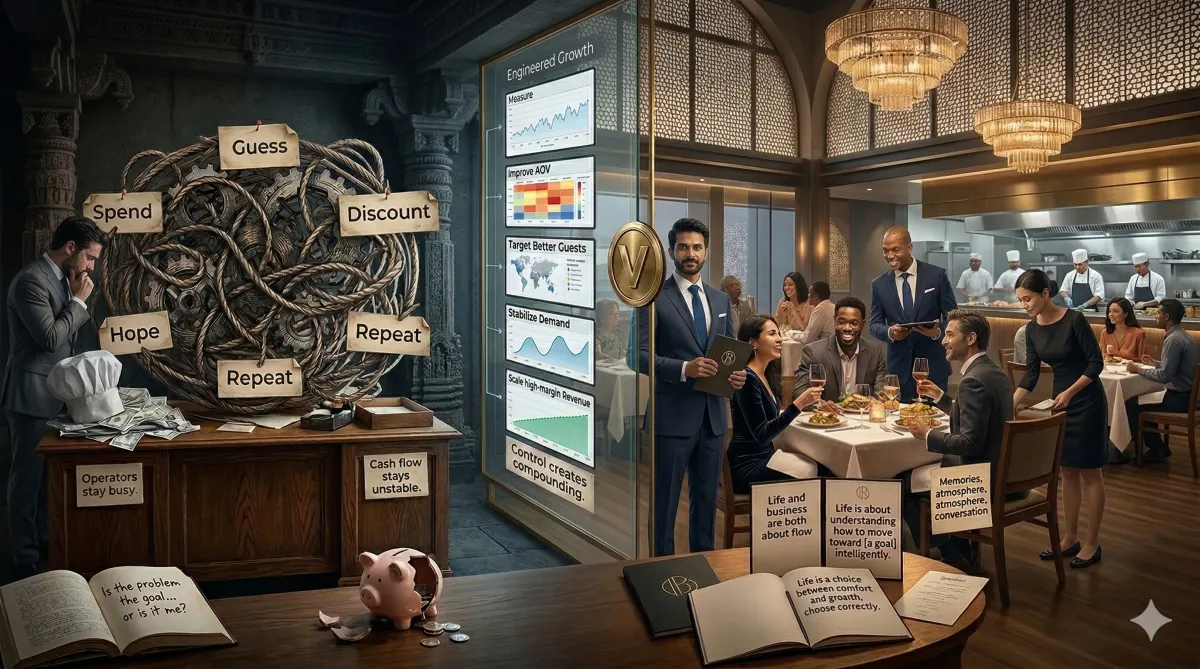
The Restaurant Industry Is About to Split in Two. Here Is Which Side You Want to Be On.
Sometimes it is just hard.
You lie awake wondering why you are not closer to your goal. Why you have not reached it yet. It becomes a burden in your mind. You lose sleep over it. You just want to do the things that will make it happen. What is stopping you? What can you do to make it come faster?
I have been there. Every restaurant owner I know has been there.
We sacrifice relationships, family time, kids' birthdays, weekends, holidays—all for the goal. And yes, there are seasons when that is necessary. Entrepreneurs have seasons. Days where you go hard, weeks where you push, months where everything else takes a backseat.
But here is what I have learned after years of watching restaurant owners build and burn out:
It is not the goal. It is you.
What you do and how you do it determines everything. You can make the road harder for yourself or easier for yourself. Both paths have hard parts and easy parts. Both have trade-offs. But the ones who win are not the ones who sprint until they collapse. They are the ones who analyze carefully, sprint strategically, do what is necessary, ignore the rest, and reach the goal faster—so they can make the next one bigger.
I am writing this because something massive is happening right now. Something that will split the restaurant industry into two sides. And which side you choose will determine everything about your next decade.
The AI Shift No One Is Talking About Honestly
AI is here. You already know that.
But most people are asking the wrong question. They ask: "How do I use this tool?" They think about writing captions faster or generating menu descriptions or automating social media posts.
That is not what matters.
AI does not just make work faster. AI changes where value lives.
And when that happens, it changes what businesses should sell, what agencies should do, and what restaurants must become.
Let me show you what I mean.
AI is going to do to many industries what quartz did to watches. Quartz made timekeeping cheap, accurate, and universal. Suddenly, the basic function of a watch—telling time—became a commodity. Anyone could do it.
AI is doing the same thing to writing, design, coding, research, ad creation, strategy drafts, editing, automation, customer service, and personalization.
So the question becomes: If everyone can produce decent output, what becomes scarce?
The answer is everything AI cannot easily replicate:
Trust. Taste. Distribution. Speed of execution. Proprietary data. Systems. Attention. Identity. Brand. Real-world proof.
That is why AI is not killing value. AI is creating a massive Brand Age explosion.
What AI Commoditizes
Before AI, many services were expensive because they required labor. Now AI makes those outputs cheaper, faster, more abundant—and more average.
The market is getting flooded with decent logos. Decent websites. Decent ad copy. Decent email sequences. Decent SEO outlines. Decent social posts. Decent sales scripts.
"Good enough" is everywhere now.
And when "good enough" is everywhere, people stop paying premium prices for the output itself. They start paying for something else entirely.
They pay for who made it. Whether it works. Whether it feels right. Whether it saves time. Whether they trust the operator. Whether it fits their identity. Whether it creates measurable outcomes.
That is the shift.
For restaurants, this means something specific: if AI gives every restaurant access to decent social captions, decent email newsletters, decent ad copy, decent websites, decent photos, decent promo ideas—then all restaurants start looking "kind of competent."
Basic marketing polish no longer stands out.
So what matters more?
Distinct identity. Memorable positioning. Real-world proof. Experience design. Consistent story. Audience fit.
The restaurants that understand this will pull away. The restaurants that do not will become interchangeable. And interchangeable businesses get price pressure. Memorable businesses get pricing power.
That is the whole game.
What Restaurants Actually Sell
Here is something most restaurant owners have never thought about clearly.
You do not sell food.
I know that sounds wrong. You cook food. You serve food. Customers eat food. But that is not what they are buying.
Most restaurants think they sell curry, naan, biryani, lunch, dinner.
No.
They sell a feeling. A social experience. Belonging. Status. Memory. Ritual. Convenience. Local identity. Trust. Story.
The food must be good enough. That is the price of entry. But after that, brand takes over.
That is why two restaurants with similar food can have radically different outcomes. One is packed. One is invisible. The food is comparable. But one owns a position in the customer's mind and the other does not.
The Restaurants That Understood This First
Let me tell you about some restaurants that figured this out before everyone else.
Eleven Madison Park
Will Guidara and Daniel Humm took a restaurant to number one in the world. But Guidara will tell you it was not because of the food alone. It was because of what he calls "Unreasonable Hospitality"—going beyond what anyone expects to create moments people remember forever.
They once overheard a table of tourists saying their only regret about visiting New York was not getting a street hot dog. So the team sent someone out, bought a hot dog, plated it elegantly, and served it as an extra course. The food cost nothing. The memory was priceless.
That is brand. That is what separates packed restaurants from forgotten ones.
Dishoom
This UK-based restaurant group took the Bombay café concept and turned it into a cultural phenomenon. Multiple locations. Cult following. Hours-long waits.
But they are not selling Indian food. They are selling nostalgia for a Bombay that no longer exists. They are selling belonging to a story. Every detail—the music, the décor, the menu language, the matchboxes you can take home—reinforces the same narrative.
The food is excellent. But the brand is what fills the seats.
Massimo Bottura and Osteria Francescana
Three Michelin stars. Ranked number one in the world. But Bottura does not describe himself as someone who cooks food. He describes himself as someone who tells stories through food.
His signature dish—"Oops, I Dropped the Lemon Tart"—looks like an accident. It was inspired by an actual mistake in the kitchen. Instead of throwing it away, he turned it into art. Into a philosophy. Into something people travel across the world to experience.
That is what brand does. It transforms commodity into meaning.
Danny Meyer and Union Square Hospitality
Danny Meyer built Shake Shack into a billion-dollar company starting from a hot dog cart in Madison Square Park. But before that, he built Union Square Café, Gramercy Tavern, and a hospitality empire.
His philosophy? "Hospitality is how the delivery of a product or service makes its recipient feel."
He wrote a whole book about it. He trains every employee in it. And it is why his restaurants thrive decade after decade while others come and go.
The lesson from all of them is the same:
Good food gets you into the game. Brand, systems, and consistency determine who wins.
What AI Cannot Replace
This is the strategic gold for anyone paying attention.
AI struggles most with things that require:
Taste — Knowing what feels premium, clear, compelling, culturally right. AI can generate options. It cannot know which one actually works for this specific audience in this specific moment.
Context — Knowing this specific restaurant, this neighborhood, this owner's psychology, this community's preferences. AI works from patterns. It does not know your story.
Accountability — Someone owning the result. AI can suggest. It cannot commit. It cannot care.
Real-world implementation — Actually shipping, measuring, correcting, improving. AI can draft. It cannot execute.
Trust — Owners trust people, not prompt outputs. They want someone who understands their vision and will fight for it.
Positioning — Choosing what game to play. AI can help you play a game better. It cannot tell you which game is worth playing.
Brand truth — Finding the real story worth amplifying. This requires human insight, not pattern matching.
That is the moat for anyone willing to build it.
Why This Hits Agencies Directly
Most marketing agencies still think they are selling content, ads, websites, SEO, funnels, copy, automation.
Wrong.
Those things are becoming inputs, not the product.
The real product now is one of these:
Distribution — Can you put the offer in front of the right people?
Decision leverage — Can you tell the client what actually matters?
Systems — Can you build a machine that keeps producing results?
Brand authority — Can you make the business feel bigger, clearer, more trusted, more desirable?
Proof — Can you tie your work to revenue, retention, and margin?
Agencies that sell hours, tasks, and vague marketing activity are dying. "We post 12 times per month." "We manage your Instagram." "We do SEO." This becomes commodity sludge.
Agencies that sell combined execution plus strategy survive. "We run Meta plus Google plus email." "We manage your acquisition funnel." Better, but still replaceable.
Agencies that sell owned outcomes through systems win. "We build your catering acquisition engine." "We install a follow-up and booking system." "We create a full-stack growth machine tied to reservations, repeat visits, and higher average order value."
That is where the value lives now.
We Are Not a Marketing Agency Anymore
I need to tell you what has changed for us.
I had my season of being the business owner who does everything himself. Lost the art of doing what I really love, which is to build. With AI and the right team, I can now do what I love most—build, develop, create, and connect with restaurant owners who think like entrepreneurs.
And that shift made me realize: we are not a marketing agency anymore.
Anth Consulting has become something else.
Part growth operator. Part brand architect. Part AI systems integrator. Part restaurant demand engine.
We do not sell posts. We do not sell SEO deliverables. We do not sell ad setup.
We sell a growth operating system for serious restaurants.
That means customer acquisition systems. Retention systems. Content engines. AI-assisted brand systems. Offer architecture. Local demand capture. Review generation. Catering pipelines. Lead follow-up automation. Conversion assets. Reporting tied to money.
Outputs can be copied. Systems are harder to copy. Proof is harder to copy. Taste is harder to copy. Restaurant-specific understanding is harder to copy.
That is what we build now.
The Opportunity for Indian Restaurants
I need to say something specific about the niche we know best.
Indian restaurants—especially dine-in legacy restaurants—often have:
Amazing food. Real cultural depth. Family story. Generations of recipes. Authenticity that cannot be faked.
But also:
Underdeveloped positioning. Weak systems. Inconsistent media. Poor follow-up. Poor local brand articulation.
That is perfect.
Because we are not trying to invent value from nothing. We are extracting and amplifying value that already exists but is not packaged, systemized, or communicated properly.
The food is there. The story is there. The culture is there.
What is missing is the infrastructure to turn all of that into a brand people remember, talk about, and return to.
That is what we build.
The Restaurant That Wins in the AI Era
Let me summarize the winning model.
The best restaurants will be a combination of:
Good product — The food has to actually hit. This is non-negotiable.
Strong concept — Clear identity and emotional positioning. What do you stand for?
Great media — Content that spreads, that makes people curious, that tells your story.
Great systems — Follow-up, reviews, retention, bookings, upsells. The infrastructure that compounds growth.
Great experience design — From first impression to final bite. Every touchpoint intentional.
Brand consistency — Every touchpoint reinforces the same story.
A restaurant without systems will leak money. A restaurant without brand will be forgettable. A restaurant without product will not survive.
All three matter.
The Brutal Truth
AI will destroy agencies that sell labor.
AI will help agencies that sell leverage.
And restaurants that do not become brands will increasingly become interchangeable.
In the old world: "Good food wins."
In the real world now: "Good food gets you into the game. Brand, systems, and consistency determine who wins."
Execution is becoming cheaper. Attention is becoming harder. Trust is becoming rarer. Brand is becoming stronger. Systems are becoming essential. Proof is becoming king.
AI and the Human Element
One more thing I need to say.
My gut tells me that nothing can really replace the human element in the dining room and kitchen. Maybe you can optimize it. Re-engineer fixed costs. Save money. But every customer wants that human connection—the server, the staff, the cooked meal, the story from a human brand.
Use AI everywhere else. Get the small tasks and complex tasks done. Make your restaurant the most optimized, automated, stress-free environment possible—not just for your customers, but for your team to perform better and be more relaxed.
But the magic? The hospitality? The feeling someone gets when they walk through your door?
That stays human. That is what customers pay for. That is what AI cannot touch.
And here is something beautiful about that:
When AI handles the work that does not require humans, people have more time. More time for family. More time for friends. More time to go out and eat together.
Restaurants will be in more demand, not less. People will eat out more. They will enjoy time with others more.
The restaurant industry has an edge here that most people are not seeing yet.
Which Side Are You On?
The industry is splitting.
On one side: restaurants that become interchangeable. Competing on price. Racing to the bottom. Working harder for less.
On the other side: restaurants that become brands. Commanding premium prices. Building loyalty. Creating something people remember and return to.
AI accelerates both paths. It makes the commodity side more crowded and the premium side more valuable.
The choice is yours.
If This Resonated
If you run a restaurant and this resonated—if you see yourself on the brand side but have not built the infrastructure to get there—we should talk.
We are no longer a marketing agency. We are building restaurant growth infrastructure. Brand, demand capture, retention, and automation for serious restaurants.
Explore Restaurant Growth OS →
See what we have built. See how it works. See if it fits where you are and where you want to go.
Or if you prefer to talk directly:
Send an email to [email protected]
Tell me about your restaurant. Your vision. What you want to build. What is standing in the way.
I read every message. I respond personally.
Because the restaurants that become brands in the next five years will own their markets.
And I want to help build as many of them as possible.
Frequently Asked Questions
What do you mean by "AI changes where value lives"?
AI commoditizes outputs that used to be expensive—writing, design, basic marketing. When everyone can produce decent output, the value shifts to things AI cannot replicate: trust, taste, brand, systems, real-world proof. Restaurants that understand this shift toward brand and systems. Restaurants that do not become interchangeable.
Why do you say restaurants do not sell food?
The food is the price of entry. It has to be good enough. But what customers actually buy is the feeling, the experience, the memory, the social moment, the belonging. Two restaurants with similar food can have completely different outcomes based on brand alone.
What makes the winning restaurants different?
They have all three: good product, strong brand, and great systems. They are not just cooking—they are building something people remember and return to. They compound growth instead of starting from zero every week.
Why are you no longer a marketing agency?
Because marketing tasks are becoming commodities. AI can draft posts, write emails, generate ad copy. What AI cannot do is build systems, develop brand strategy, understand restaurant-specific context, and tie everything to revenue. We build infrastructure now, not deliverables.
What is Restaurant Growth OS?
It is our operating system for restaurant growth. Customer acquisition systems, retention systems, content engines, AI-assisted brand systems, review generation, catering pipelines, follow-up automation—all connected and all tied to actual revenue. It is the infrastructure that serious restaurants need.
Why is this especially relevant for Indian restaurants?
Indian restaurants often have incredible food and deep cultural value that is underdeveloped in terms of positioning and systems. The raw material is exceptional. What is missing is the infrastructure to package it, communicate it, and compound it. That is exactly what we build.
What can AI not replace in restaurants?
The human element in hospitality. The warmth of a greeting. The care of a server. The story from a real person. AI can optimize operations and marketing, but customers come to restaurants for human connection. That stays.
How does AI actually help restaurants?
AI handles the tasks that do not require humans—content drafts, data analysis, follow-up automation, research, optimization. This frees up owners and staff to focus on what matters: the product, the experience, and the relationships. It makes restaurants more efficient without losing soul.
What is the risk if I do nothing?
The market is splitting. Restaurants that do not build brand and systems become interchangeable, competing on price, racing to the bottom. Restaurants that do become premium, command loyalty, and own their markets. Doing nothing means drifting toward the commodity side.
How do I know if this is right for my restaurant?
If you have strong fundamentals—good food, real cultural depth, a story worth telling—but inconsistent positioning, weak systems, and unpredictable demand, this is built for you. We extract and amplify value that already exists.
What is the first step?
Explore Restaurant Growth OS or email [email protected]. Tell me about your restaurant and what you want to build. I will be honest about whether we can help.
Jeffry Jonas is the founder of Anth Consulting, a restaurant growth company that builds brand infrastructure for serious restaurants. After years of watching AI transform industries, he realized the restaurant industry is about to split—and he is betting on the brand side.
