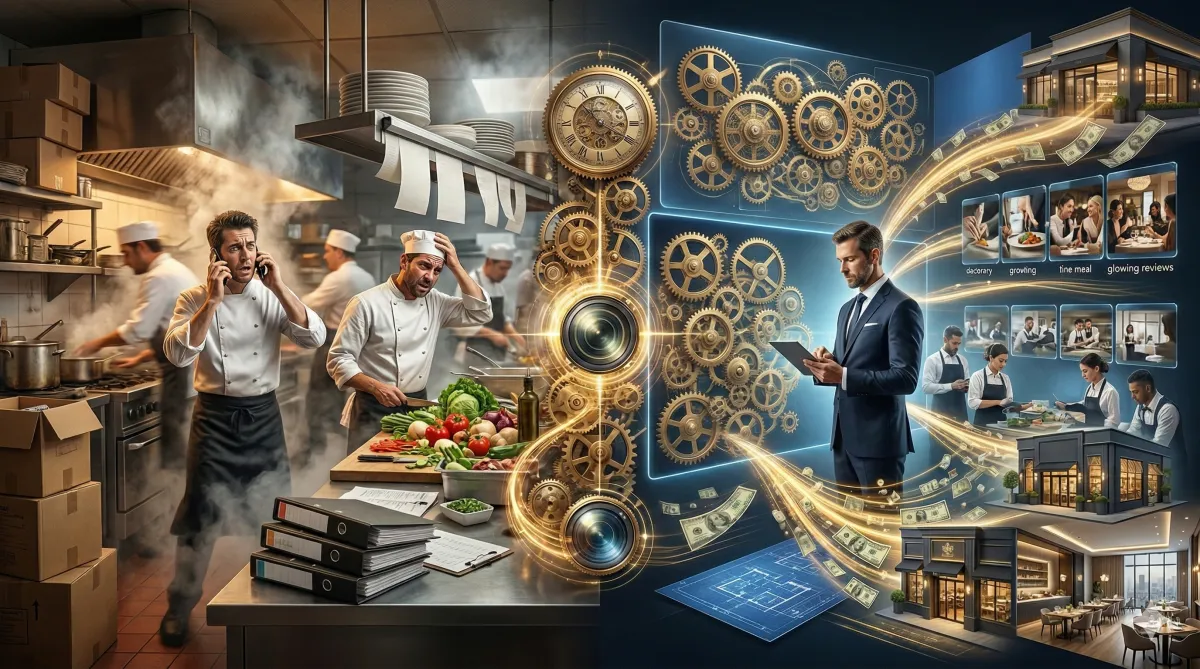
Stop Running Your Restaurant. Start Building a Brand That Prints Money.
Stop Running Your Restaurant. Start Building a Brand That Prints Money.
You're busy. I know. You've got a line cook calling in sick, a vendor shorting your order, and 47 things on fire before noon. That's the restaurant life.
But here's what separates the owners doing $2M a year from the ones doing $50M across multiple locations — the second group stopped just running a restaurant. They started building a machine.
This post is the thinking behind that machine. No theory. No fluff. Just what actually works when you're ready to scale.
Speed Wins. Period.
In this business, the owner who moves fastest wins. Not reckless — fast. There's a difference.
Every hour you save is an hour you reinvest. Better product. Better hires. Better marketing. Better position in your market. The top operators I work with are obsessed with cutting waste — wasted time, wasted labor, wasted spend — so they can pour that energy back into the things that actually grow revenue.
You already know this in your kitchen. Mise en place. Everything in its place so service runs smooth. Now apply that same thinking to your entire business.
Your Brand Should Make the Decision Easy
When a customer is scrolling for a place to eat, your brand should end the debate. No confusion. No "maybe." Just — "that's the spot."
Strong brands do one thing better than anything else: they remove confusion from the category. Your customer knows what you stand for. They know what they're getting. They trust it. And they'll pay a premium for it because you've made the choice effortless.
But you don't build that on vibes. You build it on data.
Look at your numbers and be honest:
Who are your best suppliers — the ones who actually deliver quality, on time, every time?
Who are your best cooks? Not just skill-wise. Who's consistent? Who shows up?
Which servers drive the highest check averages? Who gets the best reviews by name?
Where are your customers actually finding you — Google, Instagram, TikTok, word of mouth? Are you showing up there or just hoping?
Are you being picky enough about who you're trying to attract?
The restaurants that scale don't guess at this. They measure it, review it weekly, and make moves based on what the data says.
Say No to Almost Everything
This is the part most owners get wrong. You think growth means saying yes to more — more events, more catering, more partnerships, more menu items, more locations.
The opposite is true.
The fastest-growing restaurants I've seen are run by owners who got ruthless about saying no. No to the things that don't directly serve the mission. No to shiny distractions. No to "opportunities" that eat time and return nothing.
High volume, high margin. That's the game. You can't play it if you're spread across 15 different priorities.
Pick your lanes. Go hard. Ignore everything else.
Think Like a Sales Guy AND an Engineer
Here's something I've noticed over years of working with restaurant owners.
When you ask a sales-minded person a question, they're thinking: "What does he really want? What's the move here? How do I connect?" They read people. They create energy. They close.
When you ask an engineer-type the same question, they're thinking: "What's actually true? Let me verify. Let me pressure-test this." They build systems. They find problems before they become fires.
Put both of those brains into one restaurant operation and you get a powerhouse. And honestly? That's why I've watched so many people with engineering or systems backgrounds enter the restaurant game — a business that's all emotion, connection, and sales — and absolutely dominate.
They bring the structure. The restaurant supplies the soul.
But at the end of the day, nobody beats the owner who does this because they love it. The one where it feels like play. That's the edge no system can copy.
Know Your Restaurant Better Than Anyone Alive
Not your GM. Not your chef. Not your POS system. You.
You should be the most knowledgeable person in the building about every detail of your operation. And I mean every detail.
Your ingredients: Where do they come from? Is it actually grass-fed or is that just the sales rep's pitch? How is it stored? How is it handled? What oil is your chef using — and is it the best option or just the cheapest?
Your kitchen: Is the pan worn out? Is your line using one cloth for everything or a clean one per dish? Is the dessert portion right — not too much, not too little, not identical to the plate before it?
Your floor: Forks on the correct side? Napkins folded right? Is this really the best layout for your tables and chairs, or is it just the way it's always been?
I know this sounds extreme. That's the point. The owners who operate at the highest level see their restaurant at what I call the mathematical level — every variable accounted for, every detail intentional. That's where average restaurants become unforgettable ones.
Script the Customer Journey Like a Movie
Your guest's experience doesn't start when they walk through the door. It starts the moment they first hear about you. And it doesn't end when they pay the check. It ends when they leave a review, tell a friend, and come back next month.
Every step in between should be planned.
Map it out. Literally. On paper or a whiteboard. Walk your team through it.
How does someone first discover you?
What do they see when they look you up online?
What happens when they walk in the door?
How are they greeted? Seated? Served?
What's the feeling during the meal — connection? Excitement? Relaxation?
What happens after they leave? Do you follow up? Is there a reason to come back?
When your team understands the full arc — not just their individual station — the experience becomes seamless. That's how you build the kind of loyalty that no discount or promotion can touch.
Restaurants are about provoking emotion. Making people feel something real. Your job is to design that feeling from start to finish and make sure nothing breaks the spell.
Build Your Team the Right Way
When you're in growth mode, your leadership team should be generalists first. People who understand the full picture — marketing, operations, kitchen, front of house, finance — at a fundamental level. Not specialists. Not yet.
You want people who feel like the exact right fit. Not just available. Not just experienced. The person who makes you think, "This is the one."
Build your core around those generalists. Then, as you scale toward multi-location and eight figures, each one builds a specialized team underneath them. That's how you grow without losing quality or culture.
A few non-negotiables:
Hire with intention. Never settle because you're desperate.
Empower your people. Give them ownership and room to lead.
Get a sharp legal team and a sharp accountant. Not optional.
Clarity creates speed. When everyone knows the mission, things move fast.
Trust Your Gut — After You've Fed It
The best restaurant owners I know make decisions fast. It looks like instinct. A feeling from the gut.
But that gut didn't come from nowhere. It was built over years of studying the numbers, tasting every dish, watching every service, listening to every customer, and paying attention when most people zone out.
When you've done that work — when you've soaked in the data and the details — the right decision starts to feel obvious. Not because you're guessing. Because you've internalized so much information that speed and accuracy become the same thing.
That's the level. That's where we're headed.
Here's Where We Come In
Your job is the restaurant. The connection. The emotion. The experience that makes people feel something they can't get anywhere else.
Our job is everything around it. Brand building. Growth systems. Positioning you in the market so the right customers find you and keep coming back. Solving the problems that eat your time so you can focus on what you do best.
We've done this for restaurants at every stage of scale. And it always starts the same way — with the fundamentals.
Get The Restaurant Growth Playbook (Free)
This is the exact framework we use with owners who are serious about scaling. It covers brand positioning, customer journey mapping, team structure, and the operational systems behind restaurants that grow fast and stay profitable.
No fluff. No filler. Just the plays that work.
The Restaurant Growth Playbook → Click Here
Drop your email and it hits your inbox in minutes.
FAQ
Who is this for? Restaurant owners and operators who already have a working business. You're past the startup grind. You've got revenue coming in and customers who love what you do. Now you want to know how to turn that into something bigger — more locations, higher margins, a brand people recognize. That's who this is for.
My restaurant is already doing well. Why would I need this? Because doing well and being built to scale are two completely different things. Most restaurants hit a ceiling not because the food isn't good, but because the systems, brand, and team structure weren't designed for growth. The playbook shows you where those gaps are.
What do you mean by "premium brand positioning"? It means when someone in your market thinks about your category — Italian, sushi, fine dining, fast casual, whatever it is — your name comes up first. Not because you're the most expensive. Because you're the most trusted, most consistent, and most clearly defined option. Your brand makes the decision easy.
I know my restaurant inside and out. How is data going to tell me something I don't already know? You'd be surprised. Gut feel is powerful, but it has blind spots. Data shows you which dishes actually drive profit (not just sales), which staff members move the needle, which marketing channels bring in your best customers, and where you're leaking money you don't even realize. Instinct plus data is the combination that scales.
What kind of results are we talking about? Every restaurant is different, but the operators we work with consistently see stronger brand recognition, better customer retention, higher average tickets, and a clear roadmap for growth — with less chaos, less guessing, and less wasted effort.
How do I know if I'm actually ready to scale? If you've got consistent revenue, a product people love, and a gut feeling that you should be further along than you are — you're ready. The playbook will help you see exactly where to focus first.
What do I do after I read the playbook? Use it. Implement what makes sense for where you are right now. And if you want hands-on help taking it further, that's what we're here for. But the playbook alone will give you a clear picture of your biggest growth opportunities.
