How to Actually Get Results at Your Restaurant: The Effort-Output Ratio That Changes Everything
Whether you have been getting results or struggling to see any, what I am about to share will make sense for you.
There is a principle that governs everything in business, and most restaurant owners have never thought about it clearly. I call it the effort-output ratio.
It means this: for every effort you put in, the results you get should be far more meaningful and significant than what it took you to create them. You do less, but you get more. Not because you are lazy—because you are strategic.
Every action has an equal and opposite reaction. Every cause has an effect. This is physics, but it is also business. And for restaurants, it means you should always be searching for the most unique, fastest, and easiest actions to get the reactions and effects you want.
Reduce. Simplify. Focus.
If your restaurant feels too complicated right now—too many things happening, too many directions, too much chaos—the answer is not to do more. The answer is to reduce.
Why Most Restaurant Owners Stay Stuck
I know what you are thinking. Reducing feels scary. Pivoting feels risky. Changing direction feels like admitting something was wrong.
This is human nature. We are too comfortable to move toward the uncomfortable. Even when we know—deep down—that the uncomfortable eventually becomes comfortable. It happens every single time. But some people cannot seem to think long term. They cannot think critically about where they are versus where they could be.
So they stay stuck. Doing the same things. Getting the same results. Wondering why nothing changes.
Here is the truth most restaurant owners do not want to hear.
The real reason you are not getting results is probably not because the agency you hired is doing poor work. It is probably not because customers are not seeing your posts. It is probably not because the market is bad or the economy is tough or your location is wrong.
And it definitely does not mean you should be doing everything yourself.
The Trap of Doing Everything Yourself
This is the trap I see restaurant owners fall into constantly.
They put a little bit of effort here. A little bit of effort there. They post something on social media themselves to save money. They try to run their own ads. They handle their own marketing because hiring someone feels expensive.
Look at your time. Really look at it.
You are putting it on the wrong things every single day. And what does that cause? Much poorer results. Average outcomes. A restaurant that stays stuck while you work harder and harder for less and less.
You have to be strategic here.
Ask yourself: did you start a restaurant to save money? Did you open your doors thinking, "I want to cut corners on talent, ingredients, and reputation"?
Of course not.
You started because you wanted to create something excellent. Something worth experiencing. Something that would make people feel something when they walked through your doors.
So why are you cutting corners on the things that would actually help you achieve that?
What Your Real Job Actually Is
Let me reframe what you should be spending your time on.
Perfecting the best food and experience takes time. It takes attention. It takes presence. That is your job—to be the best leader you can be, to be with your team, to make them excellent.
The chefs cooking amazing food. Putting love into their work. Caring about every plate that leaves the kitchen.
The staff and servers being excellent. Showing charisma. Expressing genuine gratitude. Demonstrating hospitality in every interaction. Paying attention to details that most people would miss.
Your main output—the thing you should be obsessing over—is this: every single customer should leave your restaurant feeling like they just had one of the greatest experiences of their lives.
Not a good meal. Not acceptable service. The greatest experience.
This is the true mastery. And when you have mastered this, something remarkable happens.
You do not have to worry about getting more customers ever again.
The Three Things That Actually Matter
Once you understand this, everything simplifies.
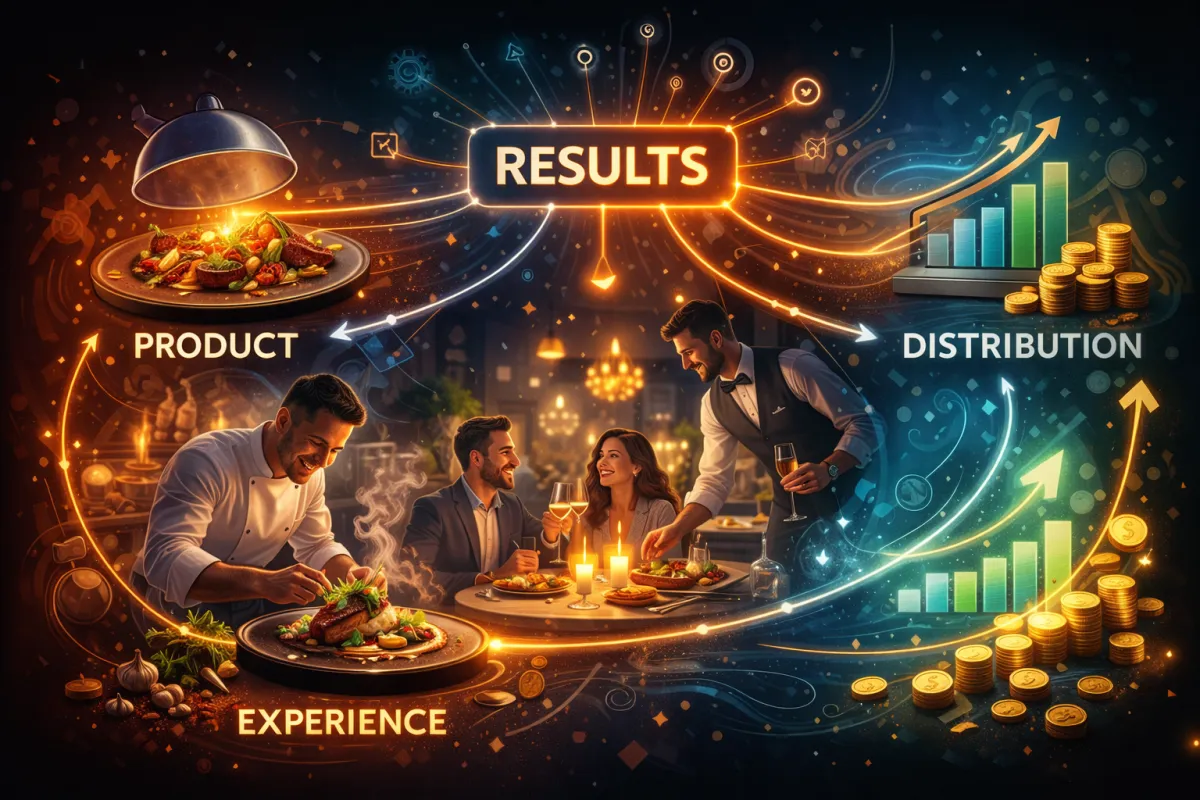
There are only three things that actually matter for a restaurant: product, experience, and distribution.
Product is your food. Is it excellent? Is it consistent? Is it worth talking about? Would someone who ate at your restaurant today tell their friends tomorrow that they have to try it?
Experience is everything that happens around the food. The greeting. The atmosphere. The service. The attention. The feeling someone has when they are sitting at your table. The memory they carry when they leave.
Distribution is how people find out about you. How your restaurant reaches people who would love it but do not know you exist yet. How you stay present in the minds of people who visited once but have not thought about you since.
That is it. Product. Experience. Distribution.
Get those three right, and everything else follows. Revenue grows. Customers return. Word spreads. Reviews accumulate. The restaurant becomes known for something real.
Get those three wrong—or focus on the wrong things while ignoring them—and no amount of tactics will save you.
The Strategic Shift
Here is what I want you to take away from this.
Stop scattering your effort across a hundred small things. Stop trying to save money by doing everything yourself. Stop putting your time into tasks that produce average outcomes.
Instead, focus your energy where the output is massively larger than the effort.
Be present with your team. Make them excellent. Obsess over the customer experience. Perfect the product. And find partners who can handle distribution so you do not have to figure it out yourself.
This is the effort-output ratio in action. Less effort scattered everywhere. More output concentrated on what actually matters.
The restaurants that win are not the ones working the hardest. They are the ones working the smartest. They are the ones who understood that strategic focus beats random activity every single time.
The Question You Need to Answer
Here is a question I want you to sit with.
If every customer who visited your restaurant this week left feeling like they had the greatest experience of their lives—how much marketing would you actually need?
The answer is: much less than you think.
Because those customers would come back. They would bring friends. They would leave reviews. They would talk about you without being asked.
The product and experience would do the distribution for you.
That is the goal. That is what mastery looks like. That is what happens when you get the effort-output ratio right.
Focus on the product. Focus on the experience. Let the right partners handle the distribution.
Everything else follows.
If This Resonates
If you are a restaurant owner who has been scattered—doing a little of everything, getting average results everywhere—this is your sign to change.
Stop trying to save money on the things that matter most. Start investing your time where the output is real.
And if distribution is the piece you need handled—if you want partners who understand this philosophy and can actually execute it—we should talk.
Send an email to [email protected]
Tell me about your restaurant. Where are you now? What does your effort look like? What results are you getting? What do you wish was different?
I will read every word. I will respond personally. And I will be honest about whether we can help.
Because the restaurants that win are not the ones doing the most.
They are the ones doing the right things.
And they are the ones who finally understood: excellence first, money follows.
Frequently Asked Questions
What do you mean by the effort-output ratio?
It means the results you get should be significantly larger than the effort you put in. If you are working extremely hard and only getting average results, your ratio is off. The goal is to find the actions that produce outsized results—and focus your energy there instead of scattering it everywhere.
How do I know if my restaurant is too complicated?
If you feel overwhelmed, if there are too many initiatives happening at once, if nothing seems to be working despite constant activity—you are probably too complicated. The answer is to reduce. Cut the things that are not working. Focus on fewer things done excellently rather than many things done poorly.
Why is doing everything myself a bad strategy?
Because your time is limited and valuable. When you spend it on tasks you are not excellent at—like marketing or advertising—you get average results. Meanwhile, you are not spending that time on what you are actually excellent at: leading your team and perfecting the customer experience. The math does not work in your favor.
What should I actually be spending my time on?
Being present with your team. Training them. Inspiring them. Making sure every customer leaves with an exceptional experience. Perfecting the product. Building the culture. These are the high-leverage activities that only you can do. Everything else can and should be delegated to people who are excellent at those things.
What do you mean by "product, experience, and distribution"?
Product is your food—the quality, consistency, and uniqueness of what you serve. Experience is everything around the food—service, atmosphere, hospitality, attention to detail. Distribution is how people find out about you and how you reach new customers. Get all three right, and everything else follows.
Why do you say I would not need much marketing if every customer had a great experience?
Because exceptional experiences create word of mouth. Customers who feel something remarkable tell their friends, leave reviews, and come back with others. The product and experience do the marketing for you. Distribution amplifies this, but it cannot replace a mediocre experience with volume.
How do I reduce without losing what makes my restaurant special?
Focus on the things that actually matter to customers. Cut the initiatives that are not producing results. Simplify your operations. Often, what makes a restaurant special is not complexity—it is excellence in the basics. You can reduce activity while increasing quality.
What if I have already hired an agency and it is not working?
First, ask whether the problem is actually the agency—or whether the product and experience are not strong enough for marketing to work. Distribution cannot fix a broken foundation. If the foundation is solid and results are still not coming, then it may be time to find partners who understand restaurant growth differently.
How long does it take to see results from this approach?
The internal shift—focusing on experience and team excellence—can produce immediate improvements in customer satisfaction and reviews. The compounding effect on revenue typically becomes visible in 90-180 days. This is not a quick fix; it is a fundamental change in how you operate.
What is the first step I should take after reading this?
Audit where your time is going. Write down everything you did last week and categorize it: was this high-leverage (customer experience, team leadership) or low-leverage (tasks someone else could do better)? If most of your time is in the low-leverage category, that is your problem. Start shifting immediately.
Jeffry Jonas is the founder of Anth Consulting, a restaurant growth operation focused on helping restaurants master the effort-output ratio. After five years and conversations with over 1,000 restaurant owners, he believes the restaurants that win are not the ones working the hardest—they are the ones working the smartest.
