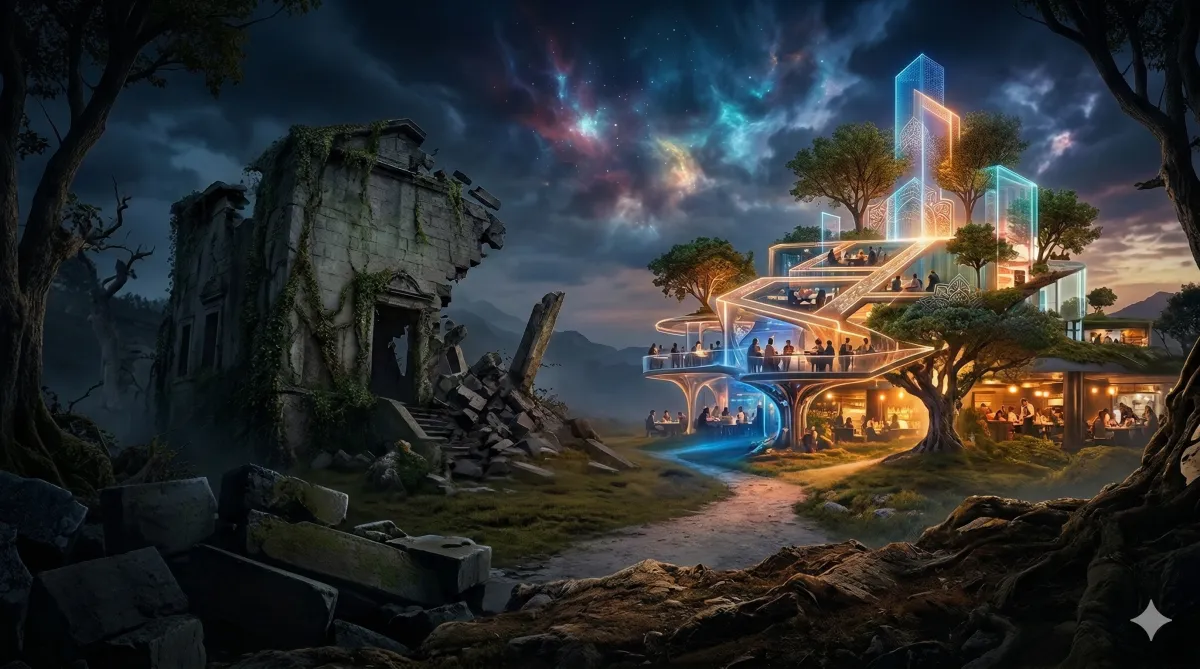
The Death of the Restaurant Marketing Agency (And What We Are Building Instead)
I am going to tell you something that might end my business as it currently exists.
For the past six years, I have run a marketing agency for restaurants. We have done good work. We have helped restaurants grow. We have built a reputation.
But I am done with the agency model.
Not because it does not work. It does—sometimes. Not because there is no money in it. There is—for some.
I am done because I have seen what is actually possible. And once you see it, you cannot unsee it.
The Problem With Every Marketing Agency
Let me tell you what is wrong with the agency model. Not just my agency. Every agency.
Agencies sell activity, not outcomes.
Twelve posts per month. SEO optimization. Email campaigns. Ad management. Content calendars.
All of it sounds productive. All of it looks like work. But here is the question nobody asks:
Did any of it actually fill tables? Did it increase revenue? Did it bring customers back? Did it make the restaurant more profitable?
Usually, the answer is: "We do not know."
And that is the fundamental problem.
Agencies get paid whether or not their work produces results. Restaurants pay retainers month after month, hoping something sticks. The incentives are misaligned. The agency wins when it looks busy. The restaurant only wins when customers show up.
I have been on the agency side of this equation for six years. I know how it works. And I am tired of it.
What Restaurants Actually Need
Let me strip this down to first principles.
A restaurant has outcomes it wants:
More customers coming through the door
Those customers coming back
Higher average spend per visit
Predictable revenue week after week
A brand people remember and talk about
Time to actually focus on the craft—the food, the service, the hospitality
Everything else is just a means to those ends.
The marketing activities—the posts, the ads, the emails, the SEO—these are not the product. They are inputs. They are workflows that should lead to outcomes.
Here is the insight that changed everything for me:
There is an outcome you want. There are things to get to that outcome. The secret sauce is in those things—in how well they are executed, how consistently they run, how intelligently they are connected.
Every single one of those things is a task. A workflow. Some workflows are critical. Some are just important. Many are daily necessities that nobody thinks about but everyone needs.
Restaurants spend money on these workflows. They spend time on them. They hire people for them. They stress about them.
And all of that spending and stressing stops them from doing what they actually opened the restaurant to do: create exceptional food and hospitality.
The Agency Model Cannot Solve This
Here is why agencies fail restaurants, even when they try hard:
Problem 1: Agencies sell packages, not solutions.
You get a bundle of activities regardless of what your restaurant actually needs. The package looks the same whether you need help filling Tuesday lunch or scaling catering for corporate clients.
Problem 2: Agencies are not accountable to outcomes.
They are accountable to deliverables. Did we post twelve times? Check. Did we send the newsletter? Check. Did any of it work? That is somehow not their problem.
Problem 3: Agencies cannot scale their best work.
The things that actually make agencies valuable—taste, strategy, creative vision, understanding of your specific restaurant—those require humans. And humans do not scale. So agencies either stay small (and cannot serve many restaurants) or they grow (and the quality disappears).
Problem 4: Agencies charge for time, not value.
A retainer is just buying someone's hours. But you do not want hours. You want results. The disconnect between what you pay for and what you actually need is built into the model.
I have tried to fix these problems from inside the agency model. It cannot be done. The model itself is broken.
So I am building something else.
Introducing Restaurant OS
What if instead of hiring an agency, you installed an operating system?
Not software that replaces humans. Software that makes human expertise scalable. Software that handles every workflow that does not require taste and judgment—so humans can focus entirely on the parts that do.
This is what I am calling Restaurant OS.
The concept is simple:
Every outcome a restaurant wants can be broken down into workflows. Every workflow can be broken down into tasks. Many of those tasks can be automated entirely. Some require human oversight. A few require genuine human creativity and judgment.
Restaurant OS handles all of it.
The automated parts run continuously without anyone thinking about them. The oversight parts get flagged for quick human review. The creative parts get elevated to people with real taste and vision—people who understand restaurants, who understand your restaurant specifically.
The pricing model is different too:
You do not pay a retainer and hope for results. You pay for outcomes and tasks completed. The workflows run. The tasks get done. You see what happened. You pay for what worked.
This aligns incentives completely. We only win when you win. There is no hiding behind "brand awareness" or "engagement metrics." Either customers came in, or they did not. Either revenue went up, or it did not.
What This Actually Looks Like
Let me make this concrete.
Workflow: Review Generation
Old agency model: "We will help you get more reviews" (vague promise, no system).
Restaurant OS: Automated follow-up sequence triggers after every visit. Personalized message sent based on order history. Happy customers directed to Google. Unhappy customers directed to private feedback. Reviews monitored in real-time. Responses drafted by AI, approved by humans. Negative patterns flagged for operational fixes.
You pay per review generated. We only get paid when it works.
Workflow: Customer Retention
Old agency model: "We will send email newsletters" (same template to everyone).
Restaurant OS: Customer behavior tracked across visits. Segments created automatically based on visit frequency, order patterns, preferences. Personalized campaigns triggered by behavior—a regular who has not visited in three weeks gets a different message than a first-timer. Win-back sequences, loyalty rewards, birthday offers—all automated, all personalized.
You pay per customer retained. We only get paid when they come back.
Workflow: Local Demand Capture
Old agency model: "We will do SEO and run ads" (generic approach).
Restaurant OS: Local search presence optimized continuously. Ads triggered by real-time demand signals. Budget allocated dynamically based on what is working. Seasonal patterns learned and anticipated. Competitor movements monitored and countered.
You pay per customer acquired. We only get paid when someone walks through the door because of us.
Workflow: Catering Pipeline
Old agency model: "We will help you get catering clients" (usually means they will post about catering sometimes).
Restaurant OS: Catering inquiry system captures every lead. Automated follow-up sequences nurture prospects. Proposals generated based on event details. Calendar integration prevents double-booking. Post-event feedback collected automatically. Repeat business sequences triggered after successful events.
You pay per catering booking closed. We only get paid when revenue lands in your account.
The Hands-On Parts That Cannot Be Automated
Here is what I believe deeply:
Taste, vision, and care cannot be replicated by software.
The strategic decision about what your restaurant should stand for. The creative concept that captures your essence. The judgment call about which direction to take. The care that comes from one human genuinely wanting another human to succeed.
These stay human. These have to stay human.
Restaurant OS does not eliminate the human element. It elevates it. By automating everything that does not require human judgment, we free up all human attention for the things that do.
This is the opposite of what most agencies do. They spread human attention thin across hundreds of tasks, most of which are repetitive. Restaurant OS concentrates human attention on the few decisions that actually matter.
The result:
You get automation handling the volume. You get humans handling the vision. You get outcomes instead of activity. You get your time back to focus on what you actually love—the craft of hospitality.
Why This Matters for the Restaurant Industry
The restaurant industry is painful. Low profit margins. High chaos. Brutal hours. Constant stress.
But here is what I have learned: it is only that way if you make it that way.
Every business is hard. Every business has pain. But the restaurants that thrive—the ones that build real brands, that keep customers coming back, that actually enjoy the work—they have figured something out.
They have built systems.
Not systems that remove the human element. Systems that protect it. Systems that handle the operational chaos so the humans can focus on hospitality. Systems that create predictability so the creative work can flourish.
Most restaurants are missing these systems entirely. They are trying to do everything manually. They are trying to handle growth with spreadsheets and memory and hope. They are burning out because there is no infrastructure underneath them.
Restaurant OS is that infrastructure.
The Vision: What This Becomes
I am not building a better agency. I am building something that makes agencies obsolete.
Imagine every restaurant having access to the same growth infrastructure that the biggest chains have. The same automated workflows. The same data-driven decisions. The same continuous optimization.
But with something the chains do not have: genuine human care for each individual restaurant. Taste that understands your specific market. Vision that aligns with your specific goals.
This is what changes:
The solo restaurant owner competing against chains finally has a fair fight. The family-run Indian restaurant with incredible food but weak marketing finally gets seen. The passionate chef who opened a restaurant to cook, not to become a marketer, finally gets to focus on cooking.
The agency model will not get us there. It cannot scale quality. It cannot align incentives. It cannot free restaurant owners to do what they love.
Restaurant OS can.
The Honest Part
I do not have all the answers yet.
I do not know exactly what the infrastructure looks like. I do not know every application that needs to be built. I do not know how every workflow should connect.
What I know is the destination. What I know is the outcome.
Restaurants deserve better than agencies selling activity. Restaurants deserve a system that produces results. Restaurants deserve to pay for outcomes, not hope.
And restaurant owners deserve to spend their time on hospitality—on the craft, on the relationships, on the magic that happens when food brings people together—not on figuring out how to game social media algorithms.
I am betting my business on this.
The agency model served its purpose. It taught me what restaurants actually need. It showed me where the value really lives. It gave me six years of conversations with over a thousand restaurant owners, understanding their pain, their goals, their dreams.
Now it is time to build something better.
Why Indian Restaurants Specifically
I need to say something to the Indian restaurant owners reading this.
You have an unfair advantage that you are probably not using.
Indian cuisine has depth that most other cuisines do not have. Thousands of years of regional traditions. Hundreds of distinct dishes. Flavor profiles that create genuine addiction. Cultural richness that creates emotional connection.
The raw material is exceptional.
But the infrastructure is usually missing. The positioning is underdeveloped. The systems are weak. The marketing is inconsistent. The brand is not articulated.
This is exactly what Restaurant OS is built for.
Not to invent value from nothing. To extract and amplify value that already exists but is not packaged, systemized, or communicated properly.
Your grandmother's recipes deserve to reach more people. Your family's story deserves to be told. Your cultural depth deserves to be positioned as the asset it is.
Restaurant OS makes that happen—systematically, continuously, with outcomes you can measure.
The Split Is Happening Now
Earlier, I wrote about how the restaurant industry is splitting in two.
On one side: restaurants becoming interchangeable commodities, competing on price, racing to the bottom.
On the other side: restaurants becoming brands, commanding premium, building loyalty, owning their markets.
AI accelerates both paths. It makes the commodity side more crowded. It makes the brand side more valuable.
Restaurant OS is built for the brand side.
It is built for restaurants that have something worth amplifying. It is built for owners who want to build something that lasts. It is built for the ones who understand that the goal is not just survival—it is creating something memorable.
The agency model served the old world. Restaurant OS is built for the new one.
What Happens Next
We are building this now.
The core workflows are being systematized. The automation is being developed. The human expertise is being concentrated on what actually matters.
If you run a restaurant and this resonates—if you are tired of paying for activity and want to pay for outcomes—I want to talk to you.
Not to sell you something. To understand what you need. To make sure we are building the right thing. To find the restaurants that will be the first to install Restaurant OS and prove what is possible.
This is the future of restaurant growth.
Not agencies selling deliverables. Operating systems producing outcomes.
Not paying for hope. Paying for results.
Not spreading human attention thin. Concentrating it where it matters.
Not just marketing. Infrastructure for restaurant success.
If This Resonates
If you are a restaurant owner and this speaks to what you have been feeling—the frustration with agencies, the desire for outcomes, the need to get back to the craft you love—reach out.
Explore Restaurant Growth OS →
See what we are building. See the vision. See if it matches what you need.
Or email me directly:
Tell me about your restaurant. Tell me what is working and what is not. Tell me what outcomes you actually want.
I read every message. I respond personally.
Because this is not just a business pivot. This is a bet that restaurants deserve better. And I am looking for the restaurant owners who are ready to prove it.
Frequently Asked Questions
What exactly is Restaurant OS?
Restaurant OS is an operating system for restaurant growth. It automates the workflows that lead to customer acquisition, retention, and revenue growth—while concentrating human expertise on the strategic and creative decisions that require taste and judgment.
How is this different from a marketing agency?
Agencies sell activity (posts, ads, campaigns). Restaurant OS sells outcomes (customers acquired, customers retained, revenue generated). Agencies charge retainers regardless of results. Restaurant OS charges for tasks completed and outcomes achieved.
What workflows does Restaurant OS handle?
Customer acquisition, retention, review generation, email and SMS marketing, local SEO, social content, catering pipelines, booking optimization, competitive monitoring, and more. Every workflow that can be systematized is systematized. Every workflow that requires human judgment gets human attention.
Is this just software?
No. It is software plus human expertise. The automation handles volume and consistency. Humans handle taste, strategy, and creative vision. This hybrid model is what makes it work—you get the scale of software with the quality of human insight.
What do I actually pay for?
You pay for outcomes and tasks completed, not just activity. If a workflow runs and produces results, you pay for it. If it does not produce results, we fix it. The incentives are aligned—we only win when you win.
Is this for all restaurants or just Indian restaurants?
Restaurant OS works for any restaurant with strong fundamentals and a genuine story to tell. We have particular depth in Indian restaurants because that is where our expertise started, but the system itself is designed for any restaurant ready to build a real brand.
What if I already have a marketing agency?
Many restaurants will transition from agency to Restaurant OS over time. If your current agency is producing measurable outcomes, that is great. If you are paying retainers and wondering whether anything is actually working, Restaurant OS might be what you need instead.
When will Restaurant OS be available?
We are building and testing now. Early restaurants are being onboarded to help us refine the system. If you want to be part of the early group, reach out directly.
What makes you qualified to build this?
Six years of working with restaurants. Over a thousand conversations with restaurant owners. Deep understanding of what works and what does not. And a willingness to burn down my own agency model to build something better.
How do I get started?
Visit anthconsulting.com/restaurant-growth-os or email [email protected]. Tell me about your restaurant and what you are trying to build. I will be honest about whether we can help.
Jeffry Jonas is the founder of Anth Consulting, now evolving into Restaurant OS—an operating system for restaurant growth. After six years in the agency model, he is betting that restaurants deserve better: outcomes instead of activity, results instead of hope, infrastructure instead of promises.
