Actions, Workflows & AI Agents: The Next Step for Restaurants
Every result in a restaurant comes from a chain of actions. What if those chains could be engineered, structured, and automated?
It Always Comes Back to Workflows
The more I think about the future of restaurants, the more I keep returning to one idea:workflows. Not just ideas. Not just tools. Not just "using AI." But actual, structured sequences of actions that produce results.
Want more bookings? There's a workflow behind that. Better reviews? A workflow. Stronger margins? Another workflow. Better social media? You guessed it.
Once you see everything through this lens, the question shifts from"How do I use AI?"to something far more powerful:
Can the workflow itself be engineered, structured, and automated?
AI Should Adapt to the Business
The fundamental reasoning behind what I'm building is simple: adapt AI to the business in a way that scales as far as possible. Get humans out of repetitive loops as fast as possible. Increase productivity, speed, and quality.
Not so people do less meaningful work — but so they can dobetter work in the areas that actually matter. For restaurants, that means less time chasing repetitive tasks and more time spent on food, hospitality, leadership, taste, experience, and brand.
Every Restaurant Runs on Workflows
Take something as simple as social media. A restaurant wants more followers, more reach, more awareness. But that outcome doesn't just "happen." Behind it is a chain of discrete actions:
Idea→Research→Create→Edit→Format→Caption→Schedule→Track→Review→Iterate
That's a workflow. And inside that workflow are many smaller actions. Once you break work into individual actions, you can start asking the questions that matter:
Can this step be automated? Can this decision be improved with data? Can this output become more consistent? Can an AI agent handle this better than a distracted human doing it manually at 11 PM?
The Real Opportunity: Action-Level Automation
Most people think about automation too broadly. They think in roles: "Can AI replace a marketer?" or "Can AI replace a manager?" That's the wrong framing.
The better question is:what actions inside the workflow can be automated?Businesses aren't really made of job titles. They're made of repeated actions — observe, think, act — and when those actions repeat every day, week, and month, they become workflows.
I believe80% of many restaurant workflows can eventually be automatedat the action level. Not the human magic. But the mechanics. And the output can often become more consistent than what happens when overworked humans try to do everything manually.
The Core Loop: Observe, Think, Act
The best way I can explain the intelligence model is through a simple loop that mirrors how a great operator already works:
Observe
What is happening?
→
Think
What does it mean?
→
Act
Clear definition of done
Not random prompts. Not vague automation. Structured intelligence tied to outcomes. That's how every agent inside Restaurant OS is designed to operate.
The Restaurant OS Agent Architecture
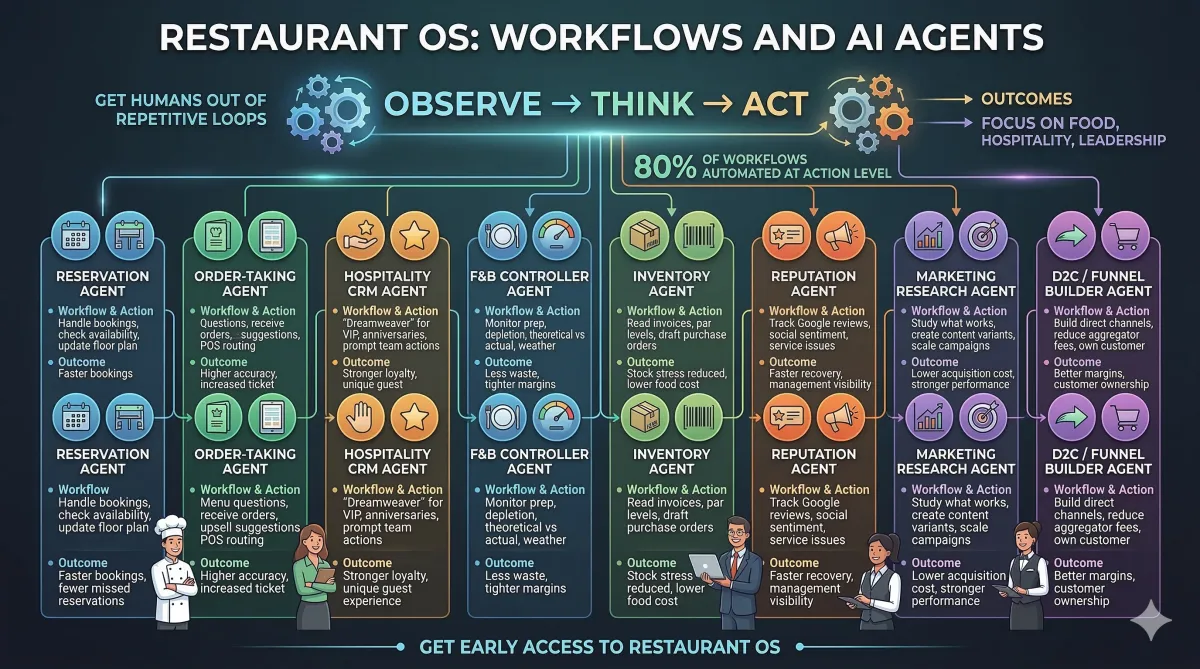
Restaurant OS is not another dashboard. It's a multi-agent operating layer — a system of AI agents designed around the real workflows that keep restaurants alive and profitable.
DATA SOURCESPOS / OrdersReservationsInventoryReviewsSocial / WebRestaurant OS — Orchestration LayerRoutes tasks · Manages approvals · Coordinates agentsReservation AgentBookings · Floor plan · MessagesOrder AgentMenu · Upsells · POS routingHospitality CRMVIPs · Loyalty · Human momentsF&B ControllerPrep · Waste · Cost trackingInventory AgentPar levels · Invoices · OrdersReputation AgentReviews · Sentiment · RecoveryMarketing AgentContent · Campaigns · TestingD2C / FunnelDirect channels · OwnershipObserve→Think→ActFREES THE TEAM TO FOCUS ONFood & TasteHospitalityLeadershipBrand & Experience
The 8 Agents Restaurants Actually Need
When you map the restaurant from front to back, a set of purpose-built agents emerges. Each one owns a specific workflow domain and follows the Observe → Think → Act loop.
01
Reservation Agent
Handles incoming booking requests, checks availability, confirms tables, updates the floor plan, and sends messages automatically.
→ Faster bookings, fewer missed reservations
02
Order-Taking Agent
Handles menu questions, receives orders, suggests upsells, validates totals, and routes everything correctly into the kitchen and POS flow.
→ Higher accuracy, increased average ticket
03
Hospitality CRM Agent
The "Dreamweaver" layer. Watches for human moments — anniversaries, complaints, VIP guests, returning customers — then prompts the team to act.
→ Deeper loyalty, stronger word of mouth
04
F&B Controller Agent
Watches prep, depletion, theoretical vs actual usage, weather, holidays, and anomalies to keep the kitchen running tight.
→ Less waste, tighter margins
05
Inventory Agent
Reads invoices, monitors par levels, tracks cost drift, and drafts purchase orders so your team never scrambles.
→ Lower food cost, better ordering discipline
06
Reputation Agent
Tracks Google reviews, social mentions, sentiment shifts, and service issues across every channel in real time.
→ Faster recovery, better online reputation
07
Marketing Research Agent
Studies what content works, creates variants, tests offers, and helps scale winning campaigns without constant manual effort.
→ Lower acquisition cost, stronger performance
08
D2C / Funnel Builder Agent
Helps restaurants build direct channels so they depend less on aggregator fees and disconnected customer ownership.
→ Better margins, owned customer relationships
The Goal Is Not Full Autonomy on Day One
Not everything should be fully autonomous immediately. There are stages of maturity, and restaurants need trust — not hype.
Assist humans -> Manage with exceptions-> Own metrics & workflows
You start with clear workflows. You connect the tools. You automate the obvious. You add approvals where needed. Then over time, you increase autonomy. That is the path.
Why This Matters So Much
Restaurant owners are drowning in repeated cognitive work — planning, checking, following up, scheduling, ordering, posting, responding, fixing. And the tragedy is that most of this isn't the actual magic of the business. It's the mechanical layer.
If we can remove that burden, owners and teams get something rare:mental space. And mental space leads to better decisions, better food, better service, better ideas, and better businesses.
A restaurant where the systems handle the mechanics, so the humans can focus on the soul.
That is what I want Restaurant OS to become. Not by replacing hospitality, but by supporting it. Not by removing people from the restaurant, but by removing repetitive mental burden from the people inside it.
Get First-Hand Access
If you are a restaurant owner, operator, or hospitality leader who wants to see where this is going, I am opening up early access conversations around Restaurant OS.
Get First-Hand Access to Restaurant OS →
I am especially interested in speaking with restaurants that want to reduce manual work, improve margins, and build a stronger operating system behind the business.
Or email me directly:
Tell me about your restaurant. Tell me what workflows drain your time. Tell me what you wish was automated.
I read every message. I respond personally.
Because this is not just about technology.
It is about giving restaurant teams their time back—so they can do what they got into this business to do.
Frequently Asked Questions
What do you mean by "workflows" in restaurants?
Every result comes from a chain of actions. Want more bookings? There is a workflow of steps that creates that. Want better reviews? There is a workflow. When you see business as workflows, you can engineer, structure, and automate them.
What is "action-level automation"?
Instead of asking "can AI replace a marketer," we ask "what actions inside the marketing workflow can be automated?" Businesses are made of repeated actions, not job titles. Automate the actions, and humans focus on judgment and creativity.
What are the eight agents in Restaurant OS?
Reservation Agent, Order-Taking Agent, Hospitality CRM Agent, F&B Controller Agent, Inventory Agent, Reputation Agent, Marketing Research Agent, and D2C/Funnel Builder Agent. Each handles a specific domain with its own workflows.
What is the Observe-Think-Act loop?
Each agent continuously observes data (POS, reviews, inventory), thinks about what it means (patterns, problems, predictions), and acts based on clear outcomes (execute tasks, send alerts, trigger workflows).
Will this replace my staff?
No. The goal is not full autonomy. The goal is removing repetitive mental burden so staff can focus on hospitality, creativity, and human connection—the things that actually make restaurants special.
What are the stages of autonomy?
Stage 1: Assist (system suggests, humans execute). Stage 2: Manage (system executes routine, humans handle exceptions). Stage 3: Own (system owns metrics, humans focus on strategy). You start with Stage 1 and build trust over time.
What does "subsidize the ego" mean?
Restaurant owners are proud of what they built. Software should not fight that—it should support it. The AI handles the mechanical work so owners can focus on what only they can do: the soul of the food and spirit of the brand.
How does this affect different team roles?
GMs get briefings instead of spreadsheets. Floor managers get real-time alerts and comp budgets. Chefs get auto-generated prep lists. Servers get VIP prompts. Owners get business health at a glance. Everyone spends more time on their actual job.
Is this available now?
We are building and testing now with early restaurants. First-hand access is limited. If you want to be part of shaping how this evolves, reach out directly.
How do I get first-hand access?
Visit anthconsulting.com/restaurant-growth-os to get first-hand access, or email [email protected]. The restaurants that get in first will shape how this system evolves.
Restaurant OS is no longer just software. It is actions, workflows, AI agents, and orchestration. A system that helps restaurants run better, faster, and more profitably—while keeping humans at the center of hospitality.
